
Enterprise Wallet Governance Policy: 5 Sections, DARE Certification Ready

A wallet governance policy is the set of controls that inventories, assigns, approves, and revokes authority over any digital wallet capable of moving value, tying signing power to verified identity, defined workflows, and a permanent audit trail. Governance needs both halves to work: written rules and something that actually enforces them, whether that’s a policy engine or a custody provider’s controls. Frameworks from NIST and the World Bank already map this territory, so no enterprise team needs to invent the wheel from scratch.
TL;DR:
- A comprehensive wallet governance policy must include verified identity binding, a clear custody model, and detailed approval workflows to prevent unreviewed signing authority.
- Implementing destination allowlists, transaction caps, and scope inheritance are essential control measures to reduce the risk of unauthorized fund transfers.
- Enforcement requires translating policy language into system rules with robust logging, audit trails, and well-designed breakglass procedures for emergencies.
- Starting with inventory, assigning roles, choosing enforcement points, and testing controls systematically ensures scalable and auditable governance.
- External standards like NIST, Visa, and the World Bank provide valuable frameworks, while third-party validation such as DARE certification enhances trustworthiness.
Table of Contents
- Why Wallet Governance Matters More Than Traditional Account Controls
- What Are the Core Components of a Wallet Governance Policy?
- Turning Policy Language Into Enforceable Rules
- How Do You Implement a Wallet Governance Policy Step by Step?
- How Do Standards and Regulatory Guidance Shape Wallet Policy?
- From Baseline Controls to Certified Governance Maturity
- What Tradeoffs Actually Matter in Wallet Governance?
- Formalizing Governance With DARE Certification
- Where to Go Next for Wallet Governance Standards
- Sources
- FAQ
Why Wallet Governance Matters More Than Traditional Account Controls
A bank account has a reversal button. A wallet usually doesn’t. That single difference explains why treating wallet access like another line item in an IT access review is a mistake that shows up the hard way, usually during an incident postmortem.
Signing authority on a wallet is spending authority, full stop. Whoever holds a private key, controls a multi-signature quorum, or operates an API-connected signer has the practical power to move funds, and once that transaction confirms on-chain, there’s no chargeback desk to call. The World Bank’s research on digital wallet trust frameworks makes the point directly: a technically secure wallet without governance behind it is still fragile, because identity and legal accountability are what give a signature meaning in the first place.
This is why wallet governance can’t live inside a single department. It touches:
- Treasury, which needs limits and liquidity controls that match cash management policy.
- Legal and compliance, which needs to map wallet activity to sanctions screening and reporting obligations.
- Information security, which owns key management, device hygiene, and access review.
- Internal audit, which needs evidence trails it can actually test.
Most failures trace back to the same root cause: a machine or service account held signing authority with no human review layer above it, or a wallet sat outside the official inventory entirely until someone noticed a balance that shouldn’t have existed. Neither problem is exotic. Both are entirely preventable with a documented policy.
What Are the Core Components of a Wallet Governance Policy?
A workable policy breaks into five parts, and skipping any one of them leaves a gap an auditor or an attacker will eventually find.
- Identity assurance and role binding. Every signer needs to be tied to a verified identity, not just a device or a key file. NIST’s SP 800-63 identity assurance levels give a ready-made scale for how rigorous that verification needs to be based on the wallet’s risk tier.
- Custody model and inventory. Classify every wallet as hot, warm, or cold, and decide upfront whether balances are held in an omnibus structure or segregated by client, business unit, or purpose. You cannot govern what isn’t inventoried.
- The policy or rules layer. This is where a policy engine evaluates conditions before a transaction executes, checking amount, destination, origin, and intent, then returning an allow, deny, or approval-required decision.
- Approval workflows and quorums. Separation of duties means the person who initiates a transfer is never the same person who can unilaterally approve it. Ripple’s custody governance model frames this as answering six questions: what action, from where, under what conditions, approved by whom, in what scope, and which policy wins when rules conflict.
- Logging and policy-evaluation records. Every attempted action, its outcome, and the specific policy revision in force at the time needs to be captured, because that’s the evidence an auditor or incident responder will ask for first.
Pro Tip: Build your policy document around these five components as literal section headers. When an auditor asks how you handle separation of duties or identity assurance, you want to point to a numbered section, not reconstruct your logic on the spot.
Turning Policy Language Into Enforceable Rules
Writing “limit large transfers” in a policy document accomplishes nothing until it becomes a rule a system can actually evaluate. That translation from plain English to executable logic is where most governance programs stall.
Destination allowlists are the simplest control and often the most effective. If a wallet can only send funds to a pre-approved list of addresses, an attacker who compromises a signing key still can’t redirect funds anywhere useful. Pair that with per-transfer and daily caps, plus separate limits by asset type, since a $50,000 cap makes sense for a stablecoin treasury wallet and no sense at all for a wallet holding a volatile token.
Scope and inheritance matter just as much as the rules themselves. A policy set at the organization level should cascade down to project, account, and individual wallet levels, with more restrictive rules always winning ties. That’s the “which policy wins” question Ripple’s documentation calls out directly, and it’s the one most policy drafts leave ambiguous.
Concrete conditions worth codifying include:
- Transaction amount crossing a defined threshold, triggering a required second approver.
- Destination address failing a compliance screening check, which should hard-block, not just flag.
- Transfers requested outside normal business hours, requiring extra scrutiny or a delay window.
- New or unrecognized destination addresses, which get quarantined pending manual review.
Breakglass access deserves its own careful design. Emergency override paths need to exist for genuine crises, but every breakglass event should require multiple approvers, generate its own audit record, and automatically expire. A breakglass policy that’s easier to invoke than the normal workflow isn’t an emergency control, it’s a backdoor.
How Do You Implement a Wallet Governance Policy Step by Step?
Most teams overthink the starting point. The sequence below works whether you’re governing three wallets or three hundred.
- Inventory and classify every wallet. Tag each one by custody type, risk level, and business purpose. Anything undiscovered during this step is your biggest immediate exposure.
- Assign owners, reviewers, and approvers. Build a RACI matrix and define quorum sizes per wallet tier. High-value treasury wallets need a larger quorum than a low-balance operational wallet.
- Choose your enforcement point. Decide whether rules live in a policy engine, a custody provider’s native controls, or an internal gatekeeper service, then simulate the rules against historical transactions before going live.
- Deploy logging and integrate audit trails. Policy-evaluation records need to flow into the same audit system that already covers your other financial controls, not sit in an isolated log file nobody reviews.
- Build revocation and rotation into the lifecycle. Define exactly how a signer is removed, how keys rotate on a schedule and on demand, and how a wallet gets formally retired rather than just abandoned.
- Test breakglass procedures on a calendar, not just in theory. An emergency path nobody has exercised in eighteen months will fail exactly when you need it.
Pro Tip: Treat any machine-held or service-account signing key as a privileged identity, the way you’d treat a service account with domain admin rights. That means scheduled rotation, an independent human reviewer, and zero standing exceptions. This mirrors guidance from the Open Wallet Foundation’s wallet safety documentation, which flags non-human signing paths as a distinct risk category deserving their own controls, not an afterthought bolted onto human access review.
Teams building out access control models for the first time often find it easier to work from an existing framework, like this access control practices guide, rather than drafting role definitions from a blank page.
How Do Standards and Regulatory Guidance Shape Wallet Policy?
You don’t need to reinvent control language when writing a policy that has to survive an audit or a board review. Three frameworks do most of the heavy lifting.
- NIST’s Cybersecurity Framework, SP 800-63, and SP 800-207 give you identity-proofing tiers and a Zero Trust model for continuous verification, both directly applicable to who gets signing authority and how often that authority gets re-checked.
- Visa’s digital wallet guidance sets operational requirements for wallets that front payment credentials, including disclosure rules and how staged digital wallets must handle token services, relevant for any enterprise wallet touching card-linked funding.
- The World Bank’s five-layer trust framework structures governance across strategic vision, technical architecture, scheme rules, compliance enforcement, and legal agreements, giving you a template for organizing scheme rules and compliance testing into one coherent document.
Map your own controls against these three and you’ve got a defensible answer ready the next time an auditor or regulator asks why your wallet controls look the way they do.
From Baseline Controls to Certified Governance Maturity
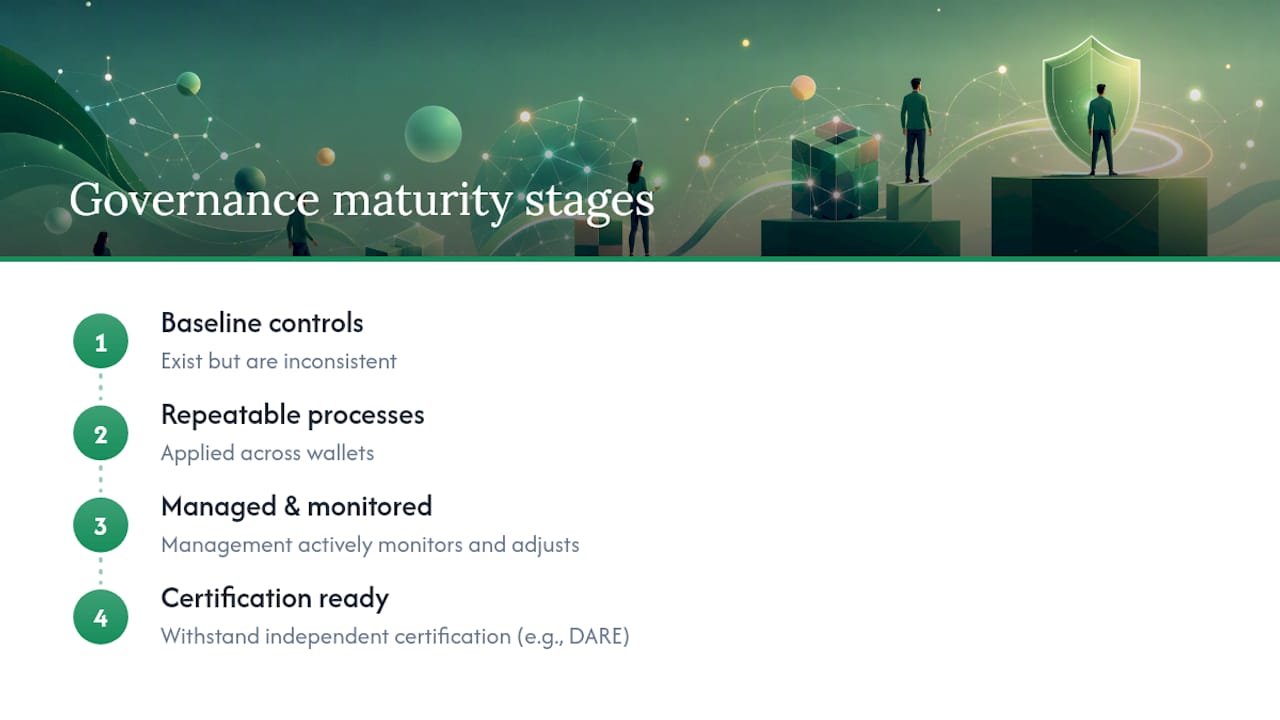
Governance maturity tends to move through four stages: baseline controls exist but are inconsistent, processes become repeatable across wallets, management actively monitors and adjusts them, and finally the program reaches a state that can withstand independent certification.
That last stage is where third-party validation, like the DARE certification, earns its place. Certification assesses whether your controls, assessments, and evidence retention hold up against external standards, and periodic renewal cycles encourage ongoing compliance rather than letting a policy quietly go stale. For boards asking whether digital asset controls meet the bar, and for procurement teams vetting vendors, an independent credential answers the question faster than a self-authored policy binder ever will. A board-level oversight checklist is a useful companion document while that conversation is happening.
What Tradeoffs Actually Matter in Wallet Governance?
Every added approval step buys security and costs speed. The right question isn’t whether to add friction, it’s where. Protect your highest-value wallets and every machine-held signing path first. Those are the two places where a mistake is both most likely and most expensive.
Executive reporting on policy changes deserves the same rigor as the policy itself. A quorum change or a new allowlisted address should never happen quietly. If your board can’t see what changed and why, your governance program has a gap no amount of technical control will close.
— Gregg
Formalizing Governance With DARE Certification
If you’ve mapped your policy against NIST and Visa guidance and built out approval workflows, the next honest question is whether your controls would hold up under outside scrutiny. That’s precisely the gap DARE certification closes: independent validation of your digital asset governance, rather than a self-graded policy binder nobody outside your team has ever reviewed.
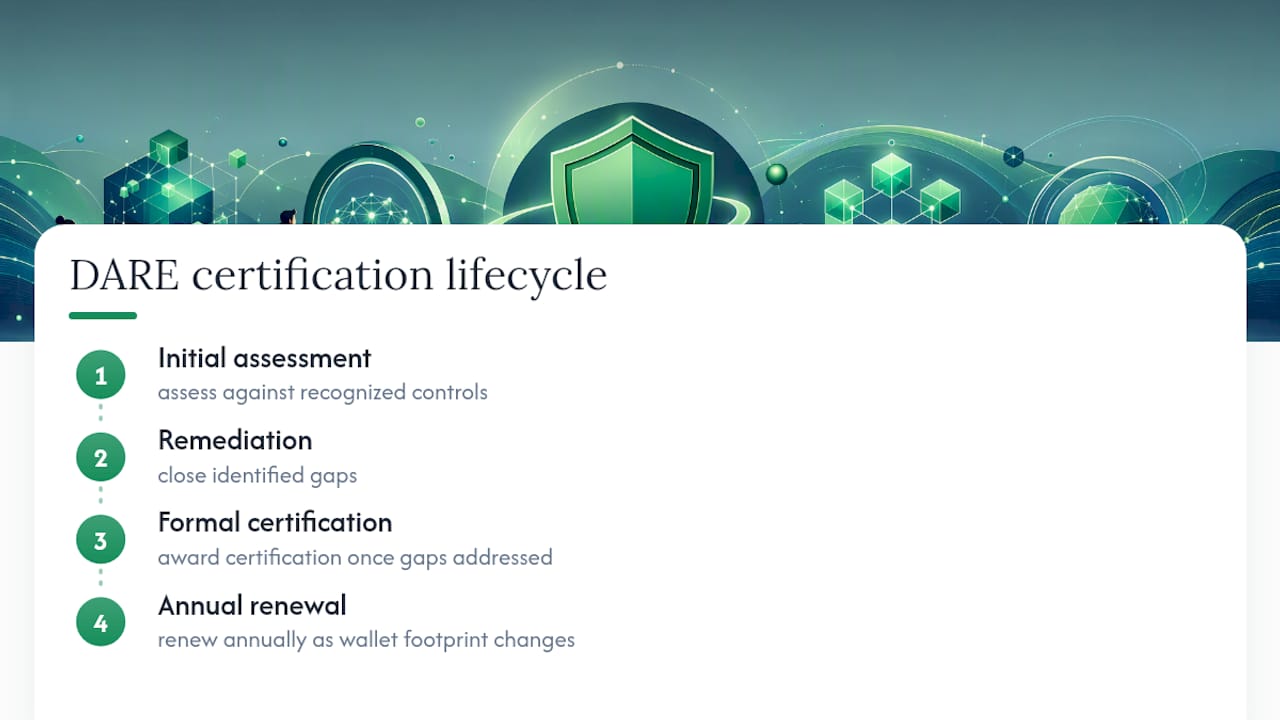
The path runs through four stages: an initial assessment against recognized controls, a remediation phase to close identified gaps, formal certification once those gaps are addressed, and annual renewal to keep the credential current as your wallet footprint changes. Enterprises use it to answer board questions faster, satisfy vendor due diligence, and give procurement teams a credential they can point to instead of a lengthy explanation. If your team has the policy drafted but wants a structured way to prove it works, start with an evaluation on the DARE certification page.
Where to Go Next for Wallet Governance Standards
Keep these resources on hand alongside your governance documentation and audit packets:
- NIST Cybersecurity Framework for identity and Zero Trust mapping
- World Bank digital wallet trust framework for scheme-level structure
- Vendor policy-engine documentation from Coinbase, Ripple, and Solana
- Visa’s digital wallet guide for payment-network requirements
- An audit trail checklist for structuring evidence retention
Sources
- Digital wallets: trust frameworks. Governing the ecosystem (World Bank policy note)
- Policy Engine - Coinbase Developer Documentation
- Wallet operations and policies — Solana platform docs
- NIST Cybersecurity Framework
FAQ
Can the Government Freeze a Crypto Wallet?
Government agencies can compel exchanges or custodians to freeze assets they control, and in some cases can seize wallets tied to seized private keys, but a self-custodied wallet with no third party holding the keys is much harder to freeze directly.
What Should You Never Store Alongside Wallet Access Credentials?
Avoid keeping seed phrases, private keys, recovery codes, exchange login credentials, unencrypted backup files, or written PINs in the same physical or digital location as your wallet access device, since combining them defeats the purpose of separating custody from credentials.
What’s an Example of a Governance Token?
A governance token grants holders voting rights over protocol decisions, such as parameter changes or treasury spending, within a decentralized project, distinct from the enterprise wallet governance policies covered in this article, which govern custody and signing authority rather than protocol voting.
Can the IRS See Crypto Wallet Activity?
The IRS can trace wallet activity through blockchain analysis tools and by compelling exchange reporting, and transactions on public blockchains are inherently traceable, so enterprises should assume transaction-level activity is discoverable during an audit or investigation.
Does a Wallet Governance Policy Require a Policy Engine?
Not strictly. Smaller organizations can enforce rules manually through documented approval workflows, but any team scaling past a handful of wallets benefits from a policy engine that evaluates conditions automatically and defaults to denial when no rule matches.