
Avoid Enforcement: 5 Steps for Tokenized Securities in U.S. Compliance

Under U.S. federal law, a token that conveys the economic characteristics of a security is treated as a security. Token format does not change legal treatment. The SEC’s January 2026 staff statement makes that explicit, and it means every registration, disclosure, broker-dealer, transfer-agent, and custody obligation that applies to a traditional stock or fund interest applies with equal force to its tokenized version. For issuers, the practical work is mapping token rights to legal form and building enforceable controls before launch, not after an examiner asks for them.
TL;DR:
- Tokenized securities are treated as securities under U.S. law, requiring full registration and compliance obligations regardless of token format or recordkeeping method.
- The SEC classifies any token representing a security’s rights as a wrapper, meaning underlying legal rights do not change despite technological form.
- Structuring involves choosing between issuer-sponsored tokens, third-party custodial claims, or derivatives, each carrying different legal risks and compliance paths.
- Offering exemptions like Regulation D, A+, or S impose specific onchain control and verification requirements, including accredited investor checks and geofencing.
- Ongoing compliance, including custody controls, KYC re-verification, and transfer restrictions, must be built into the technology and documented thoroughly to withstand regulator scrutiny.
Table of Contents
- Tokenized Securities Regulation Starts With How the SEC Defines the Asset
- Tokenization Models and the Risks Each One Carries
- Registering or Exempting a Tokenized Offering
- Who Handles the Trading: Broker-Dealers, ATSs, and Transfer Agents
- Custody Controls and Programmable Compliance Regulators Actually Expect
- A Practical Roadmap for Issuers and Compliance Teams
- Where Tokenized Securities Programs Actually Get Flagged
- How a Certification Framework Maps to Exam-Ready Evidence
- The Cost Side of Tokenizing a Security
- Primary Sources Worth Bookmarking
- Why Practitioners Keep Getting This Wrong
- Sources
Tokenized Securities Regulation Starts With How the SEC Defines the Asset
The SEC staff’s January 28, 2026 statement defines a tokenized security as a financial instrument that already meets the legal definition of a security, formatted as or represented by a crypto asset, where ownership records live on or through a crypto network. That last clause matters more than it sounds. The SEC is not creating a new asset category. It is describing a new recordkeeping method for an old legal category.
Two structural models dominate the market. Issuer-sponsored tokens are minted directly by the entity that issued the underlying security, so the token itself carries the registration and reporting obligations. Third-party tokens are wrapped by an outside platform that holds the real asset and issues a synthetic or derivative claim against it, which introduces a separate layer of counterparty and custody risk the issuer never faces.
Classification still runs through the Howey test. A token satisfies the securities definition when buyers invest money in a common enterprise with an expectation of profit derived from the efforts of others, and the 2026 interpretive release, reiterates that economic reality, not the technology or the marketing label, controls the outcome. A handful of factual variables shift the analysis in practice:
- What rights the token actually confers (voting, dividends, redemption, or none of the above)
- Whether the token is convertible into a traditional certificate or exists only onchain
- Whether a sponsor or platform performs ongoing managerial effort on holders’ behalf
- Whether resale is restricted or freely tradable on secondary venues
Executives frequently assume tokenization itself creates something legally novel. Regulators read it the opposite way: the token is a wrapper, and the wrapper does not launder the underlying rights into a different regulatory category.
Tokenization Models and the Risks Each One Carries
Not all tokenized securities are structured the same way, and the structure determines who bears the legal risk when something goes wrong.
Issuer-sponsored tokens represent the cleanest model. The company that issued the underlying stock, bond, or fund interest also mints and maintains the token, so registration status, periodic reporting, and transfer-agent obligations carry over without interruption. The main risk here is operational: reconciling the onchain ledger with the official record of ownership.
Third-party custodial or synthetic tokens are riskier. A platform holds the real security in custody and issues a token that represents a claim on it, sometimes called a security entitlement. If that custodian becomes insolvent, token holders may find themselves competing with other creditors rather than owning the underlying asset outright, depending on how the entitlement was documented and whether it was properly segregated.
Security-based swaps and linked-security formats add a third wrinkle. Some tokens are structured as derivatives referencing a security rather than the security itself, which pulls in a separate set of trading eligibility rules and restricts who can transact in them and on what venues.
- Issuer-sponsored: registration and reporting duties transfer directly to the token
- Third-party/custodial: counterparty and bankruptcy risk depends on entitlement structure.
- Synthetic/swap-linked: security-based swap rules constrain eligible counterparties and trading venues
Pro Tip: Before you evaluate any tokenized offering, ask one question first: does this token directly represent the security, or does it represent a claim against someone else’s custody arrangement? That single distinction determines almost every downstream compliance obligation.
Registering or Exempting a Tokenized Offering
Every offer and sale of a security, tokenized or not, must be registered with the SEC or fall under a recognized exemption. There is no third path. The exemptions issuers reach for most often are Regulation D (both 506(b) and 506©), Regulation A+, Regulation Crowdfunding, and Regulation S for offshore sales, and tokenization compliance practice shows each one carries its own onchain implementation burden.
- Reg D 506(b) allows sales to accredited investors and a limited number of sophisticated non-accredited investors without general solicitation, which usually means the smart contract’s whitelist logic must exclude marketing-driven inbound buyers entirely.
- Reg D 506© permits general solicitation but requires verified accreditation for every purchaser before the token can settle, so the whitelist has to gate on documented proof, not self-certification.
- Reg A+ allows broader retail participation with SEC qualification, and the token contract needs to enforce whatever offering caps and resale restrictions the qualified offering circular specifies.
- Reg CF caps how much a company can raise and how much individual investors can put in, which means the smart contract needs investment-limit tracking baked into the transfer logic, not just at the point of sale.
- Reg S covers offshore offerings and requires geofencing that actually works, since a Reg S token bought abroad and immediately bridged back to a U.S. wallet defeats the exemption’s purpose.
Every Reg D offering still requires a timely Form D filing, and most exemptions trigger state blue-sky notice filings that founders routinely underestimate. On the verification side, the workable pattern is a third-party KYC and accreditation provider that issues a verifiable credential the smart contract checks at the point of transfer, rather than a one-time manual document review that goes stale the moment a holder’s status changes.
Who Handles the Trading: Broker-Dealers, ATSs, and Transfer Agents
A platform that matches buyers and sellers of tokenized securities, holds customer funds, or receives transaction-based compensation is almost certainly acting as a broker-dealer and needs to register as one. The narrow issuer exemption that lets a company sell its own securities without a broker-dealer license does not extend to running a marketplace for other people’s tokens.
- Platforms facilitating secondary trading of tokenized securities generally need broker-dealer or alternative trading system registration, depending on how order matching and execution work
- An ATS operator takes on surveillance obligations, including monitoring for manipulative trading patterns that are arguably easier to spot onchain but harder to act on across pseudonymous wallets, which requires understanding AI agent types in financial services to build effective compliance systems
- Transfer agents remain responsible for maintaining the official record of ownership, and a blockchain ledger does not substitute for that role unless the transfer agent’s own systems are built to treat it as the source of truth
This last point trips up a lot of issuers. A distributed ledger can be internally consistent and still diverge from the legally controlling shareholder record if reconciliation processes are not built in from day one. Firms considering an outside custody arrangement should look closely at how custody structures interact with security entitlements before assuming the token and the underlying asset are legally interchangeable.
Custody Controls and Programmable Compliance Regulators Actually Expect
Custody for tokenized securities is a control system, not a storage decision. Regulators and the Federal Reserve’s own supervisory guidance treat custody as a governance question: who holds legal title, how assets are segregated from house accounts, whether moving funds requires multiple independent approvals, and what happens to client assets if the custodian fails.
A compliance-first operating stack built around programmable enforcement tends to hold up better under scrutiny than one bolted on after launch. The practical checklist looks like this:
- Legal holding model documented in writing, specifying whether the custodian holds title directly or through a security entitlement structure
- Multi-party approval workflows for any transfer above defined thresholds, with no single employee able to move assets alone
- Whitelist and holding-period logic enforced at the smart-contract layer, not just in a back-office spreadsheet
- Jurisdiction gating that blocks transfers to wallets associated with restricted or sanctioned regions
- Periodic re-KYC on existing holders, not just onboarding checks at the point of purchase
- OFAC screening integrated into the transfer function itself, so a sanctioned wallet cannot receive tokens even if it clears initial onboarding
- Reconciliation between onchain balances and the official books and records on a fixed schedule, with exceptions escalated immediately
Enforceable transfer-restriction standards modeled on frameworks like ERC-3643 are becoming the de facto baseline for institutional issuers, largely because they make investor-qualification enforcement automatic rather than dependent on manual review.
Pro Tip: Treat every whitelist update as an audit event. If your compliance team can’t produce a timestamped log showing who was added, removed, or re-verified and why, an examiner will treat the entire access-control system as unverified.
A Practical Roadmap for Issuers and Compliance Teams
Getting a tokenized offering exam-ready is a sequencing problem more than a technology problem.
- Map the token’s rights to a legal category first. Determine whether it is a security, a security-based swap, or something else entirely, and get outside counsel to memorialize that conclusion in writing before any code gets deployed.
- Choose the registration or exemption pathway based on investor base, geography, and fundraising size, then build the smart contract’s compliance logic around that specific pathway rather than a generic template.
- Vet custody and KYC vendors on operational maturity, not just marketing claims, including how they handle insolvency, key recovery, and reconciliation reporting.
- Engage SEC staff before filing when the structure is novel or uses a model without clear existing precedent, since informal pre-filing conversations tend to surface problems far more cheaply than a deficiency letter does.
- Assemble examiner-ready documentation covering legal opinions, transfer logs, KYC records, and board-level risk sign-off before the first token is sold, not after a regulator asks for it.
| Step | Owner | Typical Timing |
|---|---|---|
| Legal classification memo | Outside counsel | Before contract development |
| Exemption/registration selection | Legal + compliance | 4 weeks pre-launch |
| Custody and KYC vendor diligence | Operations + compliance | Parallel to legal work |
| SEC staff pre-filing engagement | Legal | 2 weeks pre-launch, if novel |
| Examiner-ready documentation package | Compliance | Complete before first sale |
Where Tokenized Securities Programs Actually Get Flagged
Examiners see the same handful of problems repeatedly. A token gets marketed as a “utility” or “digital collectible” when its actual rights structure makes it a security under the economic-reality test, and that mischaracterization is often the single finding that triggers everything else. Transfer restrictions exist on paper but are not enforced at the smart-contract level, so tokens move to wallets that never passed accreditation checks. Custody arrangements lack documented segregation or multi-party controls. AML programs check a box at onboarding and then never re-verify. And offerings get sold without a registration statement or a properly documented exemption.
- Written legal opinion on classification, kept current as facts change
- Immutable audit trail of every whitelist and transfer-restriction change
- Board-level reporting on custody and compliance controls, reviewed on a fixed cadence
- Documented remediation plan drafted before any deficiency letter arrives, not after
If a regulator flags something, the immediate priority is freezing further distribution until the gap is closed and documenting the remediation timeline in writing, since a firm that can show it moved fast is treated very differently from one that stalls. Fiduciary-level board oversight of digital asset governance tends to be the difference between a quick correction and an escalated enforcement referral.
How a Certification Framework Maps to Exam-Ready Evidence
A structured certification program is not a substitute for legal counsel, but it gives compliance teams a repeatable way to document the controls examiners actually ask about. The DARE framework’s modular structure covers custody governance, legal classification review, operational controls, and risk management as separate tracks, which mirrors how an SEC or CFTC examiner tends to segment a review.
- Custody module evidence: segregation policy, multi-party approval logs, insolvency and recovery planning documentation
- Compliance module evidence: KYC/AML procedures, sanctions screening logs, periodic re-verification records
- Legal module evidence: classification memos, exemption selection rationale, filing history
- Operational module evidence: reconciliation reports, smart-contract audit records, incident response plans
Because DARE requires annual renewal rather than a one-time badge, the certification record itself becomes a running log of control testing over time. That kind of documentation history is exactly what signals institutional readiness to investors and gives vendor-diligence teams something concrete to review instead of a verbal assurance.
The Cost Side of Tokenizing a Security
Budgeting for a tokenized securities program means separating three distinct cost buckets: legal structuring, technology build, and ongoing compliance overhead. Legal costs run heaviest upfront, since classification memos, exemption selection, and offering documents typically require sustained outside counsel engagement rather than a single flat-fee review. Technology costs include smart-contract development and audit, custody integration, and KYC provider fees, most of which are billed as setup charges plus recurring per-transaction or per-user costs.
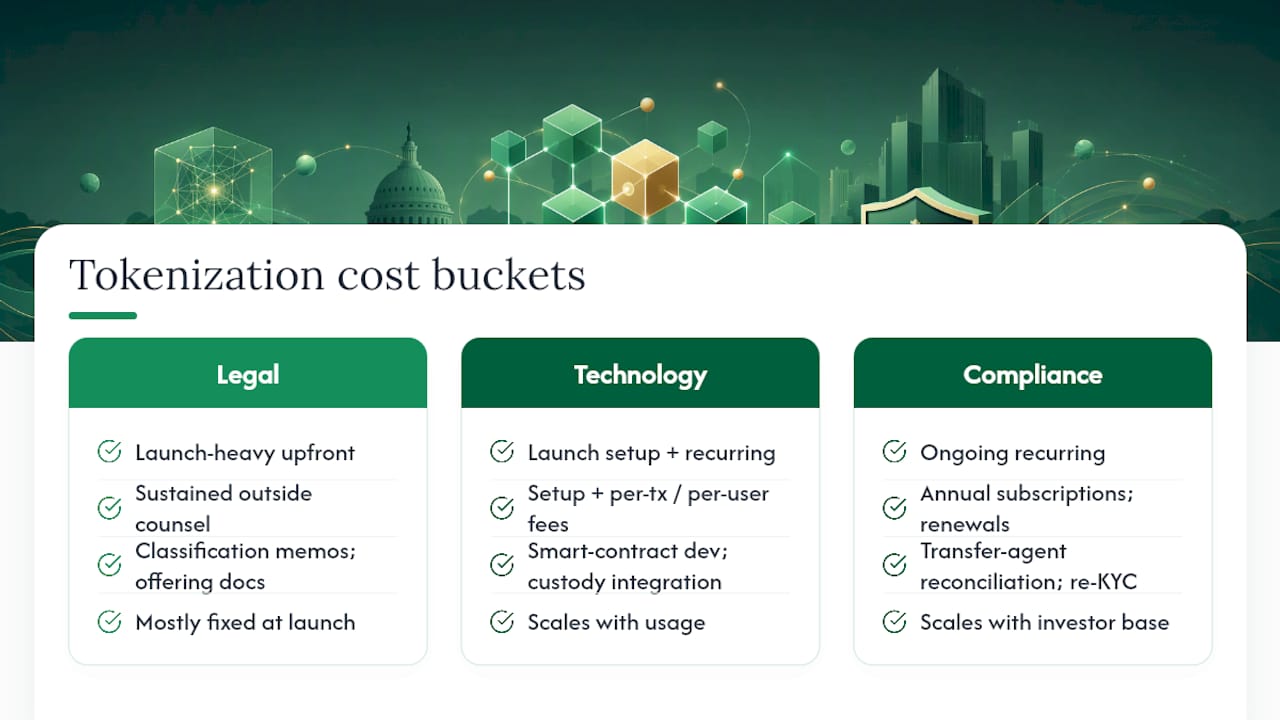
Ongoing compliance is where issuers most often underbudget. Transfer-agent reconciliation, periodic re-KYC, sanctions screening subscriptions, and board reporting all recur annually, and they scale with the size of the investor base rather than shrinking after launch. State blue-sky notice filings add per-state fees that multiply quickly for offerings sold across multiple jurisdictions. Custody arrangements, particularly third-party custodial models, often carry basis-point fees on assets under custody plus fixed monthly platform charges.
The firms that budget realistically treat compliance infrastructure as a permanent operating cost, not a one-time launch expense. A whitelist system that worked at launch with fifty investors needs monitoring and re-verification capacity that scales as the holder base grows into the thousands, and that scaling cost is rarely built into initial projections. Independent certification and pricing structures built around annual renewal give compliance teams a predictable line item instead of an ad hoc legal bill every time regulatory guidance shifts.
Primary Sources Worth Bookmarking
Legal and compliance teams should anchor every classification decision in primary regulatory text rather than secondary commentary.
- The SEC staff statement on tokenized securities for the current staff position on classification
- The 2026 interpretive release for the fuller legal analysis behind that position
- The Federal Reserve’s capital-treatment FAQs for prudential and capital-treatment questions affecting regulated institutions
- Investor for investor-protection framing useful in board and client communications
Document every regulatory interaction, including informal staff conversations, since that record becomes part of the compliance file an examiner will eventually ask to see.
Why Practitioners Keep Getting This Wrong
The biggest mistake in this space is not legal, it is conceptual. Compliance teams keep treating tokenization as a product innovation question when it is really a recordkeeping substitution question. The token does not need a new regulatory theory. It needs the same registration, custody, and transfer-agent discipline that has governed securities for decades, applied to a new ledger technology.
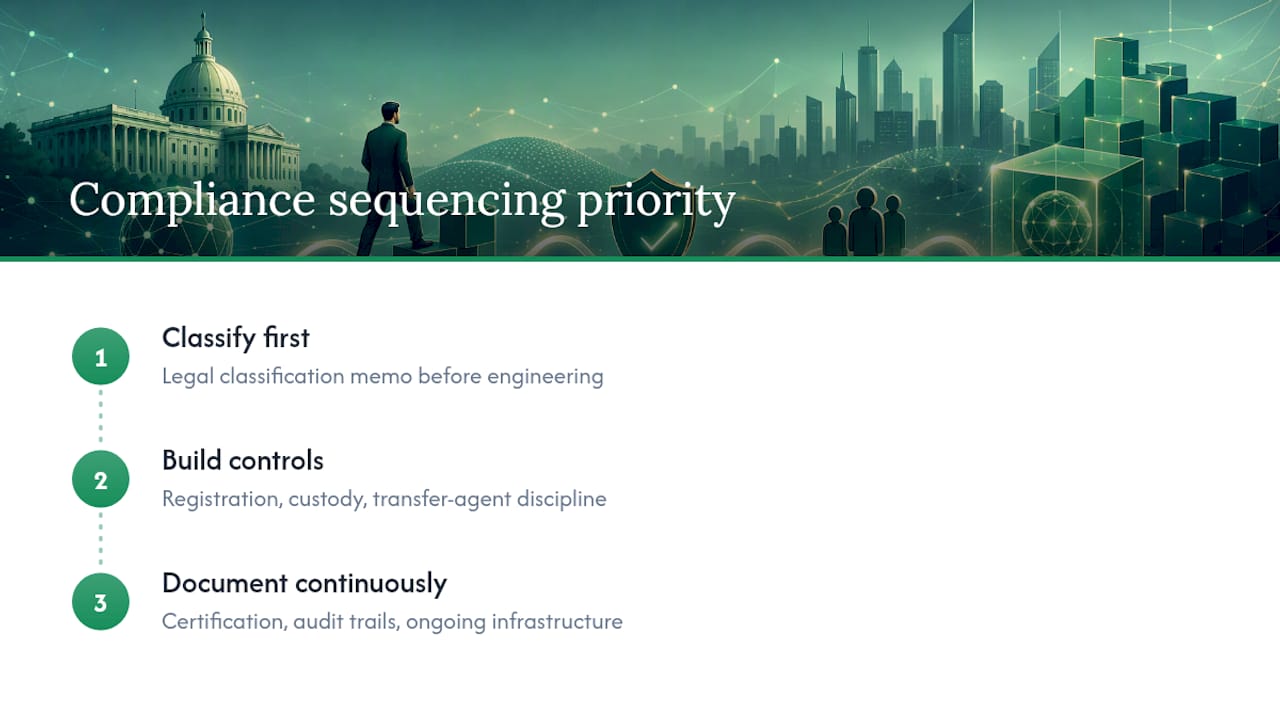
Conventional advice tends to overweight the smart-contract engineering and underweight the legal classification memo that should precede it. Get the classification wrong and no amount of whitelist logic saves you. I’d also push back on the idea that programmable compliance is optional polish. Enforceable, contract-level transfer restrictions are turning into the baseline institutional buyers expect before they’ll touch an offering, not a nice-to-have layered on later.
If there’s one priority for legal and compliance teams reading this, it’s sequencing: classify first, build controls second, and document everything as you go. Firms that treat certification and audit trails as ongoing infrastructure, not launch-day paperwork, are the ones that survive an examiner’s first visit without a remediation letter.
— Gregg
Sources
- Statement on Tokenized Securities
- Interpretive release on the application of the federal securities laws to certain types of crypto assets
- Capital treatment of tokenized securities frequently asked questions
- Investing in Security Tokens: Compliance Requirements and Regulatory Framework — TOKENIZATION COMPLIANCE
- Investor