
Enterprise Crypto Risk Governance Structure in 2026

Enterprises adding digital assets to their balance sheets face a category of risk that most existing frameworks weren’t built to handle. The enterprise crypto risk governance structure you build today will determine whether your organization can operate with confidence, survive a regulatory examination, and respond to an incident without scrambling for clarity. Get it wrong, and you’re looking at compliance penalties, custody failures, or board-level embarrassment. This article walks you through the full build: from pre-work and architecture to operationalization and ongoing verification.
Table of Contents
- Key takeaways
- Enterprise crypto risk governance structure: the prerequisites
- The four-layer governance architecture
- Implementing your governance structure
- Avoiding governance failures over time
- My perspective on what actually makes governance work
- Take your governance readiness from theory to certification
- FAQ
Key takeaways
| Point | Details |
|---|---|
| Start with scope and stakeholders | Define which assets, activities, and jurisdictions are in scope before writing a single policy. |
| Build four governance layers | Strategic, operational, technology, and compliance governance must work together, not in silos. |
| Codify decision rights early | A RACI matrix for wallet operations, approvals, and disclosures prevents dangerous gaps during incidents. |
| Board approvals must be substantive | Approval thresholds for allocations and exposures should be documented, not ceremonial. |
| Monitor and adapt continuously | Use dashboards and metrics to track governance health as regulations and asset types evolve. |
Enterprise crypto risk governance structure: the prerequisites
Before you design any governance layer, you need a clear picture of what you’re governing. That sounds obvious, but most organizations skip this step and end up with policies that don’t match their actual crypto activities.
Start by defining scope across four dimensions:
- Asset types: Are you holding Bitcoin as a treasury reserve, issuing tokenized securities, or processing stablecoin payments? Each carries a different risk and regulatory profile.
- Crypto activities: Custody, trading, staking, lending, and DeFi exposure all require different controls.
- Jurisdictions: Your obligations under FinCEN, MiCA, or local AML laws depend on where your entity operates and where counterparties are located.
- Risk appetite: The board needs to formally state how much volatility, liquidity risk, and regulatory uncertainty the organization is willing to accept.
Next, identify who needs a seat at the governance table. The core team typically includes the Chief Compliance Officer, Chief Risk Officer, General Counsel, Head of Information Security, and Treasury. IT operations joins for custody and key management decisions. Board-level oversight, ideally through an audit or risk committee, is non-negotiable.
Pro Tip: Map your stakeholder list against your existing enterprise risk committee structure. If crypto isn’t already a standing agenda item at the board risk committee, add it now, not after an incident.
You also need to assess what governance infrastructure you already have. Examiners evaluate governance by reviewing board committee charters, approved risk tolerance statements, and how well crypto risk integrates into your existing enterprise risk management processes. If those documents don’t mention digital assets yet, your governance gap is already visible to regulators.
The final prerequisite is a regulatory mapping exercise. List every applicable obligation, whether that’s BSA/AML, SEC reporting requirements, state money transmission licenses, or CFTC rules, and assign an internal owner to each. This becomes the spine of your compliance governance layer.
| Prerequisite | Owner | Output |
|---|---|---|
| Scope definition | CRO + Treasury | Digital asset inventory and activity register |
| Stakeholder mapping | CCO | RACI draft and committee roster |
| Regulatory mapping | Legal + CCO | Jurisdiction-by-jurisdiction obligation register |
| Governance gap assessment | Internal audit | Gap report with prioritized remediation items |
| Board risk appetite statement | Board risk committee | Formal written tolerance statement |
The four-layer governance architecture
A well-designed governance framework covers four interconnected layers: strategic, operational, technology, and compliance. Think of them as concentric rings, each one translating board intent into concrete controls.
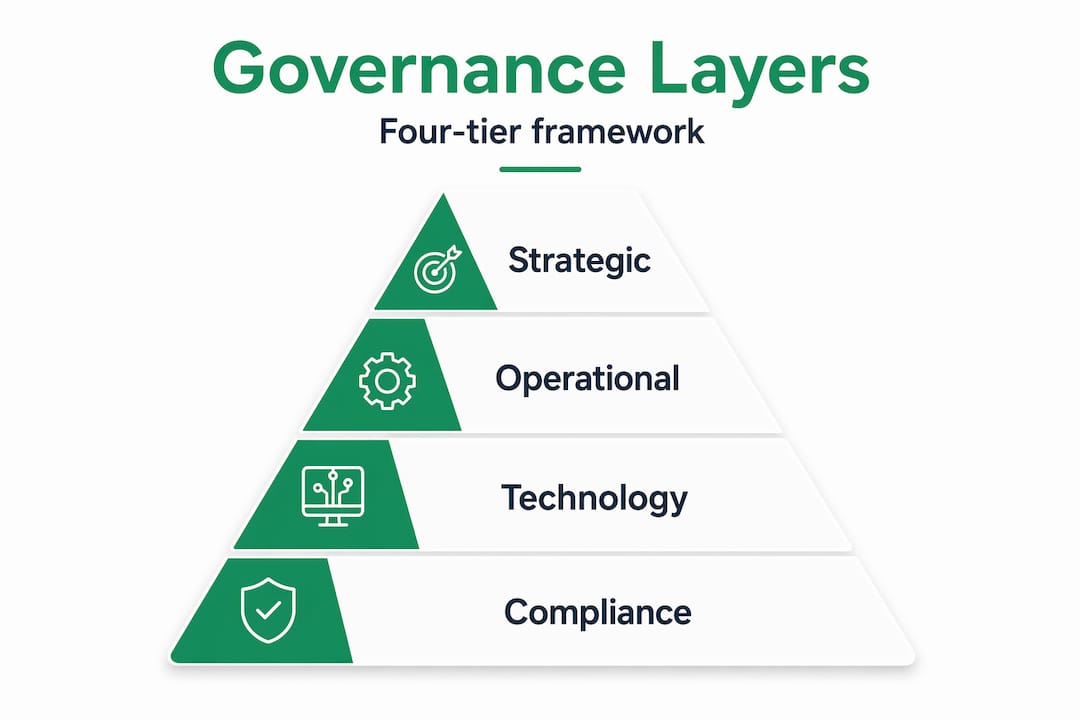
Strategic governance
This is where the board sets the terms. Risk appetite, crypto investment policy, escalation procedures, and the criteria for exiting digital asset exposure all live here. Board approvals in crypto governance must establish thresholds for allocations, exposures, and major decisions. A board that rubber-stamps treasury’s crypto strategy without defined limits creates drift and legal exposure. Document the approval path from treasury proposal to board sign-off, and make those thresholds specific.
The board oversight checklist for 2026 illustrates how agency theory applies here. You’re managing the conflict between executives who want flexibility and shareholders or regulators who want guardrails.
Operational governance
At the management level, you need policies covering custody, trading authority, vendor onboarding, and incident response. The most important document here is a RACI matrix. A clear RACI for crypto operations assigns responsibility for wallet rotation, transaction approvals, vendor due diligence, and public disclosures. Without it, you get either dangerous inaction during incidents or unauthorized workarounds when the assigned owner is unavailable.
Separation of duties between finance, legal, security, and IT is the operational control that regulators look for first. One team should never hold both custody access and the authority to approve transfers.
Technology governance
Blockchain-specific controls require their own layer. This includes private key management policies, multi-signature wallet configurations, smart contract review procedures, and node security. Integrating blockchain analytics into your compliance screening isn’t optional in 2026. FinCEN’s guidance now requires institutions to supplement traditional SDN screenings with on-chain behavioral analytics to detect indirect exposure to illicit activity.

Compliance governance
This layer covers regulatory monitoring, reporting timelines, audit readiness, and examination prep. Assign a compliance owner to track regulatory changes across every jurisdiction where you operate. Your legal risk management approach should include a process for translating new regulatory guidance into policy updates within a defined timeframe, typically 30 to 60 days.
Pro Tip: Avoid siloing crypto compliance inside a single team. Regulatory risk in digital assets touches tax, securities law, AML, and data privacy simultaneously. Cross-functional review of new guidance catches issues that specialists miss.
Institutions that integrate these layers with their existing enterprise risk management frameworks avoid the biggest trap: treating crypto as a separate risk universe instead of an extension of risks they already manage.
Implementing your governance structure
Design without execution is just documentation. Here’s how to move from framework to operating reality.
- Stand up governance committees. Create a Digital Asset Governance Committee with representation from risk, compliance, legal, security, and treasury. Define its charter, meeting cadence (monthly at minimum), and escalation path to the board risk committee.
- Develop and approve core policies. Your policy suite needs to cover custody standards, trading authority and limits, vendor onboarding requirements, incident response, and public disclosure. Each policy should have a named owner and a review cycle.
- Set approval thresholds. Board-documented approval paths prevent treasury strategy drift. Define specific dollar thresholds for single-transaction approvals, daily transfer limits, and new asset class additions.
- Deploy technology tools. Implement transaction monitoring and blockchain analytics platforms. Connect outputs to your existing compliance screening workflow. Governance also requires tracking market risk effectively with dashboards that surface concentration, liquidity, and counterparty exposures in real time.
- Test your controls. Run tabletop simulations for your most likely incident scenarios: a key compromise, a ransomware payment demand, or a regulatory inquiry. Effective incident response plans include crypto-specific triggers, defined roles, communication protocols, and recovery procedures. Testing before an incident is the only way to know whether your governance design actually works.
Pro Tip: Build your incident simulation around the scenarios your governance committee hasn’t fully discussed yet. The gaps in your tabletop exercises are exactly the gaps regulators and attackers will find.
A common mistake at this stage is treating governance implementation as a project with an end date. It isn’t. Ongoing performance reviews, quarterly control testing, and annual policy updates are part of the operating model, not optional enhancements.
Avoiding governance failures over time
Even well-designed frameworks degrade. The two most common failure patterns are over-centralization and under-documentation.
On over-centralization: assigning a single powerful policy owner who controls all crypto decisions creates bottlenecks and encourages shadow processes. When people can’t get approvals through official channels, they find unofficial ones. The antidote is delegated authority with clear escalation triggers, not a gatekeeper model.
On documentation: examiners will ask for your governance artifacts. They want to see current policies, recent board minutes reflecting crypto risk discussions, control testing results, and vendor assessments. Outdated or incomplete documentation signals governance in name only.
To verify governance health on an ongoing basis, track these indicators:
- Policy exception rate: how often are teams bypassing approved procedures?
- Incident response time: how long from detection to initial escalation?
- Control testing completion: are scheduled tests being performed and remediated?
- Regulatory update lag: how many days between new guidance and internal policy updates?
- Board reporting frequency: is crypto risk a standing agenda item?
“Governance requires clear definitions of control rights, accountability, and auditability for sustainable institutional crypto participation. Decentralization on its own is insufficient.” IE Business School
When regulations shift, and they will, your governance structure needs a defined adaptation process. That means a regulatory change log, a policy review trigger tied to major guidance releases, and a board reporting mechanism that surfaces emerging obligations before they become enforcement issues.
My perspective on what actually makes governance work
I’ve reviewed a lot of enterprise crypto governance programs, and the ones that fail have one thing in common. They over-invest in technology controls and under-invest in decision rights.
Compliance teams get excited about blockchain analytics platforms and transaction monitoring dashboards. Those tools matter. But when an incident hits, what determines whether your organization responds well is whether people know exactly who decides what, in what order, and with what authority. That clarity has to be written down, tested, and known by everyone involved before anything goes wrong.
I’ve also found that corporate governance theory explains crypto risk far better than the decentralized governance rhetoric that dominates crypto-native circles. Agency conflicts, principal-agent problems, and oversight gaps are the real issues. The organizations that recognize this stop trying to import governance models from open-source communities and start applying the same discipline they use for every other regulated activity.
The other thing I’d emphasize: define your escalation triggers before you need them. What transaction size or event type automatically requires board notification? What constitutes a reportable incident? Most governance programs I’ve seen leave these undefined, which means they get defined in the worst possible moment, under pressure, with incomplete information.
Governance maturity in crypto directly correlates with how confident your board and investors feel about your digital asset exposure. It’s not a compliance exercise. It’s the foundation of institutional credibility in this asset class.
— Gregg
Take your governance readiness from theory to certification
If you’ve built out a governance framework or you’re in the middle of designing one, the hardest question to answer honestly is: how good is it actually?
Wush built the DARE certification specifically for this moment. The Digital Asset Readiness Evaluation maps directly to the governance layers covered in this article, from board-level risk appetite documentation to compliance monitoring and custody controls. DARE gives risk managers and compliance officers a structured way to assess their current governance posture, identify gaps, and earn an industry-recognized credential backed by blockchain verification. It covers custody, regulatory compliance, risk management, legal, and operational controls in a single modular program with annual renewal to keep pace with regulatory change. If governance maturity matters to your organization, explore what DARE offers and see where you stand.
FAQ
What is an enterprise crypto risk governance structure?
An enterprise crypto risk governance structure is a multi-layered framework covering strategic, operational, technology, and compliance controls for managing digital asset risks. It assigns clear decision rights, accountability, and escalation procedures across board and management levels.
How do you build a crypto risk management framework from scratch?
Start by defining scope, mapping applicable regulations, and assessing your current governance gaps. Then build governance layers covering board policy, operational RACI matrices, technology controls, and compliance monitoring before standing up formal committees and testing your controls.
What documentation do regulators expect for crypto governance?
Examiners typically expect board-approved risk tolerance statements, crypto-specific policies covering custody and trading, control testing records, vendor risk assessments, and evidence that crypto risk appears in board reporting.
Why does separation of duties matter in crypto governance?
Crypto operations create concentrated risk when one team controls both asset custody and transfer approvals. Separation of duties ensures that no single team or individual can move assets without independent authorization, reducing both fraud risk and operational errors.
How often should a crypto governance framework be reviewed?
At minimum, conduct a full policy review annually and a targeted review whenever major regulatory guidance is issued. Monitoring dashboards and control testing should run continuously, with governance committee meetings at least monthly.