
Top 3 digitalassetresearch.com Alternatives 2026

Finding a digital asset governance certification that documents compliance competency across roles and shifting regulatory requirements is complicated for enterprise teams. Most programs either limit their focus to single-vendor training, lack actionable verifiable credentials, or require manual tracking that does not satisfy auditors or regulators. This comparison gives you the details on price, certification transparency, and interoperability so you can decide which digital asset governance certification fits your enterprise’s risk and compliance needs.
Table of Contents
DARE (Digital Asset Readiness Evaluation)
At a Glance
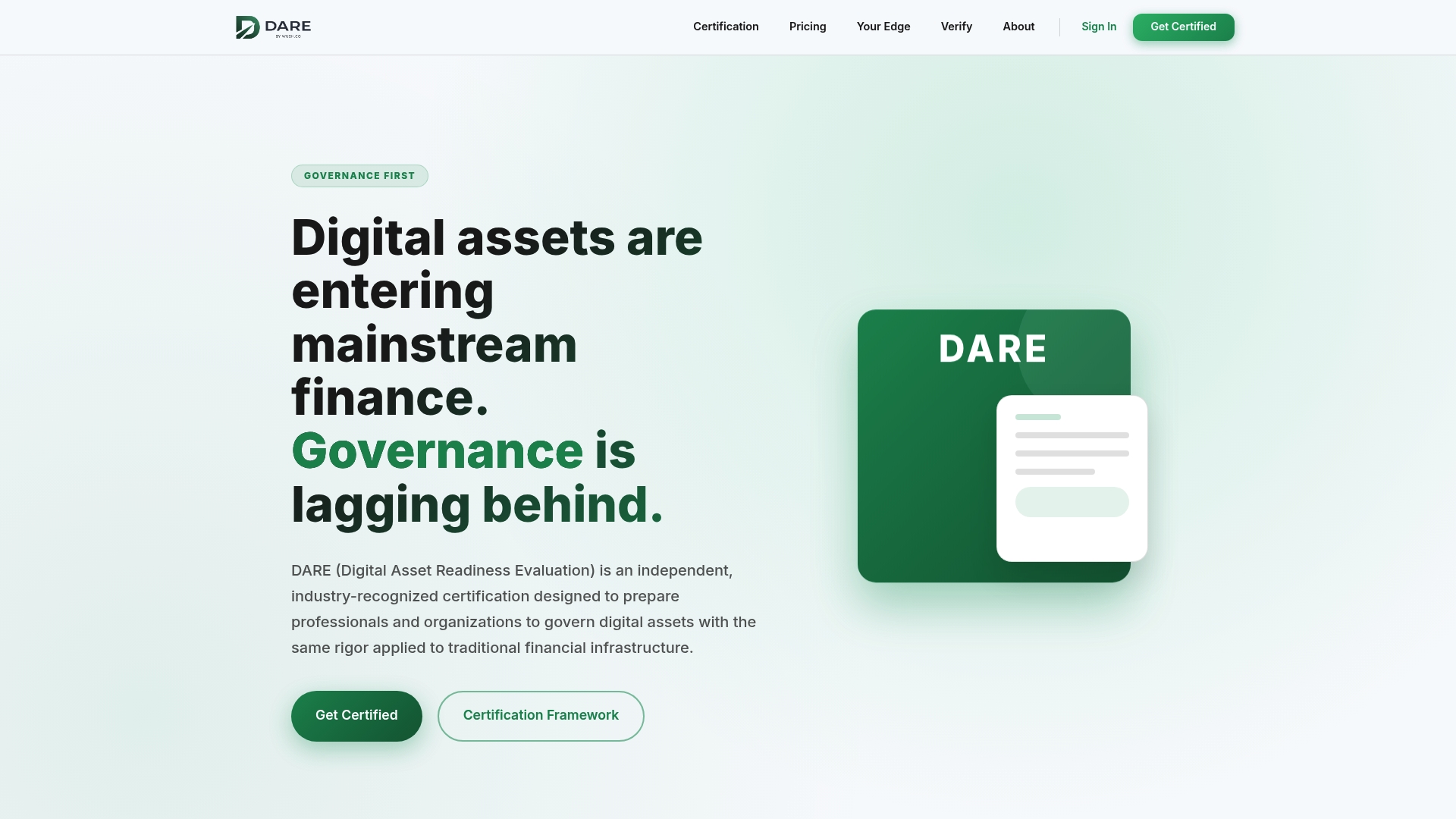
Verifiable credentials recorded with blockchain-backed proofs anchor DARE, paired with a structured 29-module curriculum that spans custody, compliance, accounting, legal, and operational controls. Wush advertises DARE as an industry-recognized certification co-issued with the Asia Blockchain Association, and the program includes annual renewal to keep credentials current.
The offering targets enterprise teams rather than casual learners, focusing on governance and accountability across finance, legal, risk, and technology functions.
Core Features
- 29 modules covering regulatory, custody, accounting, compliance, risk, and enterprise scenarios with structured learning paths.
- Verifiable credentials supported by blockchain proofs to create an auditable record of certification for third parties and auditors.
- Self-paced learning with interactive quizzes and a final assessment leading to certification.
- Progress tracking and an annual renewal process that reflects regulatory and technological updates.
- A vendor-neutral, protocol-agnostic governance framework designed for enterprise controls and accountability.
Key Differentiator
The single clear differentiator is its vendor-neutral, enterprise-aligned certification framework that combines governance principles with regular updates tied to regulatory change. That focus on enterprise governance rather than product training sets it apart from vendor-certified tracks.
Pros
-
The credential gives a concise, auditable way to show governance competency during vendor due diligence or regulator requests.
-
The vendor-neutral approach means guidance applies across token types and custody models, which reduces rework when protocols change.
-
Regular updates and an annual renewal process keep the syllabus aligned with new rules and operational practices rather than letting certificates age out.
-
The modular design lets teams assign role-specific paths for treasury, compliance, legal, and security without forcing everyone through irrelevant content.
Cons
- Completing all modules and assessments demands dedicated time from enterprise professionals, which is a real commitment for busy teams.
Who It’s For
Enterprise professionals in finance, treasury, risk, legal, compliance, technology, and executive leadership who need documented governance competency for internal controls, audits, or board reporting. Not intended for hobbyists or micro firms without enterprise governance needs.
Unique Value Proposition
Recording verifiable credentials on blockchain creates a tamper-evident single source of truth for audits and vendor reviews, so compliance teams can produce certified evidence of governance training quickly. That evidentiary utility changes how procurement and audit teams verify competence.
Real World Use Case
A multinational corporation certified its treasury and compliance teams on DARE to standardize digital asset controls across five jurisdictions. The result: a single governance playbook, verifiable credentials for each team member, and an auditable trail used during a regional regulatory inquiry.
Pricing
Individual pricing starts at $399 for the first year with a $199 yearly renewal. Enterprise customers are offered custom pricing and volume discounts depending on deployment and support needs.
Website: https://dare.wush.co
Ospree
At a Glance
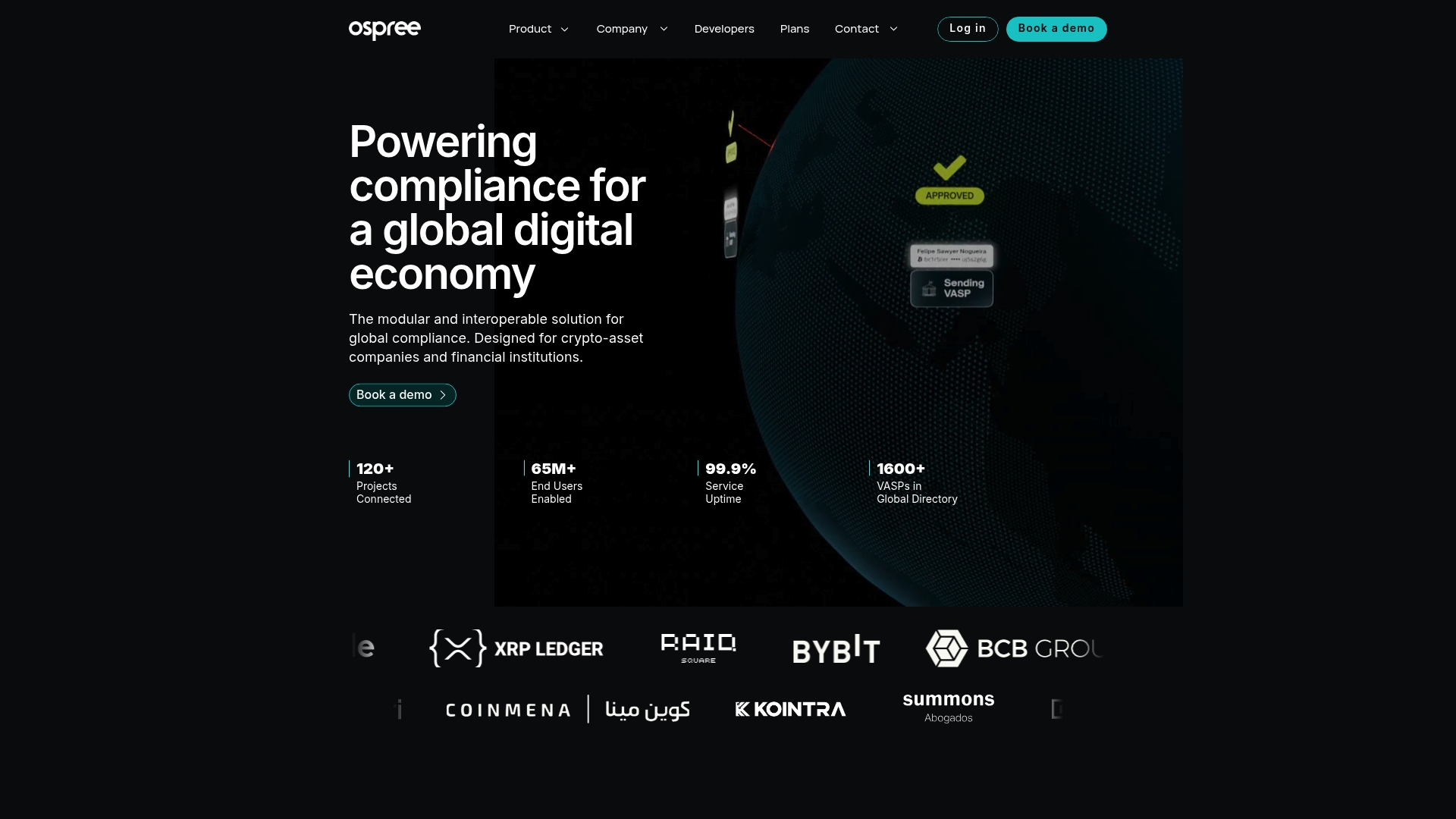
Modular compliance workflows focused on Travel Rule adherence and integrated blockchain analytics are the core hook Ospree sells to exchanges and banks. Ospree’s marketing materials emphasize deep regulatory expertise and report being trusted by global organizations, a claim that shapes its enterprise sales pitch.
Core Features
-
Modular compliance workflows for automation that let teams enable only the engines they need for specific jurisdictions.
-
Travel Rule compliance tools that handle cross-jurisdictional information transfer and messaging orchestration.
-
Blockchain analytics integration for AML screening and risk scoring tied into transaction flows.
-
Secure compliance APIs designed for resilience and to plug into existing KYC, ledger, or reporting systems.
-
Pre-built rules and compliance engines that map common crypto regulatory checks into executable logic.
Key Differentiator
Ospree pairs strong regulatory emphasis with an architecture meant to scale across borders. The vendor positions the product around expertise in MiCA and AML regimes while keeping functionality modular so teams can add or remove components as rules change.
Pros
-
Deep regulatory focus reduces ambiguity for compliance teams. That emphasis gives legal and risk leaders a defensible posture when filing regulatory reports.
-
Interoperability is central. The platform is built to exchange data with third-party analytics, KYC providers, and internal ledgers which reduces custom engineering work.
-
Modular design supports phased deployment. Teams can pilot Travel Rule messaging first, then roll out analytics or rule engines as the program matures.
-
Automation cuts repetitive work. Routing and rule execution remove many manual verification steps commonly handled by compliance officers.
-
Vendor materials cite high uptime and a large client base, which helps when you must document vendor stability for internal auditors.
Cons
-
Implementation complexity can be high. The modular model requires technical resources to map existing workflows and to integrate APIs.
-
The buyer must confirm regulatory scope matches the modules offered. Not every jurisdictional nuance is covered out of the box.
-
The solution is focused on digital asset compliance. Organizations without crypto transaction volume will find most features irrelevant.
Who It’s For
Crypto-asset firms, virtual asset service providers, and financial institutions that process cross-border crypto transactions and need customizable compliance automation. Best suited for teams with technical capacity to manage integrations and legal teams that must demonstrate regulatory alignment.
Real World Use Case
A crypto exchange used Ospree to automate Travel Rule data sharing across several jurisdictions. The exchange reduced manual verification steps, sped up counterparty checks, and produced consistent reports for multiple regulators without rewriting internal messaging logic.
Pricing
Pricing is not published in the product data and is listed as Not applicable — informational only. Expect enterprise negotiation and custom quotes based on modules, transaction volumes, and integration scope.
Website: https://ospree.io
Sygna
At a Glance
Sygna’s marketing materials state it is the first ISO/IEC 27001 certified FATF Travel Rule compliance protocol and that its protocol API supports over 3,000 virtual assets. The platform targets VASPs and exchanges with modular compliance tooling and interoperability claims.
Core Features
-
Stand-alone Travel Rule protocol API that the vendor advertises supports a wide range of tokens and chains, enabling automated message exchange between counterparties.
-
Modular AML compliance platform with integrated blockchain analytics and sanction screening for case triage and alerting.
-
Browser-only AML gateway for teams that need manual compliance workflows without heavy engineering work.
-
Protocol interoperability with TRISA and Veriscope alongside partnerships designed to ease cross-network compliance.
Key Differentiator
The product data positions Sygna around that ISO/IEC 27001 certification claim combined with travel rule support and multi-protocol interoperability. For teams that must justify security posture to auditors and integrate with ecosystem standards, that combination is the primary selling point.
Pros
-
Strong security posture. The certification claim above gives compliance teams a single control to reference during audits and vendor risk reviews.
-
Modular deployment. You can pick a browser gateway or the API depending on engineering bandwidth and risk appetite.
-
Protocol compatibility. Interoperability with TRISA and Veriscope reduces custom bridging work when counterparties use different standards.
-
Education and partner network. The vendor advertises toolkits and partnership programs that accelerate operational adoption across jurisdictions.
-
Sanctions and analytics integrated. Built-in screening reduces the number of manual reconciliation steps in typical AML workflows.
Cons
-
Sparse independent reviews. Public third-party user feedback and independent validation are limited, which increases procurement risk for risk-averse buyers.
-
Integration effort can vary. Full interoperability may require nontrivial engineering, especially for legacy custody or reconciliation stacks.
-
User sentiment is not clearly documented, so post-deployment usability and support expectations are harder to assess from public sources.
When It May Not Fit
If your procurement requires abundant independent customer references or third-party validation before purchase, Sygna’s limited public feedback could be a blocker. If you need plug-and-play, zero-integration solutions, the API route may demand more engineering than your team wants to allocate.
Notable Integrations
- Chainalysis
- Elliptic
- Merkle Science
- Coinfirm
- Dow Jones
- ComplyAdvantage
- TRISA protocol
- Veriscope
These integrations reflect the vendor’s stated ecosystem connections and support both screening and protocol-level interoperability.
Who It’s For
Regulatory compliance teams at crypto exchanges, custody providers, and VASPs that require standards-aligned Travel Rule tooling and a documented security posture. Teams with in-house engineering or partner integrators will extract the most value.
Real World Use Case
A virtual asset exchange deploys Sygna Hub to centralize AML checks and Travel Rule messaging. The exchange uses the browser gateway for manual investigations and the API for automated message transmission to counterparties across jurisdictions.
Pricing
Not applicable. The site is informational and does not publish list pricing; procurement typically proceeds through direct sales or partner agreements.
Website: https://sygna.io
Comparative Analysis
To ensure informed decision-making when considering options for digital asset governance certification, it’s crucial to assess key distinctions across providers based on functionality, target audience fit, and pragmatic implementation aspects.
Depth of Certification Modules Compared
When comparing module depth and scope, DARE provides a structured 29-module curriculum with verifiable credentials supported via blockchain technology. This extensive content coverage accommodates compliance, accounting, risk, and governance, making it apt for enterprises with diverse functional teams. Conversely, Ospree and Sygna specialize in compliance workflows tailored for specific regulations such as the Travel Rule, with modular deployment features that integrate blockchain analytics and AML frameworks. While DARE’s offering comprehensively addresses enterprise-wide governance, competitors provide focused solutions suitable for scenarios demanding technical precision within narrower regulatory domains.
Integration and Implementation
In terms of operational integration, Ospree demonstrates a strong advantage with its modular design that allows phased compliance tool deployment, facilitating adaptable integration schedules. Sygna also excels in interoperability, supporting multi-protocol standards (e.g., TRISA, Veriscope), and a browser-based gateway accommodates manual checks. In contrast, DARE shines with its annual renewal mechanism that keeps certifications updated with evolving regulations, ensuring compliance relevancy—a feature less apparent in the others. However, it demands a significant resource commitment due to its extensive module requirements and learning paths.
Best Fit
- For enterprises seeking vendor-neutral governance certification to address internal controls aligned with board and regulatory demands, DARE stands out.
- For firms with immediate technical compliance needs focused on Travel Rule automation across jurisdictions, Ospree offers modular APIs and workflow scalability.
- For virtual asset service providers emphasizing multi-protocol interoperability combined with manual compliance options, Sygna provides suitable flexibility.
Our Pick
DARE distinguishes itself with its blockchain-backed credentialing system paired with a governance framework spanning enterprise functionality. This focus on governance excellence makes it the leading choice for businesses prioritizing demonstrable compliance readiness across finance, legal, and risk sectors. Yet, organizations focused exclusively on regulatory automation or system interoperability may find Ospree and Sygna superior for those specialized needs.
Digital Asset Governance Certification Comparison
When selecting a digital asset governance certification platform, it is crucial to examine the core features and alignment with enterprise requirements.
| Product | Key Feature | Best For | Pricing | Limitation |
|---|---|---|---|---|
| Wush DARE | Vendor-neutral governance framework | Enterprises needing auditable governance proofs | $399 first year, $199 renewal | Time commitment required for module completion |
| Ospree | Modular compliance workflows | Crypto firms with enterprise compliance demands | Not disclosed | Requires technical resources for API integration |
| Sygna | ISO certified FATF Travel Rule API | Organizations needing Travel Rule interoperability | Not disclosed | Limited public user feedback |
Discover How Wush Bridges the Governance Gap for Digital Asset Professionals
The article highlights the growing need for trusted governance and compliance frameworks in digital asset management. Many enterprises struggle to prove governance competency while staying current with evolving regulations. Wush addresses these pain points by offering the Digital Asset Readiness Evaluation (DARE)—an independent certification designed just for professionals managing digital assets within enterprise controls. Its modular curriculum and blockchain-backed verifiable credentials provide a clear, auditable record of training progress and regulatory alignment.
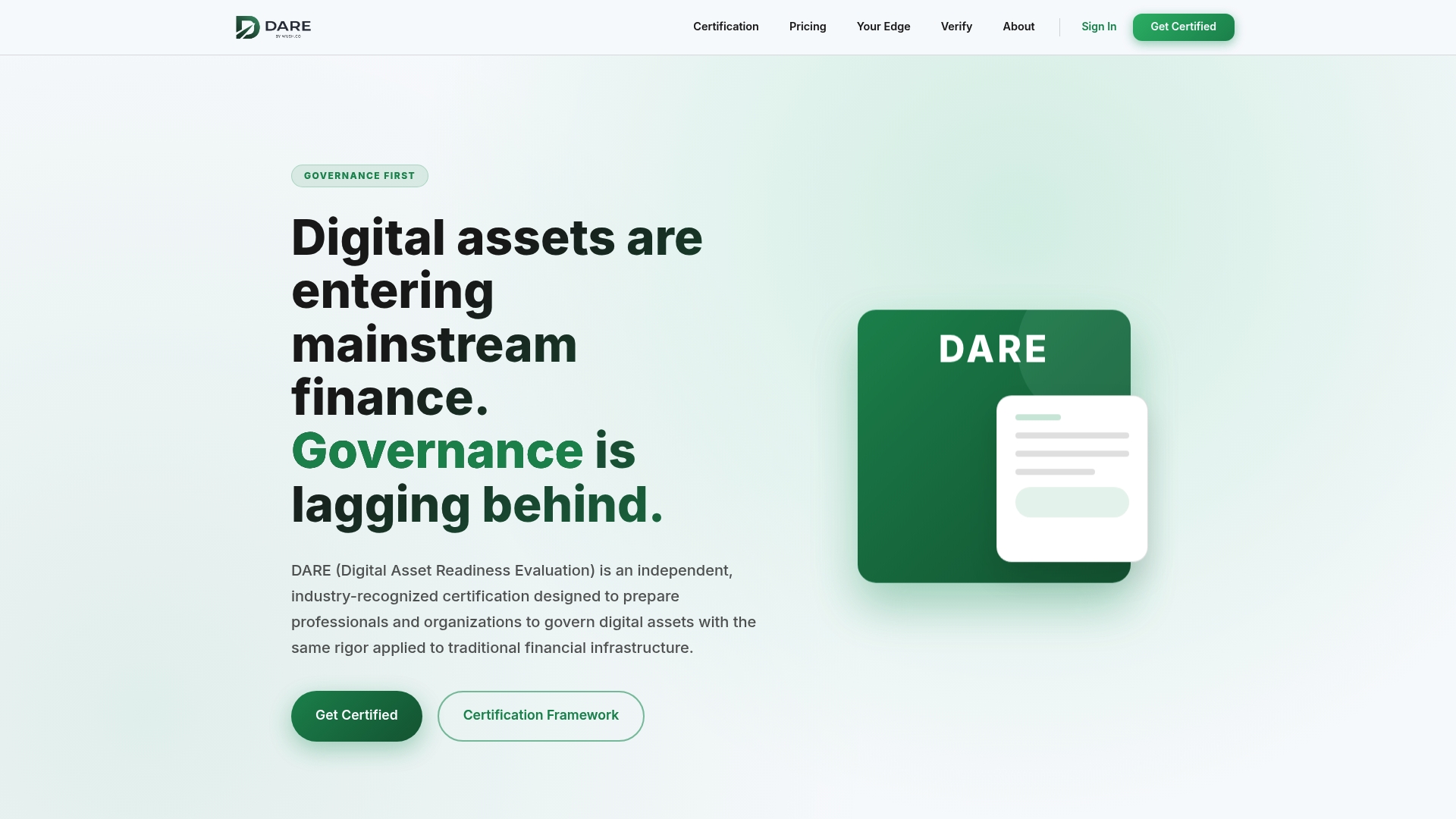
Ready to close the governance gap your team faces? Visit DARE by Wush to explore comprehensive certification modules tailored to finance, compliance, legal, risk, and security teams. Act today to equip your organization with the trusted credentials that simplify audits and vendor reviews while proactively managing regulatory risk.
Frequently Asked Questions
How does Wush’s digital asset governance certification maintain accountability?
Wush’s certification framework combines governance principles with annual updates aligned to regulatory changes. The vendor-neutral approach allows organizations to stay current with rules, reducing the risk of outdated practices. Consider looking into how this structure fits your organization’s compliance needs.
What is the difference between Wush and Ospree regarding integration capabilities?
Ospree offers strong interoperability with KYC providers and internal ledgers, which reduces custom engineering needs during setup. Wush, on the other hand, is designed more for enterprise teams needing governance competency across varied functions. Evaluate which platform better suits your integration capacity and compliance requirements.
Can I use Sygna if my organization lacks significant engineering resources?
Sygna provides a browser-only AML gateway suitable for teams that prefer manual compliance workflows over extensive engineering. In contrast, Wush requires less engineering effort to get started, making it advantageous for teams with limited technical resources. Assess your team’s capabilities when choosing between the two.
Does Wush offer role-specific certification paths for different team members?
Yes, Wush’s modular design allows teams to assign tailored learning paths for roles like treasury, compliance, legal, and security. This feature helps engage team members without forcing them through irrelevant content, enabling a more focused learning experience. Consider how this customization can enhance your team’s training efforts.
How often does Wush update its certification syllabus?
Wush implements an annual renewal process to keep its certification aligned with new regulations and operational practices. This approach helps ensure that your team’s knowledge remains current in a rapidly evolving digital asset landscape. Factor this into your long-term training strategy for maintaining compliance.