
Digital Asset Stress Testing Procedures: Enterprise Guide

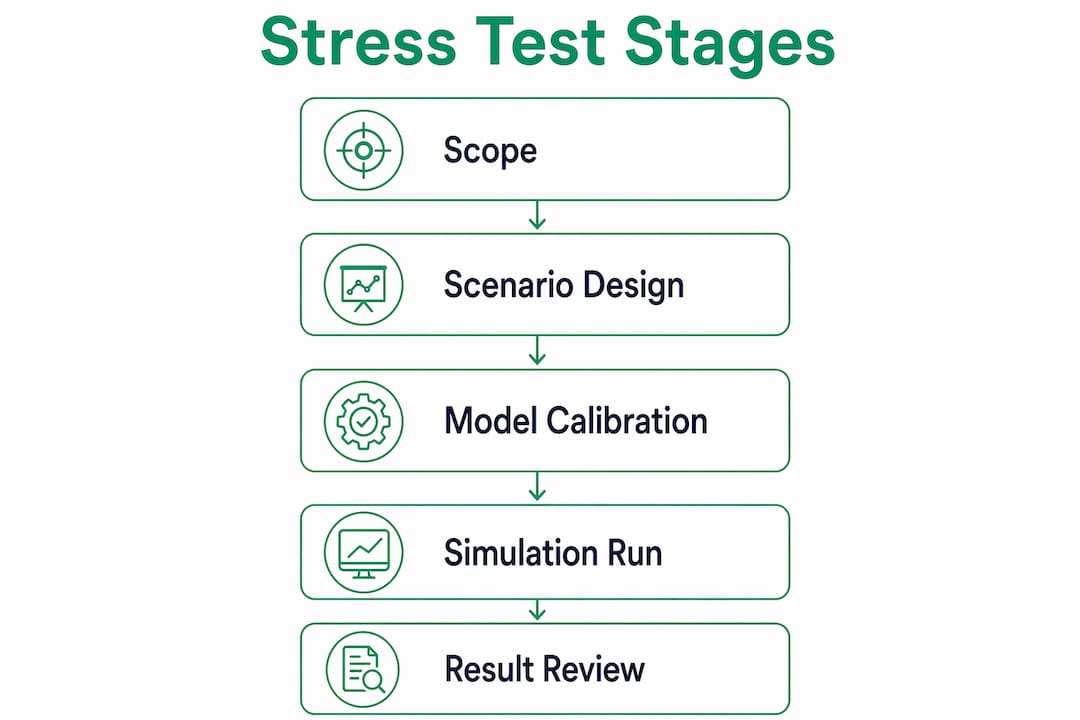
A certification-ready digital asset stress testing program must prove three things: capital and liquidity sufficiency under severe crypto shocks, operational resilience across custody and settlement systems, and a documented audit trail that satisfies boards, examiners, and certification bodies like DARE. The team that owns this is risk (scenario design and model runs), treasury (liquidity coverage), legal (regulatory mapping), and ops (technology simulation). The deliverable is a single evidence packet: scenario library, model outputs, validation log, and board summary.
Quick-start checklist for your first 30 days:
- Risk: Define failure metrics (undercollateralization threshold, redemption coverage ratio, capital buffer floor) and assign scenario ownership
- Treasury: Map on-chain and off-chain liquidity sources; establish liquidation horizon baselines
- Legal: Map exposures to U.S. supervisory expectations and, where applicable, Basel guidance on capital treatment
- Ops: Inventory custody models, smart contract dependencies, and third-party counterparties
- All: Align on the DARE certification rubric as the governance standard for artifact packaging
Table of Contents
- What do digital asset stress testing procedures actually need to prove?
- How do you design credible scenarios, including reverse stress tests?
- What quantitative modeling choices actually work for crypto?
- How do you model liquidity, market impact, and contagion?
- What operational and technology scenarios must you simulate?
- How do you make stress test results defensible to auditors and boards?
- What cadence and role structure should you operate on?
- How does DARE certification formalize your stress testing program?
- Key Takeaways
- Why separating market and operational tests is a governance mistake
- DARE gives your stress testing program a certification pathway
- Useful sources and regulatory references
What do digital asset stress testing procedures actually need to prove?
The objectives are not abstract. A well-scoped program must demonstrate solvency (can the entity absorb severe losses without breaching capital minimums?), liquidity convertibility (can reserves be liquidated fast enough to meet redemption demands?), operational continuity (do custody, settlement, and smart contract systems hold under failure conditions?), and regulatory resilience (are controls documented and defensible?).
Failure metrics to define before you run a single scenario:
| Metric | Definition | Threshold Example |
|---|---|---|
| Undercollateralization % | Reserve shortfall relative to token liabilities | triggers escalation |
| Redemption coverage ratio | Liquid assets / 30-day redemption demand | triggers buffer review |
| Time-to-settlement | Execution lag under network stress | >T+2 triggers SLA breach |
| Capital buffer floor | Minimum own funds above regulatory minimum | Breach triggers board report |
| SLA breach threshold | Operational downtime or delay limit | Defined per custody agreement |
Roles matrix — assign these before scenario design begins:
- CRO / Model Owner: scenario design, model governance, validation sign-off
- Treasury: liquidity scenario inputs, buffer sizing, redemption modeling
- Legal: regulatory mapping, escalation triggers, external reporting obligations
- Ops / InfoSec: technology simulation, custody testing, incident playbooks
- Board / Audit Committee: receives summary outputs; approves escalation thresholds
For exposure limit templates that feed directly into failure metric calibration, the DARE blog has worked examples finance teams can adapt.
How do you design credible scenarios, including reverse stress tests?
Reverse Stress Testing is the right starting point for crypto portfolios because it surfaces non-linear failure modes that a standard scenario list misses. The question is not “what happens if prices drop 30%?” but “what event would actually break us?” Work backward from insolvency or operational failure to identify the combination of shocks that gets you there.
Scenario taxonomy for enterprise crypto programs:
- Historical replication: Terra/LUNA collapse (May 2022), major exchange outages, stablecoin de-pegs
- Hypothetical concentrated shocks: 50% price drop combined with oracle failure and a liquidity spike
- Regulatory clampdown: sudden trading halt, asset freeze, or custody provider license revocation
- Protocol-specific failures: smart contract exploit, bridge hack, validator set compromise
Network-level inputs such as gas fee spikes and throughput degradation belong in every scenario because they amplify financial losses beyond pure price moves. A scenario template should specify: inputs and assumptions, expected outputs, counterparty dependencies, escalation triggers, and the time horizon (three years for solvency scenarios; up to one year for liquidity scenarios, per MiCA Article 10).
Pro Tip: Calibrate scenario severity against documented historical episodes first, then layer in forward-looking hypotheticals. A scenario library seeded only by imagination fails validation; one seeded only by history misses emergent risks.

What quantitative modeling choices actually work for crypto?
VaR understates tail risk in crypto; for additional insight on market behavior and volatility modeling, see this industry commentary on Bitcoin’s unstable market role. Supplement it with Expected Shortfall (ES), which captures the average loss beyond the VaR threshold, and document both metrics’ limitations in the validation log. This is not optional for certification-ready programs.
| Model Component | Why It Matters for Crypto |
|---|---|
| Kurtosis-aware distributions | Fat tails are structural in crypto; normal distributions underfit extreme events |
| Regime-switching models | Volatility clusters and correlation structures shift abruptly |
| Monte Carlo with rolling correlations | Captures time-varying dependencies across BTC, ETH, and stablecoin positions |
| Dynamic feedback loops | Models how selling pressure deepens price impact endogenously |
| ES / CVaR | Quantifies severity of losses beyond the VaR cutoff |
Model governance checklist:
- Document input data sources and calibration period
- Record parameter sensitivity ranges
- Run backtesting against at least two historical stress episodes
- Obtain independent validation sign-off before board presentation
- Log every model change with version, date, and rationale
Traditional risk models were built for equities and bonds. Digital assets require new frameworks because regime shifts, 24/7 markets, and on-chain mechanics create failure paths that standard factor models cannot capture.
How do you model liquidity, market impact, and contagion?
Price shocks and liquidity crises are not independent in crypto. Selling pressure thins order books, widens spreads, and deepens the price move, which triggers more selling. Model this feedback as endogenous to the stress event, not as a separate overlay.
Key metrics to quantify:
- Order book depth at 1%, 2%, and 5% price impact levels
- Bid-ask spreads under stress versus normal conditions
- Effective liquidation horizon (how long to exit a position without moving the market)
- Correlation matrices under regime-shift conditions (correlations rise sharply during crypto stress)
Conditional VaR and liquidity premiums help convert price shocks into realistic exit costs and slippage estimates. For a detailed liquidity risk methodology, including market depth measurement and slippage modeling, the DARE blog provides a practitioner-level walkthrough.
Contagion testing outputs:
| Output | Use |
|---|---|
| Liquidity shortfall estimate | Buffer sizing and capital planning |
| Time-to-redemption coverage | Redemption policy and gate triggers |
| Cascade path diagram | Board communication and escalation triggers |
| Slippage-adjusted loss estimate | Hedging and deleveraging threshold calibration |
Construct network diagrams of on-chain holdings, counterparty exposures, and pooled liquidity positions, then run layered shocks to reveal cascade paths. Secondary and tertiary effects, including forced liquidations and concentrated collateral re-use across protocols, must be included.
What operational and technology scenarios must you simulate?
Operational failures do not wait for market stress to subside. A custody compromise or oracle manipulation can trigger cascade liquidations independently of price moves, and the two often arrive together.
Core test plan components:
- Testnet forks: Replicate mainnet state using environments like Tenderly Virtual TestNets to simulate chained transaction bundles safely
- Oracle price overrides: Test liquidation engine behavior under manipulated or stale price feeds
- Network congestion simulation: Model elevated gas fees and throughput degradation on settlement SLAs
- Counterparty default drills: Simulate custodian or prime broker failure and test recovery procedures
- Key management recovery: Validate multi-sig and HSM recovery paths under time pressure
Pro Tip: Run operational simulations alongside market shock scenarios, not separately. A custody delay during a liquidity crunch is a different failure mode than either event alone, and combined tests reveal the cascade paths that single-discipline testing misses.
Incident playbooks must specify: escalation path, legal hold procedures, external communications, and evidence collection for audits. For policy templates covering custody and key management, the DARE blog has practitioner-ready frameworks.
How do you make stress test results defensible to auditors and boards?
Integrated stress testing delivers compliance-ready documentation only when validation and audit trails are built in from the start, not retrofitted after the fact.
Validation checklist:
- Data lineage documented from source to model input
- Distributional fit checks and backtesting against historical episodes (Terra/LUNA, 2022 exchange outages)
- Independent validation sign-off, separate from the model owner
- Sensitivity analysis across key parameters
| Deliverable | Audience | Frequency |
|---|---|---|
| Scenario library (versioned) | Auditors, certifiers, board | Updated quarterly |
| Model code and parameters | Independent validator, CRO | Per model change |
| Validation log | Regulators, audit committee | Per validation cycle |
| Incident simulation records | Ops, legal, certifiers | Per test run |
| Executive board summary | Board, senior management | Quarterly |
Version control and change management for models are not administrative overhead. They are the evidence that a program is governed, not just run.
What cadence and role structure should you operate on?
Set a minimum cadence and stick to it: quarterly full runs (solvency and combined market/operational), monthly liquidity checks, and event-triggered runs after material market moves, regulatory changes, or operational incidents. This aligns with the frequency structure in EU Commission Delegated Regulation 2025/415, which sets quarterly solvency and monthly liquidity testing as minimums for significant token issuers, and serves as a useful benchmark for U.S. enterprises building defensible programs.
- Board / Audit Committee: Approves escalation thresholds; receives quarterly summary; reviews annual program assessment
- CRO / Model Owner: Owns scenario design, model governance, and validation coordination
- Treasury: Provides liquidity inputs; owns redemption coverage modeling; acts on buffer recommendations
- Legal: Maps scenarios to U.S. supervisory expectations; reviews external reporting obligations
- Ops / InfoSec: Executes technology simulations; maintains incident playbooks; documents test evidence
- External Validator: Provides independent model validation sign-off; reviews scenario plausibility
| Documentation Type | Owner | Retention |
|---|---|---|
| Versioned scenario packets | CRO | 3 years minimum |
| Run logs and post-mortems | Ops | 3 years minimum |
| Validation reports | External validator | Per certification cycle |
| Board minutes referencing test outcomes | Legal / Secretary | Permanent |
For U.S. regulatory exposure mapping and how to tie scenario design to supervisory expectations, the DARE blog provides a jurisdiction-specific reference.
How does DARE certification formalize your stress testing program?
Certification requires demonstrable program maturity, not just completed runs. A certifier evaluates whether controls are mapped, models are validated, operational tests are documented, and governance records show continual improvement.
DARE certification artifact checklist:
- Mapped controls aligned to the DARE assessment rubric
- Independent validation reports with sign-off dates
- Incident simulation logs (operational test records)
- Board minutes referencing stress test outcomes and escalation decisions
- Annual renewal evidence demonstrating program updates
Pro Tip: Package all outputs as traceable, dated, and versioned documents from day one. A certification audit is not the time to reconstruct evidence. Build the evidence packet as you run the program.
DARE’s modular structure covers strategic, operational, risk, legal, and technical controls, so the assessment rubric maps directly to the program components described in this article. Verifiable blockchain-based credentials provide external stakeholders with tamper-evident proof of program maturity.
Key Takeaways
A certification-ready digital asset stress testing program requires scenario libraries, validated quantitative models, operational simulation records, and a governed audit trail that boards, regulators, and certifiers can independently verify.
| Point | Details |
|---|---|
| Scope and assign ownership first | Define failure metrics and assign roles across risk, treasury, legal, and ops before designing any scenario. |
| Build a scenario library with reverse tests | Include historical episodes, hypothetical combined shocks, and reverse stress tests that identify the event that would break the portfolio. |
| Use ES alongside VaR, with kurtosis-aware models | Supplement VaR with Expected Shortfall and dynamic feedback loops to capture fat-tail behavior and endogenous liquidity amplification. |
| Run combined market and operational simulations | Custody failures and oracle exploits must be tested alongside price shocks, not in isolation, to reveal cascade failure paths. |
| Package artifacts for DARE certification | Scenario library, validation log, incident simulation records, and board summaries must be versioned and dated from the first run. |
Why separating market and operational tests is a governance mistake
The conventional approach in enterprise risk programs is to run market stress tests in one workstream and operational resilience tests in another. It is a clean organizational structure that produces dangerously incomplete results.
The failure modes that actually break digital asset programs are almost always combined. An oracle manipulation does not occur in a vacuum; it arrives during a period of elevated volatility, when liquidation engines are already under load and order books are thin. A custody delay during a liquidity crunch is not two separate incidents. It is one cascade, and if your testing never simulates the two together, your board summary will never show the real exposure.
The practical fix is straightforward: require risk, treasury, ops, and legal to co-own at least one combined simulation per quarter. The scenario design forces cross-functional alignment, the outputs are more defensible to certifiers, and the board gets a picture that reflects how failures actually propagate. Siloed testing produces siloed confidence, and that is the kind of confidence that evaporates precisely when you need it most.
DARE gives your stress testing program a certification pathway
Completing a stress testing program is one thing. Demonstrating that it meets governance and compliance standards to a board, regulator, or counterparty is another. That gap is exactly what the DARE certification addresses.
DARE is built for finance, legal, risk, and ops professionals targeting U.S. regulatory alignment. The program provides modular learning mapped to the control areas covered in this article, assessment rubrics that mirror certification-ready artifact requirements, and verifiable blockchain-based credentials that give external stakeholders tamper-evident proof of program maturity. Annual renewal keeps credentials current as regulatory standards evolve.
The onboarding path is structured: complete the modular assessment, identify remediation gaps, build the evidence packet, and receive a verifiable credential. Enterprise licenses are available for teams. To start your certification assessment, visit dare.wush.co/certification.
Useful sources and regulatory references
Use these primary sources to support artifact documentation, scenario calibration, and model validation citations.
Regulatory and methodological references:
- EU Commission Delegated Regulation 2025/415 — minimum design requirements for stress testing programs, including frequency, governance, and scenario methodology
- EBA Guidelines on Liquidity Stress Testing under MiCAR — common reference parameters for liquidity scenario calibration
- Monte Carlo and contagion modeling framework — peer-reviewed simulation framework integrating VaR, ES, stablecoin hedging, and contagion modeling with BTC/ETH/USDT data
| Source | Best Used For |
|---|---|
| EU Delegated Regulation 2025/415 | Scenario time horizons, frequency minimums, governance requirements |
| EBA MiCAR Liquidity Guidelines | Stress factor calibration, redemption risk parameters |
| SOIC Monte Carlo Framework | Model validation citations, ES/VaR backtesting methodology |
| Anaptyss Reverse Stress Testing Guide | Scenario design rationale, reverse stress testing justification |
| Prisma Finance Hub | Kurtosis modeling, dynamic feedback loop design |
This article provides general informational guidance on stress testing methodologies and governance frameworks. It does not constitute legal, regulatory, or financial advice. Confirm current U.S. supervisory requirements with qualified legal counsel or your primary regulator before finalizing your program design.