
Digital Asset Risk Appetite Statement Explained for Finance Teams

Most organizations entering digital assets draft a one-paragraph governance statement that says something like “we maintain a conservative approach to cryptocurrency risk.” That feels like governance. It is not. A digital asset risk appetite statement explained properly is a structured, quantitative document that translates board-level tolerance into measurable limits, escalation thresholds, and linked key risk indicators. Without that architecture, you have a philosophy. With it, you have a governance tool that can actually be monitored, tested, and enforced across every team that touches digital assets.
Table of Contents
- Key takeaways
- What a digital asset risk appetite statement actually contains
- Digital asset risk categories and how to quantify them
- Operationalizing the appetite statement across governance
- Common pitfalls and what good statements look like
- My take on what most organizations get wrong
- Take the next step with DARE governance certification
- FAQ
Key takeaways
| Point | Details |
|---|---|
| Qualitative statements alone are insufficient | Board-level posture must translate into numeric exposure limits, caps, and thresholds to be operationally meaningful. |
| Risk categories must be explicit | Financial crime, custody, smart contract, and market risks each require separate quantified tolerances in the statement. |
| KRIs are the operational backbone | Key risk indicators must be tied directly to each tolerance boundary to trigger timely escalation before breaches become critical. |
| Governance is a closed loop | Appetite, tolerance, KRI monitoring, breach detection, escalation, and board reporting must form a continuous cycle. |
| Statements must evolve | As digital asset products and regulations change, the risk appetite document requires scheduled review and iterative refinement. |
What a digital asset risk appetite statement actually contains
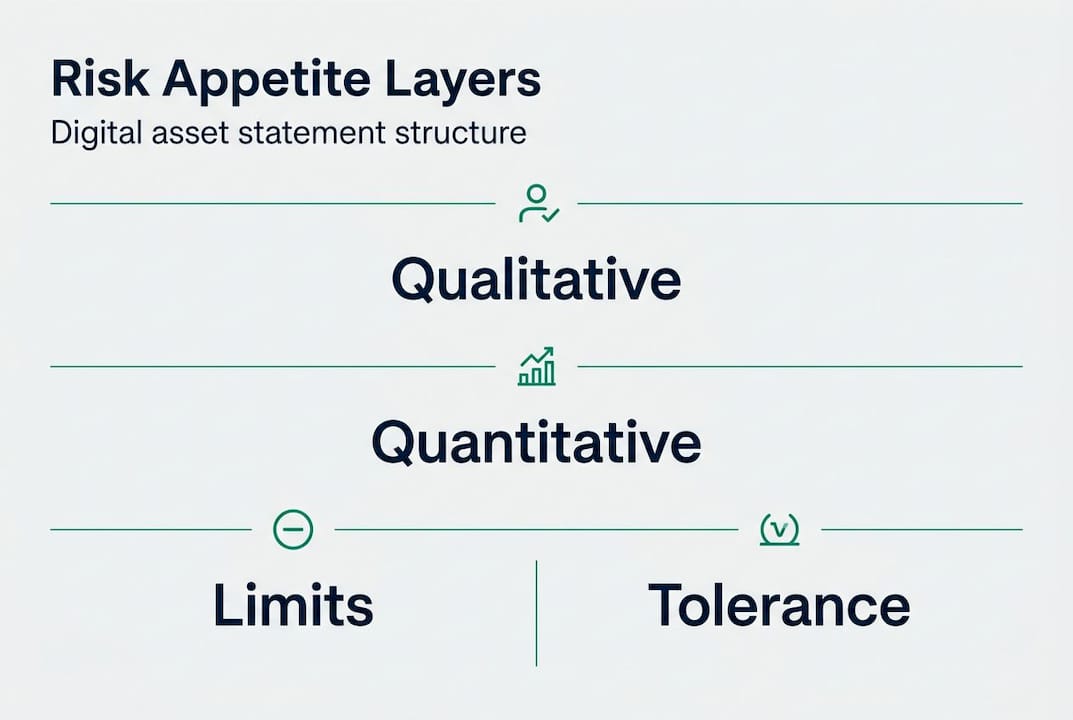
A well-constructed statement has two inseparable layers: the qualitative posture that reflects board-level values, and the quantitative boundaries that make those values enforceable. Most governance failures happen when organizations stop at the first layer.
The qualitative posture describes the organization’s overall orientation. Examples include “we will not engage with unregistered digital asset service providers” or “we accept market volatility risk only within hedged treasury positions.” These sentences matter because they communicate intent to regulators, auditors, and staff. But intent without measurement is unenforceable.
The quantitative layer is where the document becomes a functioning governance tool. Operationally effective risk appetite statements combine qualitative postures with measurable limits and escalation protocols tied directly to KRIs. This means specific numbers: no single digital asset exposure exceeding 5% of total treasury, no transaction above $250,000 approved by a single signatory, maximum 4-hour system downtime per quarter for custody platforms.
Tolerance ranges sit adjacent to those limits. The appetite defines where you want to operate. The tolerance defines how far from that target you can drift before escalation is required. These are not the same number, and confusing them is one of the most common structural errors in digital asset governance documentation.
| Component | Description | Digital asset example |
|---|---|---|
| Qualitative posture | Board-level risk orientation statement | “We will not interact with unregulated DeFi protocols.” |
| Quantitative boundary | Hard numeric limit | Maximum 3% of total assets in any single blockchain network |
| Tolerance range | Acceptable drift from target | Up to 1% above limit before escalation trigger activates |
| KRI linkage | Metric tied to boundary | Daily portfolio concentration report, alerting at 2.5% |
| Escalation threshold | Trigger for formal response | Board notification required if exposure exceeds 3.5% |
Pro Tip: Write your tolerance range as a separate value from your appetite limit. If your limit is 5% exposure, your tolerance threshold might be 5.5%. Crossing the tolerance triggers escalation; crossing the appetite limit triggers immediate remediation. That distinction protects governance from treating every minor fluctuation as a crisis.
Digital asset risk categories and how to quantify them
Digital assets introduce unique risk drivers including cybersecurity threats, loss of access, liquidity constraints, regulatory uncertainty, and technology failures that traditional financial risk frameworks simply do not capture. Each category needs its own quantified tolerance in the appetite statement.
Financial crime risks
AML and sanctions exposure in digital assets is harder to measure than in traditional banking because of pseudonymous transaction data and cross-chain activity. That difficulty is not an excuse to leave it unquantified. Institutions must specify acceptable versus unacceptable financial crime exposures using concrete metrics such as no deposits over $500 from unverified addresses within a 24-hour period, or zero tolerance for confirmed sanctions-list counterparty interactions.
The important principle here is that “zero tolerance for illicit activity” sounds strong but means nothing operationally. The quantified version specifies what gets flagged, at what threshold, and what the response protocol is.
Operational and custody risks
Many digital asset losses are operational, not market-driven. Key management failures, lost private keys, and unauthorized transaction approvals account for a disproportionate share of institutional losses. Custody risk appetite must govern private key lifecycle including multi-party approval requirements, transaction velocity controls, address whitelisting, and reconciliation frequency.

Specific tolerances here might include: no single-signature approval for transactions above $100,000, maximum 2-hour reconciliation gap, and mandatory hardware security module storage for any key controlling assets above a defined threshold.
Technology and smart contract risks
Governance frameworks must quantify limits for smart contract interactions alongside concentration by blockchain network and counterparty. An organization interacting with DeFi protocols, for example, should define a maximum percentage of treasury that can be deployed into any single smart contract, and require a formal risk review before any new protocol interaction.
Blockchain network concentration is a real risk. If 80% of your digital asset holdings sit on one chain and that network experiences a major outage, your operational exposure is enormous. A network concentration limit of, say, 40% per blockchain forces diversification and builds resilience.
Market and regulatory risks
Volatility limits and liquidity requirements belong in the appetite statement as numeric bounds. Risk appetite in cryptocurrency environments requires explicit position limits, drawdown tolerances, and liquidity exit time frames. A statement that says “we accept moderate volatility” is useless. One that says “no position may exceed a 30-day historical volatility of 85% without board approval” is a governance tool.
Pro Tip: Map each risk category to a named owner in the appetite statement itself. When a KRI for custody operations is breached, the statement should identify exactly who is notified, in what time frame, and what the initial response protocol is. Ownership without a name attached is ambiguous at precisely the moment when clarity matters most.
Operationalizing the appetite statement across governance
Writing the statement is step one. Embedding it in daily operations is where most organizations fall short. The governance model for digital asset risk appetite must be a closed loop: appetite definition leads to tolerance thresholds, which generate KRI monitoring requirements, which surface breach alerts, which trigger escalation, which produce responses, which feed board reporting, which inform appetite review.
Here is how to build that cycle in practice:
- Define the monitoring cadence. Each KRI linked to a tolerance boundary needs a reporting frequency. Transaction volume KRIs might require daily dashboards. Custody reconciliation might run every 4 hours. Market concentration reports might be generated weekly. Match frequency to the speed at which the risk can change.
- Assign escalation owners and timelines. Tolerance boundaries act as tripwires that trigger escalation. The governance document must specify who receives the alert, how quickly they must respond, and what the first remediation step is.
- Build operational KRIs at workflow level. Transaction failure rates, reconciliation breaks, and system uptime are the metrics that provide early warning before breaches become critical. Aggregate portfolio-level metrics alone are insufficient for detecting operational deterioration before it crosses the appetite limit.
- Run governance simulations. Scenario walkthroughs test the full breach-to-response chain under realistic conditions. Simulate a custody key compromise, a transaction velocity breach, or a regulatory inquiry. These exercises reveal gaps in escalation paths that are invisible until you walk through them step by step.
- Produce regular board reports. The board set the appetite. They need to see whether the organization is operating within it. Quarterly reporting that presents KRI status, breach events, and remediation actions against the stated tolerances is the minimum expectation for credible governance.
Pro Tip: Schedule a formal appetite review every 12 months and whenever the organization adds a new digital asset product, enters a new blockchain network, or faces a significant regulatory change. Digital asset risk environments move faster than annual planning cycles, and an outdated appetite statement can be worse than none at all.
Common pitfalls and what good statements look like
The most destructive version of a digital asset risk appetite statement is the one that looks thorough but lacks numeric teeth. Qualitative-only appetite statements are the primary governance pitfall. They create an illusion of oversight while leaving every operational decision open to interpretation.
Consider two contrasting examples. A weak statement reads: “The organization maintains a low risk appetite for digital asset operations and will take appropriate measures to protect against losses.” A strong statement reads: “Maximum digital asset exposure is 2% of total assets. No transaction exceeding $500,000 proceeds without dual authorization. Any single blockchain network is limited to 30% of total digital asset holdings. KRI breach notification occurs within 2 hours of threshold crossing.”
A few additional patterns that consistently undermine appetite statements:
- Confusing capacity with appetite. Capacity is the maximum loss an organization could absorb and survive. Appetite is where you actually choose to operate. Running at capacity means you have no buffer for unexpected events.
- Omitting KRI linkage entirely. A limit without a corresponding indicator is a number that nobody is watching.
- Setting tolerance equal to appetite. If your tolerance threshold is the same as your limit, you have no early warning window. By the time the alert fires, you are already in breach.
- Writing the document once and filing it. Explicit governance frameworks require continuous application through governance arrangements, not a static document that ages on a shared drive.
“A risk appetite statement without quantitative boundaries is a press release, not a governance document.”
My take on what most organizations get wrong
I’ve spent years reviewing digital asset governance documentation across financial institutions at various stages of maturity. The pattern I see repeatedly is an organization that invested real effort in drafting its risk appetite statement and genuinely believes the document is doing governance work. It is not. The statement uses careful language, cites regulatory frameworks, and gets board sign-off. What it lacks is any number.
In my experience, the reluctance to quantify comes from discomfort with specificity. If you write “maximum 5% exposure,” you are accountable to 5%. If you write “conservative exposure levels,” accountability becomes negotiable. That negotiability feels safer until something goes wrong, at which point it becomes the reason nobody can explain why the loss was permitted.
The operational realities of blockchain custody make this problem more acute than in traditional asset classes. You can monitor digital asset market risk with the right metrics, but you have to define what you are measuring first. Private key governance, transaction authorization chains, and smart contract interaction limits are not captured by any standard financial risk template. They require original thinking tied to specific numeric thresholds.
What I have seen work in practice is treating the risk appetite statement as a living operational document. That means quarterly KRI reviews, annual full revisions, and simulations that deliberately break the escalation chain to find the gaps. Organizations that do this build genuine risk culture rather than risk theater.
— Gregg
Take the next step with DARE governance certification
For organizations working to move beyond qualitative governance statements, Wush offers the DARE certification program, a structured evaluation specifically designed for digital asset risk governance. The program covers risk appetite frameworks, custody controls, KRI design, and board reporting aligned with exactly the components covered in this article.
Whether you are building your first digital asset risk appetite framework or stress-testing an existing one, the DARE readiness evaluation gives your team a structured path to certification and credible governance credentials. Finance professionals, risk managers, and treasury teams use the platform to close the gap between policy documents and operational reality. Learn more at dare.wush.co.
FAQ
What is a digital asset risk appetite statement?
A digital asset risk appetite statement is a governance document that defines how much digital asset risk an organization is willing to accept, using both qualitative postures and quantitative boundaries tied to measurable KRIs.
How is risk appetite different from risk tolerance in digital assets?
Risk appetite is where the organization chooses to operate, while tolerance defines how far from that target it can drift before escalation is triggered. They are separate thresholds and should be documented as distinct numeric values.
What are the most important risk categories to include?
Financial crime exposure, custody and key management controls, smart contract interaction limits, market concentration, and regulatory compliance each require dedicated, quantified tolerances within the statement.
How do KRIs support a digital asset risk appetite statement?
KRIs provide the operational measurement layer that detects when tolerances are being approached. Without KRIs linked to each boundary, limits exist on paper but generate no early warning before a breach occurs.
How often should a digital asset risk appetite statement be reviewed?
Formal review should occur at least annually and whenever the organization adds a new product, enters a new blockchain network, or faces material regulatory change. Static statements become misaligned with the risk environment faster in digital assets than in traditional finance.