
Digital Asset Liquidity Risk Assessment for Finance Pros

Accurate digital asset liquidity risk assessment is one of the most technically demanding challenges in institutional finance today. Unlike traditional securities, digital asset liquidity is fragmented across dozens of exchanges, settlement networks, and on-chain protocols, and it can evaporate within minutes during stress events. The liquidity and volatility link in crypto has tightened considerably in 2026, producing faster and sharper intraday price swings whenever liquidity weakens. For risk managers, getting this assessment wrong does not just skew a model. It leads to real capital exposure at the worst possible moment.
Table of Contents
Key takeaways
| Point | Details |
|---|---|
| Liquidity is fragmented by design | Digital asset liquidity is exchange-dependent and can disappear rapidly during stress, unlike traditional FX markets. |
| Data inputs go beyond volume | Effective assessment requires order book depth, stablecoin reserves, derivatives data, and counterparty infrastructure analysis. |
| TVL is not real liquidity | Total Value Locked figures can mask structurally fragile pools; reserve composition and withdrawal speed matter more. |
| Derivatives volume changes the picture | Crypto derivatives trade at over 5x spot volume, meaning spot-only analysis systematically understates liquidity complexity. |
| Continuous monitoring is non-negotiable | Liquidity conditions shift intraday; automated dashboards and off-exchange settlement networks are necessary for ongoing risk control. |
Digital asset liquidity risk assessment: prerequisites
Before you run a single metric, you need the right data architecture in place. Most liquidity assessments fail not because of flawed methodology but because they are built on incomplete inputs.
The data points that actually matter
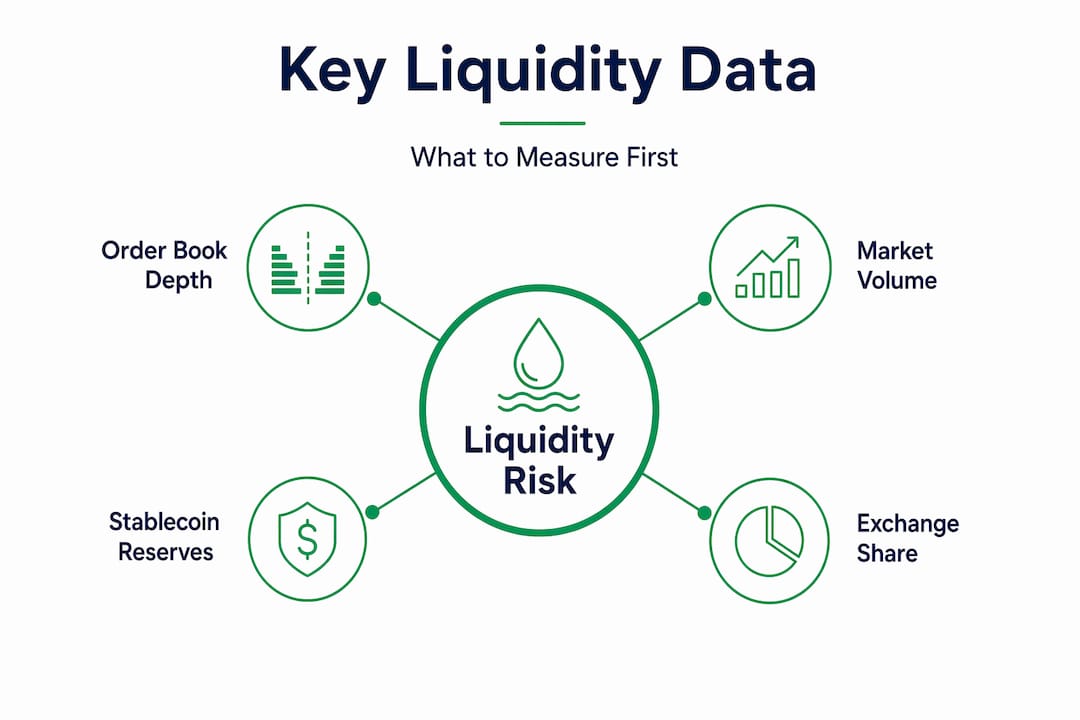
The minimum viable dataset for a credible liquidity risk assessment includes spot and derivatives market volumes across major venues, order book depth measured at standard price impact levels (typically ±1% and ±2%), stablecoin reserve balances, and exchange concentration ratios. Each of these tells a different part of the story.
Order book depth at ±2% is particularly revealing. A market can show respectable 24-hour volume while having a thin order book that would move 3% on a $2 million sell order. That gap between headline volume and actual depth is where institutions get hurt.
Stablecoin reserves matter because they proxy for deployable liquidity on a given platform. Rapid outflows of USDT or USDC from an exchange’s on-chain reserve addresses often precede stress events by hours, not days.
| Data input | What it measures | Why it matters |
|---|---|---|
| ±2% order book depth | Immediate market impact of a trade | Reveals true exit cost under real conditions |
| Spot volume (24h) | Raw trading activity | Baseline activity indicator, but not sufficient alone |
| Derivatives open interest | Leveraged exposure and unwind risk | Derivatives outpace spot 5.38x, amplifying stress scenarios |
| Stablecoin reserves | Deployable on-platform capital | Early signal of liquidity withdrawal pressure |
| Exchange concentration | Share of volume at single venues | Binance holds 68% of tracked reserves across eight major exchanges |
Infrastructure access
Beyond raw data, your assessment is only as good as the infrastructure feeding it. Platforms like Fireblocks and Copper provide institutional-grade access to counterparty networks and settlement rails. The Fireblocks network connects 2,400+ counterparties, while Copper facilitates over $50 billion in monthly notional volume through off-exchange settlement. This infrastructure access shapes what liquidity is actually available to you operationally, not just theoretically.
Pro Tip: Pull stablecoin on-chain reserve data from public blockchain explorers for the top three exchanges in your portfolio. A 10% or greater drop in a single week warrants immediate deeper review of that venue’s risk profile.
Steps for conducting a liquidity risk assessment
With your data infrastructure in place, the assessment itself follows a structured sequence. Each step builds on the previous one, and skipping any of them produces a meaningfully weaker result.
-
Measure liquidity depth and concentration. Start with order book data at ±1% and ±2% price impact for each asset and venue in scope. Calculate the ratio of depth at these levels relative to your intended position size. If your position exceeds 10% of available depth at ±2%, you face material market impact risk on exit.
-
Analyze trading volumes across spot and derivatives. Never assess spot volume in isolation. Derivatives markets are structurally larger, and perpetual futures hold the deepest pools while also carrying faster unwind risks. Model both under normal conditions and under a 30% volume reduction stress scenario.
-
Evaluate reserve composition. Break down liquidity reserves into stablecoins, platform tokens, and altcoins. Stablecoins represent genuinely available capital. Platform tokens (such as exchange native tokens) and small-cap altcoins carry redemption constraints and correlation risk that pure volume numbers hide.
-
Assess counterparty and settlement infrastructure. Map every counterparty relationship against settlement method: exchange custody, off-exchange settlement, or self-custody. Off-exchange settlement networks reduce exposure to withdrawal freezes during stress by removing the need to move assets onto exchange wallets before trading.
-
Score and document in your risk register. Assign a liquidity risk score to each position and venue based on depth, concentration, reserve quality, and settlement infrastructure. This feeds directly into your broader risk register and creates an auditable record for governance and regulatory purposes.
Pro Tip: When scoring reserve composition, treat any single platform token exceeding 15% of total reserves as a concentration risk event. Platform tokens historically show the highest correlation to that specific exchange’s operational stress.
Comparing assessment approaches

| Approach | Strengths | Limitations |
|---|---|---|
| Volume-only analysis | Fast, widely available data | Misses depth, derivatives, and concentration |
| Order book depth analysis | Reflects real execution cost | Requires direct API access or specialist data providers |
| On-chain reserve monitoring | Transparent, real-time signals | Limited to on-chain assets; misses off-chain settlement |
| Infrastructure-integrated assessment | Full counterparty and settlement picture | Requires institutional-grade platform access |
Common pitfalls in liquidity risk analysis
Even experienced risk teams make repeatable mistakes in this space. Recognizing them before they affect your assessment is half the work.
The most pervasive error is treating Total Value Locked as a proxy for liquidity. TVL can mask structurally fragile pools where liquidity is concentrated in a few large providers or deployed on temporary incentive programs. True liquidity analysis requires examining LP distribution, wallet concentration, and the share of liquidity withdrawable within a single block. A pool can show $500 million TVL while being practically illiquid for an institutional exit.
A second critical gap is the failure to account for tokenized asset structure. Tokenized real-world assets may trade around the clock on secondary markets while their underlying instruments operate on T+1 or T+2 settlement cycles. KYC requirements and whitelist restrictions limit the counterparty universe, which constrains real liquidity far below what headline numbers suggest.
“Liquidity pools should be viewed as critical infrastructure, not just marketing figures. Mercenary liquidity can dissipate rapidly, risking position unwinding during stress.” — Insight from liquidity pool risk analysis
A third pitfall is exchange concentration risk. With Binance holding 35.4% spot market share despite a 23% volume drop, institutional liquidity is consolidating toward a small number of venues. Assessing liquidity at a venue level without stress-testing concentration risk creates a dangerous blind spot.
Finally, watch for feedback loop dynamics. When volatility spikes, liquidity providers widen spreads and retreat, compressing available liquidity precisely when you need it most. This self-reinforcing cycle is structurally different from traditional fixed income or equity markets and requires scenario analysis that assumes liquidity availability drops 40% to 60% during peak stress.
Monitoring liquidity risk on an ongoing basis
A point-in-time assessment is a starting point. Liquidity conditions in digital asset markets shift intraday, and the tools you use for ongoing monitoring are as important as the methodology you used to build the initial assessment.
-
Automated dashboards connected to order book APIs and on-chain data feeds should alert your team when depth at ±2% drops below defined thresholds for any major position or venue in scope.
-
Policy engines within treasury management platforms let you set pre-approved counterparty lists and position limits that automatically flag or block transactions when liquidity conditions deteriorate.
-
Off-exchange settlement monitoring through networks like Copper ClearLoop or Fireblocks tracks settlement flows without requiring assets to move to exchange wallets, preserving optionality and reducing counterparty exposure. These networks handle tens of billions in monthly settlement volume.
-
Stablecoin reserve tracking via on-chain analytics should run continuously for every exchange holding institutional assets. A consistent reserve decline over 72 hours is a documented early warning signal.
-
Stakeholder reporting cadence should include a liquidity risk summary at minimum on a weekly basis, with immediate escalation protocols when any single trigger threshold is breached.
The underlying principle is that institutional treasury managers benefit significantly from off-exchange settlement infrastructure, yet many enterprise teams still rely on exchange-custodied settlement as their primary model. Closing that gap is as much an operational decision as it is a risk management one.
My perspective on where liquidity risk thinking still falls short
I’ve spent considerable time reviewing how institutional teams approach digital asset risk, and the honest assessment is that most frameworks are still about a cycle behind where the market is.
The assumption I see challenged most often in 2026 is that market depth data from a credible exchange provides a reliable liquidity signal. It does not. Liquidity in crypto is highly fragmented and exchange-dependent, and the tightening relationship between liquidity and volatility means that stress events now move faster than most monitoring systems can respond.
What I’ve found actually works is building the legal and custody framework before you need the liquidity. Off-exchange settlement networks and self-custody models are not just operational upgrades. They are structural risk mitigants that reduce your dependence on any single venue’s solvency. And yet teams deprioritize them until after a problem occurs.
My caution on tokenization is equally direct. Tokenization alone doesn’t create liquidity. It requires engineered secondary markets with professional market makers and interoperability standards to avoid persistent low-liquidity states. The marketing around tokenized real-world assets often skips this inconvenient structural reality. Build your assessment assuming tokenized positions are less liquid than their trading activity suggests, not more.
The teams I see getting this right are the ones treating liquidity assessment as a living process, not a quarterly checkbox.
— Gregg
Evaluate your digital asset readiness with DARE
Finance professionals who want a structured framework for assessing not just liquidity risk but the full spectrum of digital asset risk factors have a clear starting point.

Wush’s Digital Asset Readiness Evaluation (DARE) is an independent certification platform built specifically for institutional teams managing digital asset governance, compliance, and risk. DARE covers liquidity risk factors alongside custody controls, regulatory compliance, and operational frameworks. It is designed to close the governance gap that leaves most enterprise digital asset programs exposed. Whether you are formalizing your risk register, stress-testing your current assessment methodology, or building credentials for your team, DARE provides the structured evaluation your program needs.
FAQ
What is digital asset liquidity risk?
Digital asset liquidity risk is the possibility that a position cannot be exited at fair value due to insufficient market depth, exchange concentration, or structural constraints in settlement infrastructure. It differs from traditional market liquidity risk because crypto liquidity is highly fragmented and can disappear rapidly during stress.
Why is TVL not a reliable liquidity measure?
TVL reflects assets deposited in a protocol but does not account for LP concentration, withdrawal constraints, or the share of liquidity that can be exited within a single block. Structurally fragile pools can show high TVL while being practically illiquid for institutional-sized exits.
How do derivatives markets affect liquidity risk assessment?
Crypto derivatives markets trade at over 5x spot volume, meaning they hold deeper liquidity pools but also carry faster unwind risks. Ignoring derivatives leads to a systematic underestimate of both available liquidity and potential stress amplification.
What data inputs are most critical for a liquidity risk assessment?
Order book depth at ±2% price impact, derivatives open interest, stablecoin on-chain reserves, and exchange concentration ratios are the four inputs that provide the clearest picture of actual liquidity risk. Volume alone is consistently insufficient.
How should tokenized assets be treated in a liquidity risk framework?
Tokenized assets should be assessed against their underlying instrument’s settlement cycle and counterparty access constraints, not just their secondary market trading activity. Redemption mismatches and whitelist restrictions mean real liquidity is structurally lower than on-chain trading volume implies.