
Digital Asset Hedging Strategies Explained for Enterprise Teams

Enterprise digital-asset hedging uses futures, perpetual swaps, options, and stablecoin overlays to limit downside while preserving upside exposure. The governance pillars that matter most are custody controls, hedge accounting alignment under U.S. GAAP, margining discipline, and audit-ready documentation. Institutional adoption of digital-asset hedging tools among hedge funds has increased markedly, rising from 18% to 67% by early 2026. This surge signals that enterprise-grade hedging is now mainstream, not a boutique practice.
Immediate priorities for enterprise teams:
- Accounting alignment: Confirm whether hedge accounting treatment is achievable under ASC 815 or IFRS 9 before committing to an instrument. ISDA’s quantitative analysis supports using futures and ETFs for major crypto assets to meet hedge-effectiveness tests.
- Regulatory touchpoints: Map your program against SEC and CFTC jurisdiction. Custody arrangements, reporting obligations, and permitted counterparties differ depending on whether the instrument is classified as a security or a commodity.
- Operational separation: Implement Hedge Mode or equivalent margin segregation so the hedge leg never commingles with core holdings.
- Custody and settlement controls: Require institutional-grade custodians, multi-signature authorization, and proof-of-reserves verification for all counterparties before going live.
CME Group’s regulated Bitcoin and Ether futures remain the benchmark for U.S. enterprises that need exchange-traded, cash-settled instruments with established clearing infrastructure.
Table of Contents
- What hedging instruments work for digital assets?
- How do U.S. regulations and accounting rules shape hedging design?
- What operational controls and custody practices does enterprise hedging require?
- How does Hedge Mode work, and what implementation patterns should you use?
- How do you measure hedge effectiveness and avoid common pitfalls?
- How long does it take and what does enterprise hedging cost?
- What does a governance and policy checklist look like for enterprise hedging?
- How does DARE certification support hedging governance readiness?
- Key Takeaways
- Why governance beats ad hoc hedging every time
- DARE gives your team audit-ready hedging governance credentials
- Useful sources and primary references
What hedging instruments work for digital assets?
Five instrument categories cover most enterprise use cases. Each carries distinct trade-offs on hedge accounting fit, liquidity, and operational complexity.

| Instrument | Hedge-Accounting Fit | Liquidity | Ongoing Cost | Operational Complexity |
|---|---|---|---|---|
| CME Futures (BTC/ETH) | High | High | Roll slippage + fees | Moderate |
| Perpetual Swaps | Low–Moderate | Very High | Funding rates | Moderate |
| Options (puts/collars) | Moderate | Moderate | Premium upfront | High |
| Spot ETFs / Trusts | High | High | Management fee | Low |
| Stablecoin Overlays | Low | High | Depeg/issuer risk | Low |
Futures (CME-listed, cash-settled) are the cleanest fit for U.S. hedge accounting because they trade on a regulated exchange with standardized contracts. The trade-off is roll management: every quarterly expiry creates slippage and basis risk.
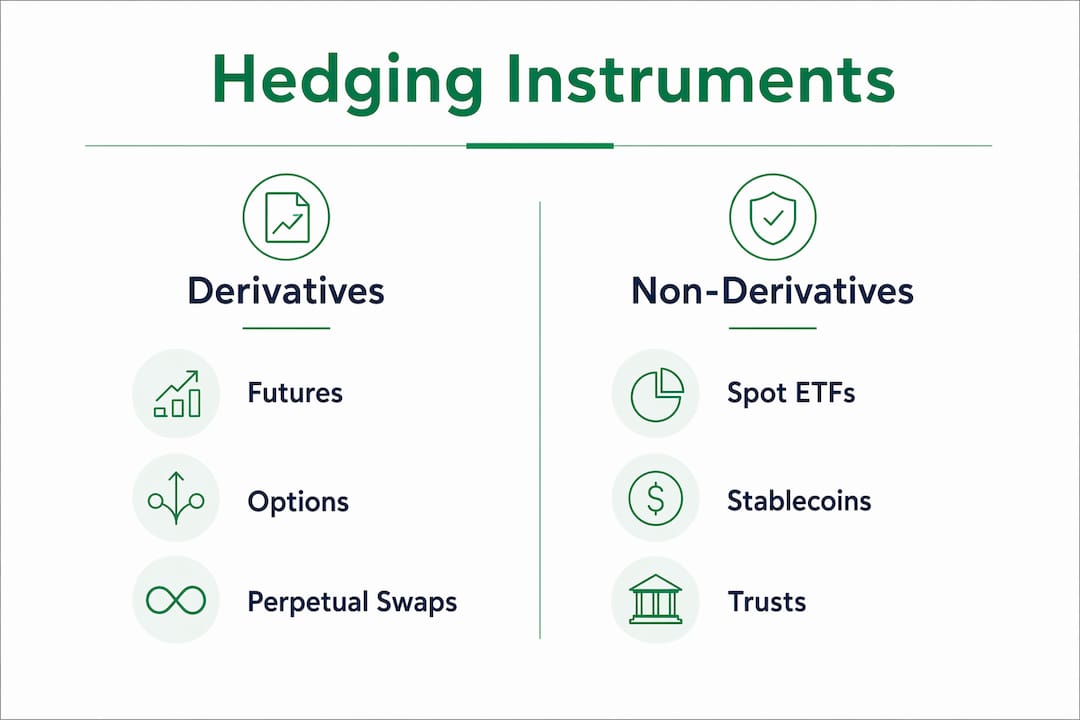
Perpetual swaps are the most liquid crypto derivative, but funding-rate costs can spike during stressed markets and turn a protective hedge into a net drain. They work best as an active, short-duration hedge when you can monitor basis and funding thresholds daily.
Options give asymmetric protection. A protective put caps downside to a known premium while leaving upside open. Standard monthly puts typically cost a moderate premium relative to notional. A collar (buy put, sell call) reduces that premium but surrenders upside beyond the call strike.
Spot ETFs and trusts are the simplest instrument for teams with limited derivatives infrastructure. Hedge accounting documentation is straightforward, but they offer less precision than a direct futures position.
Stablecoin overlays reduce beta quickly without derivatives knowledge, but they introduce issuer, depeg, and smart-contract risk. Verify reserves and redemption mechanics before treating them as a hedge.
Pro Tip: Layer options for asymmetric tail protection on top of a perpetual or futures delta hedge. The futures leg handles continuous exposure management cheaply; the options leg converts catastrophic drawdowns into a known premium spend.
How do U.S. regulations and accounting rules shape hedging design?
Three bodies define the U.S. regulatory perimeter for enterprise digital-asset hedging.
- ISDA provides the master agreement framework and netting documentation for OTC derivatives. Any enterprise trading OTC crypto swaps or options needs an ISDA Master Agreement in place before execution.
- The SEC has jurisdiction over instruments classified as securities. Custody of security-type digital assets triggers broker-dealer and investment adviser obligations, including the SEC’s custody rule considerations.
- The CFTC regulates commodity derivatives, which currently covers Bitcoin and Ether futures and swaps. CME-listed contracts fall squarely here, giving U.S. enterprises a clear regulatory path for those instruments.
For hedge accounting under ASC 815, the program must pass a hedge-effectiveness test both prospectively and retrospectively. ISDA’s analysis confirms that Bitcoin and Ether futures and ETFs meet common effectiveness parameters, with beta and R-squared values consistent with large equity-index hedges. An R² of 0.80 or above and a beta within the 80–125% range are the benchmarks most auditors reference.
Regulatory checklist:
- Confirm instrument classification (security vs. commodity) before selecting a venue.
- Segregate custodial assets per SEC guidance; avoid commingling hedge collateral with operating funds.
- For cross-border trading, verify that the foreign venue is not restricted under CFTC registration requirements.
- Retain all hedge election paperwork, model backtest outputs, and counterparty confirmations for at least three years.
What operational controls and custody practices does enterprise hedging require?
Custody controls:
- Use institutional custodians (qualified custodians under applicable U.S. standards) with multi-signature authorization for all on-chain movements.
- Require proof-of-reserves attestations from exchange counterparties at least quarterly.
- Segregate hedge collateral from operating treasury; never post operating funds as margin.
- Maintain a digital asset collateral management policy that defines eligible collateral, haircuts, and substitution rights.
Trade execution to settlement flow:
- Pre-trade approval: risk officer sign-off against approved instruments list and position limits.
- Execution: trade logged in real time with counterparty confirmation captured.
- Margin monitoring: independent daily verification of margin levels against a 125% collateral buffer minimum.
- Settlement reconciliation: same-day matching of exchange settlement statements to internal ledger.
- Accounting handoff: P&L attribution split between hedge leg and spot position, posted to general ledger within 24 hours.
- Reporting: daily risk report to treasury and risk officer; weekly summary to CFO.
Additional controls:
- Spread positions across at least two exchanges to reduce single-platform failure risk. Exchange outages have caused material losses when firms concentrated all hedge exposure on one venue.
- Define a collateral waterfall: primary margin, then reserve buffer, then emergency liquidity facility.
- Enforce role-based access controls so execution, reconciliation, and reporting functions are handled by separate personnel.
- Incorporate third-party custodial risk into counterparty limits: cap exposure to any single custodian at a defined percentage of total hedge notional, and review that cap at least annually.
For detailed settlement risk examples and mitigation patterns, the DARE blog covers specific operational failure scenarios relevant to U.S. enterprise teams.
How does Hedge Mode work, and what implementation patterns should you use?
Common implementation patterns:
- 30–50% partial hedge: Reduces volatility without fully capping upside. Suitable for treasuries with a long-term hold thesis that still need quarterly risk budgets.
- 100% delta-neutral: Eliminates directional exposure entirely. Used by market makers, miners, or funds needing pure carry or volatility exposure. Requires frequent rebalancing as delta drifts.
- Options collar: Buys a put and sells a call to reduce net premium. Caps both downside and upside. Practical for concentrated holdings or funds with defined risk budgets.
- Stablecoin overlay + periodic options: Core beta reduction via stablecoin conversion, with options layered around macro catalysts. Lower operational complexity than a continuous futures hedge.
Hedge Mode, available on major derivatives platforms, maintains separate margin pools for long and short positions on the same contract. That separation means a short hedge leg cannot be automatically offset against a long core position during a margin call, preserving the intended risk envelope. Hedge Mode functionality is the operational control that makes simultaneous long/short positions auditable and traceable.
A typical implementation flow: execution and margin segregation confirmed on day one, daily monitoring of delta drift and funding costs, threshold-based rebalancing triggered automatically, and a defined unwind procedure with pre-approved counterparties.
Pro Tip: Treat new hedge logic like a software feature flag. Deploy to a small notional position first, run parallel monitoring against the existing hedge for two weeks, then scale. This limits systemic exposure if the new logic has an undetected flaw.
Automation best practices:
- Set automated alerts for margin levels below 130% of requirement.
- Use threshold-based rebalancing rules rather than calendar-based to reduce unnecessary transaction costs.
- Log every automated action with a timestamp and rule reference for audit trail completeness.
How do you measure hedge effectiveness and avoid common pitfalls?
Core metrics to track:
- Delta coverage ratio: Notional hedge size divided by spot exposure. Target range depends on strategy (30–100%).
- Hedge ratio: Adjusted for beta. Professional practice requires tuning hedge size based on beta since ETH can move up to 1.2x relative to BTC; a static 1:1 hedge can leave material residual exposure.
- R-squared: Measures how much of spot price variance the hedge instrument explains. An R² below 0.80 signals material basis risk.
- Realized vs. implied volatility spread: A wide gap often precedes funding-rate spikes or correlation breakdowns.
Common pitfalls:
- Basis divergence under stress: Futures and spot prices can decouple during market dislocations, leaving the hedge partially ineffective precisely when it matters most.
- Funding-rate shocks: Perpetual funding rates have historically spiked during stress events, turning a net-zero hedge into a cash drain.
- Excessive leverage: Keep hedge leverage at 1x–2x and maintain a ~125% margin buffer. Higher leverage risks liquidation during a rapid rally, which eliminates the hedge at the worst moment.
- Slippage on large unwinds: Size positions so that a full unwind can execute within normal market depth without moving the price materially.
For a practical example of monitoring digital asset market risk with dashboards and alert thresholds, the DARE blog provides enterprise-specific tooling guidance.
How long does it take and what does enterprise hedging cost?
Implementation timeline:
- Pilot phase (4–8 weeks): Select instruments, establish custodial accounts, draft hedge policy, run backtests on historical data, execute small notional test trades.
- Scale and policy integration (3–6 months): Expand notional, integrate with general ledger and risk systems, complete hedge accounting documentation, train treasury and ops teams.
- Audit certification readiness (6–12 months): Full governance documentation in place, first external audit of hedge effectiveness, counterparty confirmations filed, certification or attestation obtained.
Cost drivers:
- Collateral requirements: typically 10–20% of notional for futures, higher for options.
- Exchange fees and funding costs: perpetual funding rates are the largest variable cost.
- Third-party custody and clearing fees: institutional custodians charge basis points on assets under custody.
- Staff and engineering time: a minimum viable program needs treasury, risk quant, legal/compliance, ops, and infosec involvement.
- Backtesting and modeling tools: regression analysis, scenario modeling, and reporting infrastructure.
Required roles: CRO or Head of Risk (program ownership), Treasurer (execution authority), Risk Quant (model development and effectiveness testing), Legal/Compliance (regulatory mapping and documentation), Operations (settlement and reconciliation), Infosec (custody and access controls), External Audit Support (effectiveness attestation).
What does a governance and policy checklist look like for enterprise hedging?
Audit-ready checklist:
- Documented hedging policy approved by the board or risk committee, reviewed annually.
- Approved instruments list with permitted venues, maximum notional per instrument, and prohibited structures.
- Hedge approval matrix: who can authorize trades at each size tier (e.g., up to $1M: Treasurer; above $1M: CRO + CFO).
- Backtest artifacts and regression outputs retained for each designated hedge relationship.
- Standardized reporting templates for daily risk, weekly summary, and quarterly board reporting.
- Escalation procedure for margin calls, counterparty default, or exchange outage.
Role ownership table:
| Role | Control Owned | Approval Authority |
|---|---|---|
| CRO | Program policy, limits, escalation | Final approval on new instruments |
| Treasurer | Execution, margin management | Trades within approved limits |
| Head of Operations | Settlement, reconciliation, access controls | Operational procedure sign-off |
| Compliance Officer | Regulatory mapping, audit documentation | Counterparty and venue approval |
| Risk Quant | Model development, effectiveness testing | Backtest and model sign-off |
Sample policy clause outlines (illustrative, not legal language):
- Permitted instruments: Exchange-traded futures and options on CME; OTC instruments only under a signed ISDA Master Agreement with an approved counterparty.
- Margin threshold: Minimum 125% collateral coverage at all times; automated alert at 130%.
- Counterparty requirements: Institutional custodian with proof-of-reserves attestation; maximum 40% of hedge notional with any single counterparty.
For sample exposure limit structures and operational risk policy templates, the DARE blog provides finance-team-specific examples.
How does DARE certification support hedging governance readiness?
A governance policy is only as strong as the team’s ability to execute it consistently and demonstrate that competence to auditors. That is where structured certification fills a gap most enterprises discover late.
What DARE provides:
- Modular learning covering custody, regulatory compliance, risk management, legal frameworks, and operational controls.
- Formal assessments that test applied knowledge, not just familiarity with concepts.
- Verifiable, blockchain-backed credentials that auditors and counterparties can independently confirm.
- Annual renewal to keep credentials current as regulations evolve.
Where certification reduces friction:
- Pre-audit evidence: verifiable credentials demonstrate that key personnel completed structured training on the controls being audited.
- Board reporting: certified team members provide boards with documented assurance that governance competence exists.
- Counterparty reassurance: institutional counterparties increasingly ask about governance maturity before extending credit or custody relationships.
- Vendor due diligence: demonstrates to custodians and clearing firms that the enterprise meets a defined governance standard.
Key Takeaways
Enterprise digital-asset hedging requires instrument selection, governance documentation, and audit-ready controls working together before the first trade executes.
| Point | Details |
|---|---|
| Choose instruments by accounting fit | CME futures and spot ETFs offer the clearest path to hedge accounting under U.S. GAAP; perpetuals carry funding-rate risk. |
| Keep leverage at 1x–2x | Hedge positions at 1x–2x leverage with a ~125% margin buffer to prevent liquidation during rapid rallies. |
| Implement Hedge Mode | Separate margin pools for hedge and core positions preserve the intended risk envelope and produce clean audit trails. |
| Run regression-based effectiveness tests | Target R² ≥ 0.80 and beta within 80–125% range; document results at hedge inception and at each reporting date. |
| Certify your team with DARE | DARE’s verifiable credentials give auditors and counterparties independently confirmable evidence of governance competence. |
Why governance beats ad hoc hedging every time
The firms that struggle most with digital-asset hedging are not the ones that picked the wrong instrument. They are the ones that picked the right instrument and then ran it without a policy, without segregated margin, and without anyone who could explain the hedge to an auditor six months later.
A structured governance program forces the decisions that ad hoc hedging defers: which instruments are permitted, who approves what, how effectiveness gets tested, and what happens when a margin call arrives at an inconvenient moment. Those decisions made in advance are what separate a hedge that survives market stress from one that collapses precisely when it was needed.
Certification matters here because governance programs erode without accountability. When key personnel turn over or market conditions change, an uncertified team tends to drift from the policy. Annual renewal in a program like DARE creates the forcing function that keeps the governance current and the credentials verifiable.
DARE gives your team audit-ready hedging governance credentials
Most enterprise teams have the hedging mechanics roughly right. What they lack is the documented, verifiable governance layer that auditors, boards, and institutional counterparties now expect. DARE addresses exactly that gap.
The DARE certification program covers custody, regulatory compliance, risk management, legal frameworks, and operational controls through modular learning and formal assessments. Credentials are blockchain-verified, independently confirmable, and renewed annually to stay current with evolving U.S. regulatory standards. For treasury, risk, and compliance professionals who need to demonstrate governance readiness, not just claim it, DARE provides the structured path from policy to credential.
Start your readiness assessment at dare.wush.co and find out where your program stands before your next audit does.
Useful sources and primary references
| Source | What it covers | Relevance to this article |
|---|---|---|
| ISDA Crypto-asset Risks and Hedging Analysis | Quantitative hedge-effectiveness analysis for BTC/ETH futures and ETFs | Hedge accounting tests, beta and R² benchmarks |
| CME Group Bitcoin and Ether Futures | Exchange-traded, cash-settled crypto futures under CFTC oversight | Instrument selection, U.S. regulatory compliance |
| SEC Digital Assets Guidance | Custody rules, security classification, reporting obligations | Regulatory design considerations for U.S. enterprises |
| CFTC Digital Assets | Commodity classification, swap dealer registration, margin rules | Jurisdiction mapping for futures and swaps |
| Kraken: What is Hedging? | Mechanics of futures, options, and perpetual swaps for hedging | Instrument mechanics and funding-rate explanation |
| DARE Blog: Institutional Digital Asset Adoption | Institutional adoption trends and enterprise readiness context | Adoption framing and governance urgency |
| DARE Blog: Risk Frameworks in Digital Finance | Enterprise risk framework integration for digital assets | ERM integration and governance structure |