
Digital Asset Governance Gap Assessment: 2026 Guide

Running digital assets through governance frameworks built for traditional finance is like navigating with an outdated map. The territory has changed, and the gaps are real. A proper digital asset governance gap assessment gives finance and compliance professionals a structured method to find where controls are missing, where oversight is weak, and where regulatory exposure is growing. This guide covers prerequisites, assessment steps, gap prioritization, and remediation strategies, all calibrated for the regulatory environment taking shape in 2026. Ethics, board roles, and operational resilience are woven throughout.
Table of Contents
Key takeaways
| Point | Details |
|---|---|
| Governance gaps are measurable | A structured assessment maps missing controls, oversight failures, and compliance exposures before they become incidents. |
| Ethics must come first | Embedding safety, transparency, and fairness into governance from the start produces frameworks that survive regulatory scrutiny. |
| Boards need specialized oversight | Ad-hoc board engagement is insufficient; dedicated technology or digital asset committees drive better governance outcomes. |
| Third-party risks are often invisible | Custodians and technology partners create indirect exposures that standard compliance reviews frequently miss. |
| Certification accelerates maturity | Structured credentialing programs give teams a repeatable framework for assessing and improving governance maturity over time. |
Prerequisites for a solid gap assessment
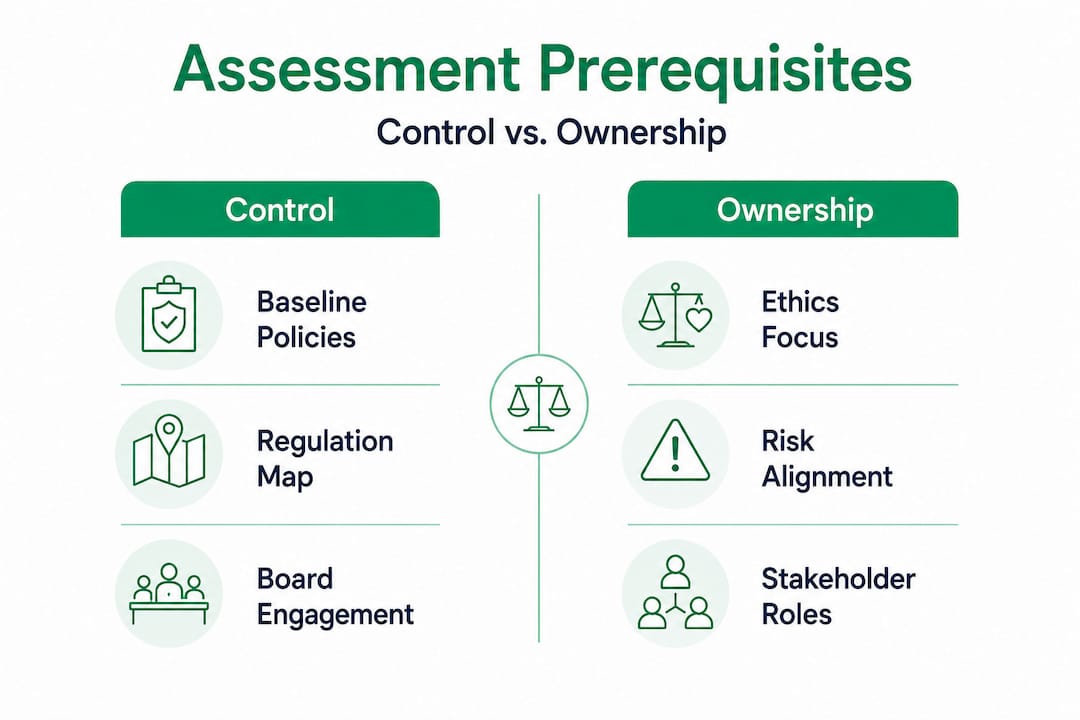
Before you run a single interview or review a single policy document, you need a clear picture of what digital asset governance maturity actually means for your organization. Maturity is not a binary state. It spans five core dimensions: documented policies and procedures, operational controls, organizational culture, technology infrastructure, and regulatory alignment. Weakness in any one of them creates leverage points for operational failure or regulatory action.
The role of ethics in digital asset governance is not a soft consideration. Experts argue that ethics — specifically safety, transparency, and fairness — should guide how policies are written before technical rules are layered on top. Without that ethical foundation, governance frameworks tend to be reactive and brittle. They patch specific incidents rather than building durable principles.
Board engagement is a genuine prerequisite, not a nice-to-have. Dedicated technology committees integrating risk management and digital asset strategy are becoming the standard for institutions serious about oversight. If your board has no structured mechanism for digital asset oversight, that gap belongs at the top of your assessment findings before you have even started the formal process.
You also need a current map of applicable digital asset regulatory frameworks for 2026. Regulations are shifting across MiCA implementation in Europe, evolving SEC and CFTC guidance in the United States, and new custody rules in multiple jurisdictions. Your assessment team should include people who can read and interpret those frameworks, not just the ones who can audit controls.
| Prerequisite | Why it matters | Who owns it |
|---|---|---|
| Governance maturity baseline | Sets the starting point for gap analysis | Compliance lead |
| Ethical framework documentation | Grounds policies in durable principles | Legal and risk |
| Board oversight structure | Confirms accountability at the top | Board secretary or GC |
| Regulatory framework mapping | Identifies applicable rules for 2026 | Regulatory affairs |
| Technology and custody audit readiness | Flags infrastructure controls before fieldwork | InfoSec and operations |
Pro Tip: Before starting fieldwork, run a half-day pre-assessment workshop with your compliance, legal, and technology leads. Surface assumptions about what governance already exists. You will consistently find that different teams have different versions of the same policy.
Assessing your current governance state
This is where most organizations either get serious or discover how much they did not know. The goal of this phase is an honest, evidence-backed picture of governance as it actually operates, not as it is written in policy documents.
A step-by-step approach keeps the process manageable and audit-ready:
-
Review internal governance structures (Week 1). Map reporting lines, decision authorities, and escalation paths specifically for digital asset activities. 40% of European financial institutions cite internal governance as a major constraint on digital asset adoption, and 47% cite operating model readiness. If your operating model has not been adapted, that is a confirmed gap.
-
Assess risk management framework applicability (Week 1-2). Most enterprise risk frameworks were designed for traditional financial instruments. Test each component against digital asset-specific risks: key management, transaction finality, smart contract failure, and on-chain regulatory compliance. Document what does not translate.
-
Review compliance monitoring and reporting (Week 2). Check whether your compliance function has sight lines into digital asset transactions. Operational risks span transaction errors, system outages, social engineering, and regulatory changes. If your monitoring program does not cover all four, document the blind spots.
-
Measure board competence and engagement (Week 2-3). Interview board members or audit committee chairs directly. Ask specific questions about custody arrangements, key management protocols, and how they receive digital asset risk reporting. 86% of board respondents report increased oversight activity, but increased activity is not the same as informed oversight.
-
Audit technology infrastructure and cybersecurity controls (Week 3). Cover wallet architecture, key management systems, access controls, and incident response procedures for digital asset-specific scenarios. Financial audits alone are insufficient for digital asset oversight; specialized controls go well beyond financial reporting.
-
Run scenario planning and stress tests (Week 3-4). Governance frameworks must incorporate human judgment for unanticipated scenarios that smart contracts cannot handle, including lost keys, emergency pauses, and counterparty defaults. Simulating these scenarios during assessment reveals whether your governance is theoretical or operational.
-
Collect and catalog documented evidence (Week 4). Gather policies, committee minutes, audit reports, training records, and technology diagrams. Gaps in documentation are themselves governance findings.
Pro Tip: Use a parallel-track approach when assessing ethics. Alongside each control review, ask: does this control reflect a commitment to transparency and fairness, or does it only satisfy a regulatory checkbox? The difference will show up in how your team interprets edge cases.
For a deeper look at how market risk integrates with governance, the risk monitoring practices outlined by Wush’s DARE team offer a useful reference frame for structuring your oversight intervals.

Identifying and prioritizing governance gaps
Assessment findings are only useful when they are sorted by severity and business impact. Not every gap carries the same risk weight, and treating them equally is how remediation budgets get misallocated.
Common gap types fall into four categories:
-
Ethical gaps: Policies that lack transparency principles, discriminatory algorithm use in compliance screening, or absence of fairness criteria in decision-making. 28% of organizations identify data privacy and 24% identify algorithmic bias as primary governance concerns, and both qualify as ethical gaps when left unaddressed.
-
Operational gaps: Missing or untested controls for transaction errors, system failures, and custody incidents. These often produce the fastest regulatory consequences when something goes wrong.
-
Oversight gaps: Board or committee structures that lack digital asset expertise, receive inadequate reporting, or have no defined escalation protocol for digital asset-specific incidents.
-
Regulatory gaps: Controls or policies that do not yet reflect 2026 regulatory developments, including MiCA obligations, updated AML guidance, or evolving custody rules.
Third-party risks deserve their own category. Governance gaps frequently arise from the opaque practices of custodians and technology partners, creating systemic contagion risks that standard compliance reviews miss entirely. Review your service-level agreements, audit rights, and incident notification protocols for every third-party relationship touching your digital asset operations.
| Gap severity | Risk implication | Recommended response timeline |
|---|---|---|
| Critical | Immediate regulatory or financial exposure | 30 days |
| High | Material control failure or oversight breakdown | 60 to 90 days |
| Medium | Partial coverage with manageable residual risk | 90 to 180 days |
| Low | Documentation or process maturity improvements | 180 days or next cycle |
When prioritizing, weight gaps by probability of occurrence and magnitude of impact. A missing escalation protocol for a smart contract failure might seem procedural until the failure actually happens. Use key risk indicators specific to digital assets, including transaction error rates, failed reconciliations, and third-party audit delinquencies, to add objectivity to the prioritization process.
Closing governance gaps
Knowing where the gaps are is only half the work. The harder part is building a remediation program that holds up over time, not just until the next internal audit.
The most durable improvements come from structural changes rather than policy edits:
-
Stand up a dedicated digital asset governance committee with clear authority over custody decisions, risk thresholds, and regulatory response. Committee-driven governance engagement consistently outperforms ad-hoc oversight models.
-
Embed ethical principles directly into control design. If a control does not have an explicit connection to transparency, fairness, or safety, rewrite it until it does. Embedding ethics upfront creates frameworks that endure regulatory scrutiny and build stakeholder trust.
-
Build a continuous board education program covering digital asset technology, regulatory developments, and incident case studies. The DARE blog’s guidance on enterprise crypto risk oversight offers a practical template for structuring board-level learning.
-
Adapt compliance frameworks proactively to digital asset regulatory frameworks for 2026, rather than waiting for enforcement actions to force the update.
-
Use technology for control monitoring and reporting automation. Manual reconciliation processes are a gap waiting to happen in high-volume digital asset environments.
Pro Tip: Do not treat governance maturity improvement as a project with a defined end date. Schedule a formal reassessment at every major regulatory change and at least annually. The organizations that treat governance as a continuous program consistently outperform those that treat it as a one-time remediation exercise.
Finance professionals looking to understand how governance connects to broader ESG obligations will find the perspective in sustainable finance frameworks useful for situating digital asset governance within enterprise-wide accountability structures.
Verifying improvements and maintaining resilience
Closing gaps on paper is not the same as closing them in practice. The verification phase confirms that controls are operating as designed and that governance maturity is actually improving.
| Verification activity | Frequency | Owner |
|---|---|---|
| KRI tracking and reporting | Monthly | Risk management |
| Internal control testing | Quarterly | Internal audit |
| Third-party review | Semi-annually | Compliance |
| Governance framework reassessment | Annually or post-regulation change | Compliance and board |
| Stress testing and scenario simulation | Annually | Risk and operations |
| Board governance effectiveness review | Annually | Audit committee |
Future-back scenario planning is particularly important for stress testing. Simulate market crises, infrastructure failures, and regulatory enforcement actions against your governance framework. The scenarios that feel unlikely are usually the ones that expose real weaknesses.
Continuous control monitoring, reconciliation, and independent audit aligned with COSO and the three lines of defense model provide the structural backbone for ongoing verification. If your digital asset governance program does not already map to those frameworks, that alignment belongs on your remediation list.
Board reporting is the final check. If your board cannot read a governance effectiveness report and understand where the organization stands, the reporting is not doing its job. Make the connection between KRI trends, regulatory developments, and governance maturity explicit in every board update.
My take on the governance challenge
What I have seen repeatedly is that organizations underestimate how much human judgment digital asset governance actually requires. Technology is not the answer. Smart contracts, automated controls, and monitoring dashboards all help, but they cannot substitute for trained people making considered decisions in ambiguous situations.
The firms that handle governance well have boards that genuinely understand what they are overseeing. They have compliance teams that read the underlying regulatory texts, not just the summaries. And they have built ethics into their frameworks as a genuine operating principle, not a box to check for regulators.
My honest view is that most organizations are two or three governance events away from a serious problem. The digital asset governance gap explained in this article is not hypothetical. It is the distance between where governance currently sits and where it needs to be to survive what is coming in 2026 and beyond. Closing that distance requires sustained commitment from boards, management, and compliance teams working from the same framework.
— Gregg
How DARE can support your governance assessment
Wush built the Digital Asset Readiness Evaluation (DARE) specifically to address what this article describes: the gap between governance as documented and governance as practiced. The DARE certification program gives finance and compliance professionals a structured, modular framework for assessing digital asset governance maturity across custody, risk management, regulatory compliance, and operational controls. Ethics and board oversight are built into the evaluation criteria, not added as afterthoughts.
For organizations ready to formalize their governance posture, DARE provides industry-recognized credentials backed by blockchain technology, along with annual renewal to keep alignment with evolving regulatory frameworks. Review the available plans and pricing to find the right fit for your team or explore how DARE’s readiness edge translates into competitive and compliance advantages.
FAQ
What is a digital asset governance gap assessment?
A digital asset governance gap assessment is a structured evaluation that identifies where an organization’s policies, controls, board oversight, and regulatory alignment fall short of what digital asset operations require. It produces a prioritized list of weaknesses and a remediation roadmap.
Why do boards need a digital asset governance framework?
Boards are accountable for organizational risk, and digital assets introduce custody, regulatory, and operational risks that standard financial oversight does not cover. Specialized board oversight through dedicated committees is increasingly recognized as a governance requirement, not an option.
What is digital asset governance maturity?
Digital asset governance maturity describes how systematically and effectively an organization manages its digital asset policies, controls, oversight structures, and regulatory compliance. Mature organizations have documented frameworks, active board engagement, continuous monitoring, and regular reassessment cycles.
How does ethics factor into digital asset governance?
Ethics provides the foundational principles, safety, transparency, and fairness, that governance policies and controls should express. Without an ethical framework, governance becomes reactive and rule-bound rather than principled and adaptive.
How often should a governance gap assessment be repeated?
At minimum, a full reassessment should occur annually and after every material regulatory change. High-risk organizations with significant digital asset exposure may benefit from semi-annual reviews aligned with third-party audits and board effectiveness evaluations.