
Digital Asset Custody Solutions Comparison 2026

For U.S. regulated enterprises, the governance-first answer to the 2026 digital asset custody solutions comparison is DARE (Digital Asset Readiness Evaluation). It maps directly to OCC, FDIC, and SEC A‑C‑T expectations, issues blockchain-backed verifiable credentials, and delivers board-level reporting materials that hold up under examiner scrutiny. If your organization needs only a narrow SOC 2 Type II attestation for a single IT system, a lighter framework mapping may suffice. But if you are building custody governance that satisfies federal banking regulators and positions the institution for banking access, counterparty trust, and M&A readiness, DARE is the structured path.
Table of Contents
- How do the leading custody certification frameworks compare in 2026?
- How do you choose the right custody certification for your institution?
- How does each framework map to U.S. regulator expectations?
- What does a realistic implementation timeline and cost model look like?
- What will assessors and auditors actually request?
- Why is governance-first certification a competitive advantage, not just a compliance cost?
- What is the final recommendation, and when should you choose a different path?
- Key Takeaways
- The governance gap is the real risk in 2026
- DARE gives your institution the governance layer custody requires
- Useful sources and further reading
How do the leading custody certification frameworks compare in 2026?
| Dimension | DARE | NIST CSF | ISO 27001 | SOC 2 (AICPA) | CSA CCM |
|---|---|---|---|---|---|
| Custody control coverage | Custody-specific: key management, MPC/HSM, segregation, reserve reconciliation | General IT risk; no custody-specific controls | General information security; no custody modules | Trust-service criteria; no key-management specifics | Cloud security controls; limited custody mapping |
| Regulatory alignment | OCC/Fed/FDIC safekeeping guidance; SEC A‑C‑T; GENIUS Act; DFAL | Referenced by FFIEC but not custody-specific | Accepted globally; limited U.S. regulator mapping | AICPA standard; examiners accept as baseline evidence | Cloud-focused; limited U.S. banking regulator mapping |
| Assessment type | Certification + verifiable credential | Framework mapping (self or third-party) | Third-party certification | Third-party attestation (Type I or Type II) | Self-assessment or third-party mapping |
| Time to implement | — | 4–12 weeks (mapping only) | — | 3 months (Type II) | 4 weeks (mapping only) |
| Monitoring and renewal | Annual renewal + continuous monitoring modules | No mandated renewal cadence | Annual surveillance audit | Annual re-attestation | No mandated renewal |
| Third-party attestation | Independent certification + blockchain credential | No independent attestation | Accredited certification body | Licensed CPA firm | No independent attestation |
| Pricing model | Annual subscription; enterprise group licensing | Free framework; consulting costs vary | Certification body fees + consulting | CPA firm fees; typically $30,000–$100,000+ | Free framework; consulting costs vary |
| Enterprise support | Board reporting templates, evidence bundles, modular training, implementation roadmap | Community resources; no enterprise tooling | Consultant-dependent | Auditor-dependent | Community resources |
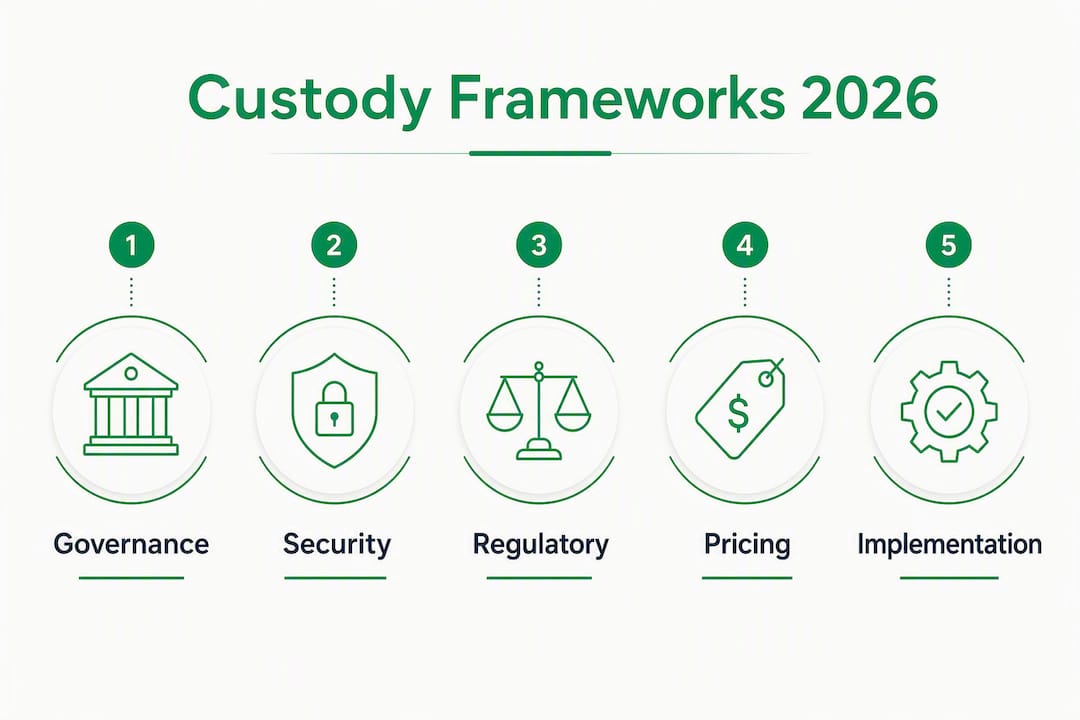
What “regulatory alignment” means to an examiner: A framework that maps to OCC/FDIC joint safekeeping guidance gives examiners a recognized control vocabulary. DARE’s published mappings let your compliance team point to specific control requirements during an examination rather than reconstructing the argument from scratch.
On pricing: SOC 2 Type II CPA fees vary widely by scope and auditor. DARE’s subscription model bundles learning, assessment, credential issuance, and renewal into a single annual cost. NIST CSF and CSA CCM are free frameworks but carry significant consulting and internal labor costs to operationalize.
How do you choose the right custody certification for your institution?
Start with a weighted scoring rubric before you issue an RFP. Suggested weights for a U.S. regulated institution:
- Regulatory alignment: 30% — Does the framework publish explicit mappings to OCC/FDIC safekeeping guidance and SEC expectations?
- Technical controls coverage: 25% — Does it address cryptographic key management, HSM/MPC architecture, and segregation requirements specifically?
- Auditability and evidence: 20% — Can the certification produce artifacts an examiner or auditor can independently verify?
- Implementation services: 15% — Are board reporting templates, gap-analysis tools, and training included, or do you need to source them separately?
- Cost: 10% — Total cost of ownership, not just licensing. Governance costs for self-custody — specialized staffing, audits, insurance, and continuous testing — often exceed third-party custodian fees when counted honestly.
Procurement questions to ask during an RFP or intro call:
- What is the typical onboarding timeline for an organization of our size and custody scope?
- Can you provide a sample assessment report and a sample board-ready deliverable?
- What is the renewal cadence, and does it include continuous monitoring between annual cycles?
- How does your framework map specifically to OCC/FDIC joint safekeeping guidance and the SEC A‑C‑T agenda?
- What incident-response support is included post-certification?
Red flags to watch for: no published mapping to OCC or FDIC guidance; marketing-only cold-storage claims with no independent attestation; absence of board-level reporting materials; no documented renewal or continuous monitoring commitment; and any vendor that cannot produce a sample evidence bundle on request.
Pro Tip: Run a custody gap analysis before scoring vendors. Knowing your current control gaps lets you weight the rubric toward the dimensions where your institution is most exposed.
How does each framework map to U.S. regulator expectations?
The OCC, Fed, and FDIC joint guidance on crypto-asset safekeeping centers on three pillars: cryptographic key management, asset analysis before safekeeping, and board/executive oversight. Outsourcing custody without documented internal vetting does not satisfy safety-and-soundness expectations under that guidance.

| Regulator/Agenda | Core Requirement | Which Frameworks Address It |
|---|---|---|
| OCC/Fed/FDIC safekeeping guidance | Key control, asset due diligence, board oversight | DARE (explicit mapping); SOC 2 (partial, baseline); NIST CSF (general) |
| SEC A‑C‑T agenda | Advance, Clarify, Transform — governance plumbing now, not after final rules | DARE; ISO 27001 (partial) |
| GENIUS Act (stablecoin issuers) | 1:1 reserve backing, short-duration assets, monthly examined disclosures | DARE reserve modules; no direct mapping in NIST/ISO/SOC 2 |
| DFAL (California, effective July 1, 2026) | Custody-specific licensing; detailed rules still in DFPI rulemaking | DARE; legal counsel required for rule-specific filings |
The SEC’s A‑C‑T agenda creates a specific pressure: agencies are clarifying taxonomies and custody expectations while rulemaking proceeds, which means firms that wait for final rules will be building governance under examination pressure. The high-value work right now is structural: reserve-composition gap analysis, custody segregation architecture, and governance reporting plumbing.
For stablecoin issuers, the GENIUS Act mandates 1:1 backing by a tightly enumerated set of reserve assets (U.S. currency, Fed balances, Treasury securities with maturities of 93 days or less) and monthly examined disclosures. Implementing rules were still in proposal stages through mid-2026, so preparatory structural work carries the most value now.
Board-level oversight is not optional under federal guidance. Examiners will expect a board package that documents custody risk appetite, key-management controls, and escalation procedures. DARE’s board reporting templates are built to satisfy exactly that expectation.
What does a realistic implementation timeline and cost model look like?
| Phase | Mid-Size Enterprise | Large Enterprise |
|---|---|---|
| Gap analysis and scoping | Weeks 1–2 | Weeks 1–4 |
| Policy design and controls mapping | Weeks 3–5 | Weeks 5–10 |
| Controls build and evidence collection | Weeks 6–10 | Weeks 11–18 |
| Assessment and audit readiness | Weeks 11–13 | Weeks 19–22 |
| Credential issuance and board reporting | Weeks 14–16 | Weeks 23–24 |
Representative first-year cost categories (ranges reflect scope and existing control maturity):
- Legal and regulatory counsel: Varies by complexity; DFAL and GENIUS Act filings require specialized counsel
- Technology (KMS, HSM, MPC infrastructure): Significant for self-custody builds; reduced when using a qualified custodian
- Certification and audit fees: DARE annual subscription; SOC 2 Type II CPA fees if layered
- Insurance: Cyber and crime coverage for custody operations
- Staffing and training: Internal security, treasury, and compliance personnel time
Milestone checklist for project planning: executive sponsor secured; gap analysis complete; policy framework approved; evidence collection assigned to owners; assessor engaged; board briefing scheduled; credential issuance date confirmed.
What will assessors and auditors actually request?
Examiners and third-party assessors converge on a consistent artifact list for custody governance reviews. Prepare these before your assessment begins:
- Cryptographic key management policy and SOPs
- HSM and/or MPC architecture diagrams with access-control documentation
- Asset segregation evidence (wallet architecture, on-chain proof-of-reserves reports)
- Reconciliation logs (daily or real-time, depending on transaction volume)
- Penetration test reports (within the prior 12 months)
- Incident response plan and tabletop exercise records
- SOC 2 Type II report or ISO 27001 certificate (if applicable as baseline evidence)
- Board and executive oversight documentation (risk appetite statement, custody risk register, escalation procedures)
SOC 2 Type II is widely accepted as a baseline for demonstrating security controls, but examiners increasingly expect custody-specific mappings on top of it, not instead of it. The distinction between a framework mapping, a third-party attestation, and a formal certification matters: a mapping shows you have reviewed the framework; an attestation (SOC 2) shows a CPA firm tested controls at a point in time; a certification (DARE) shows a structured, renewable governance program with verifiable credentials.
Pro Tip: Bundle your evidence artifacts into a single, version-controlled repository before the assessment. Assessors who can pull a complete evidence package in one request tend to complete reviews faster and with fewer findings. Pair this with digital asset risk monitoring controls to demonstrate continuous oversight between annual cycles.
Why is governance-first certification a competitive advantage, not just a compliance cost?
Analysts at Astraea Counsel advise reframing qualified custody requirements as competitive advantages rather than regulatory costs. The business case is concrete:
- Banking and correspondent access: SAB 122 (January 2025) rescinded the on-balance-sheet liability that had kept regulated banks out of custody, reopening the market. Institutions with documented governance are better positioned to access banking relationships in this reopened environment.
- Insurance negotiation leverage: Documented controls and a verifiable certification give underwriters the evidence they need to price cyber and crime coverage accurately, often reducing premiums.
- M&A and due-diligence readiness: Acquirers and counterparties now run custody governance reviews as part of standard due diligence. A certification shortens that cycle.
- Counterparty trust: Institutional clients increasingly require evidence of custody governance before onboarding. A verifiable credential answers that request without a custom audit.
- Operational continuity: Governance plumbing built before an incident is far cheaper than governance built in response to one.
The treasury role in digital asset custody has expanded to include reserve management, segregation oversight, and board reporting. Certification that covers those responsibilities directly reduces the gap between what treasury does and what examiners expect to see documented.
What is the final recommendation, and when should you choose a different path?
DARE is the recommended pick for U.S. regulated enterprises that need custody-specific governance, regulator-mapped controls, and board-ready deliverables. The core reasons: it maps explicitly to OCC/FDIC/SEC expectations, issues blockchain-backed verifiable credentials that hold up in examiner and counterparty reviews, and includes the board reporting materials that federal guidance now expects.
When a lighter approach is acceptable:
- Small organizations with limited or pilot-stage custody exposure and no federal banking regulator oversight may find a NIST CSF mapping sufficient as a starting point.
- Organizations that already hold a SOC 2 Type II and need only to demonstrate baseline IT security controls for a non-custody product line do not need a full custody certification.
Hybrid pairings that work well:
- DARE + SOC 2 Type II: DARE covers custody-specific governance and board reporting; SOC 2 covers the broader IT control environment for operational teams. This combination satisfies both examiner and enterprise security audiences.
- DARE + ISO 27001: For enterprises with global operations or international counterparties, ISO 27001 provides the international information security baseline while DARE covers U.S. custody-specific requirements.
For treasury, legal, and security teams working in parallel, the practical split is straightforward: treasury owns reserve and segregation controls; legal owns regulatory mapping and filing obligations; security owns key management, HSM/MPC architecture, and penetration testing. DARE’s modular structure supports all three workstreams without requiring a single team to own the entire program.
Key Takeaways
DARE is the governance-first custody certification for U.S. regulated enterprises in 2026, combining OCC/FDIC/SEC-mapped controls, verifiable credentials, and board-level reporting into a single annual program.
| Point | Details |
|---|---|
| Start with a gap analysis | Map your current custody controls against OCC/FDIC safekeeping guidance before scoring any certification vendor. |
| Weight regulatory alignment highest | Assign 30% of your scoring rubric to explicit regulator mapping; frameworks without published OCC/FDIC mappings fail this test. |
| Layer certifications strategically | DARE plus SOC 2 Type II covers both custody-specific governance and the broader IT control environment examiners expect. |
| Build governance now, not after final rules | SEC A‑C‑T and GENIUS Act rulemaking is still active; structural work done today survives rule changes. |
| Wush DARE | The recommended certification for U.S. enterprises: custody-specific controls, blockchain-backed credentials, and board reporting templates in one annual program. |
The governance gap is the real risk in 2026
The conversation about custody governance in 2026 keeps circling the wrong question. Most institutions ask which custodian to use. The harder question is whether the institution itself can demonstrate, to an examiner, a counterparty, or an acquirer, that it understands and governs what its custodian is doing on its behalf.
Federal guidance is unambiguous on this: outsourcing custody without documented internal oversight does not satisfy safety-and-soundness expectations. That means the governance program lives inside your institution regardless of who holds the keys. A certification that produces board-ready artifacts and verifiable credentials is not a nice addition to a custody program. It is the evidence layer that makes the custody program defensible.
The timing argument for 2026 is also straightforward. Rulemaking under the GENIUS Act and DFAL is still active, which means the specific filing requirements will shift. But the structural work — reserve gap analysis, segregation architecture, board reporting, key-management SOPs — is rule-independent. Institutions that build that plumbing now will adapt to final rules faster and cheaper than those that wait.
DARE gives your institution the governance layer custody requires
Custody governance built to satisfy examiners, counterparties, and boards requires more than a framework checklist. Wush’s DARE certification delivers modular learning mapped to OCC/FDIC/SEC expectations, structured assessments, blockchain-backed verifiable credentials, and board reporting templates that hold up under scrutiny — all in a single annual subscription with a renewal commitment that keeps your governance current as rules evolve.
For treasury, legal, risk, and security teams that need to move from gap analysis to certified governance, DARE provides the implementation roadmap, evidence bundles, and credential issuance to get there. Start your readiness evaluation and see exactly where your custody governance stands today.
Useful sources and further reading
The sources below are organized by reader role. Start with the one closest to your current priority.
For legal and compliance teams:
- OCC Proposed Rule: Permitted Payment Stablecoin Issuer AML/CFT and Sanctions Compliance — OCC/FinCEN/FDIC joint NPRM implementing GENIUS Act BSA requirements for stablecoin issuers
- Federal Register Vol. 91 No. 118 (June 22, 2026) — GENIUS Act NPRM; read alongside the OCC proposed rule above
- Federal Register Vol. 91 No. 55 (March 23, 2026) — SEC/CFTC joint guidance on crypto-asset taxonomy and custody interpretation
- Holland & Knight: Crypto’s Moment in Washington (2026) — Practitioner analysis of SEC A‑C‑T agenda and banking regulator posture
For treasury and finance teams:
- Astraea Counsel: Crypto Treasury Management in 2026 — Custody architecture, SAB 122 accounting treatment, and hybrid custody models
- Astraea Counsel: GENIUS Act Stablecoin Compliance Roadmap — Reserve-composition requirements and preparatory structural work for stablecoin issuers
- Conference Board: Outlook for Digital Assets in 2026 — Policy context and SAB 122 implications for institutional adoption
For security and risk teams:
- Astraea Counsel: Qualified Crypto Custodians — Regulatory Requirements and Selection Guide — SOC 2 Type II expectations, total cost of governance, and qualified custodian selection criteria
- DARE Blog: Digital Asset AML Compliance Checklist for 2026 — BSA/AML controls that intersect with custody operations and examiner expectations
- DARE Blog: Digital Asset Fiduciary Responsibility — A 2026 Guide — Federal and international regulatory obligations for custody providers and finance teams