
Digital Asset Cross-Border Legal Considerations: US Guide

Every cross-border digital-asset flow your team manages carries simultaneous exposure to US AML/sanctions rules, overlapping federal regulator jurisdiction, and unresolved private-international-law questions that no single statute has fully answered. The practical response is three immediate actions: map which federal and state regulators claim authority over each activity, confirm that every counterparty is reachable for Travel Rule compliance, and lock custody arrangements and choice-of-law terms in writing before the first transfer clears.
“Regulators and experts advise treating digital-asset transfers as cross-border for AML/CFT purposes because domestic exemptions are increasingly untenable in a connected global financial system.” — EU AML/CFT framework analysis
The three immediate actions in plain terms:
- Map regulators: Determine whether each activity triggers SEC securities rules, CFTC commodity jurisdiction, FinCEN VASP registration, or state money-transmission licensing — most cross-border programs trigger more than one.
- Confirm counterparty reachability: Travel Rule compliance is bilateral; if your counterparty cannot receive or transmit originator/beneficiary data, the transfer carries unresolved AML exposure regardless of your own controls.
- Lock custody and contract terms: Specify governing law, custody segregation, and insolvency ring-fencing in writing. Oral or implied arrangements do not survive cross-border disputes or regulatory examinations.
Table of Contents
- What does the US regulatory map look like for digital assets?
- How do courts decide which law governs a cross-border digital-asset dispute?
- How do AML, KYC, and sanctions rules apply to cross-border transfers?
- What custody model best manages cross-border legal risk?
- How do data privacy rules create friction for cross-border KYC and monitoring?
- Which contract clauses reduce cross-border legal risk most effectively?
- What US tax and reporting obligations apply to cross-border digital-asset activity?
- What does a practical cross-border compliance readiness checklist look like?
- Key Takeaways
- Where most cross-border programs actually break down
- DARE certification gives your cross-border controls third-party validation
- Useful sources for legal teams
What does the US regulatory map look like for digital assets?
The US regulatory framework for digital assets is not a single regime; it is a patchwork of overlapping agency mandates, and cross-border facts shift which agencies are watching most closely.
SEC claims jurisdiction over digital assets that qualify as securities under the Howey test. That covers most token offerings, investment contracts, and tokenized securities regardless of where the issuer is domiciled. Cross-border offerings that reach US persons trigger registration or exemption requirements under the Securities Act of 1933 and the Securities Exchange Act of 1934. Recent SEC enforcement against offshore exchanges and token issuers confirms the agency reads its jurisdiction broadly when US persons are involved.
CFTC regulates digital assets that qualify as commodities, including Bitcoin and Ether in derivatives contexts. The CFTC has pursued enforcement against offshore platforms offering leveraged crypto products to US customers, asserting jurisdiction based on the US nexus of the customer, not the platform’s registration address.
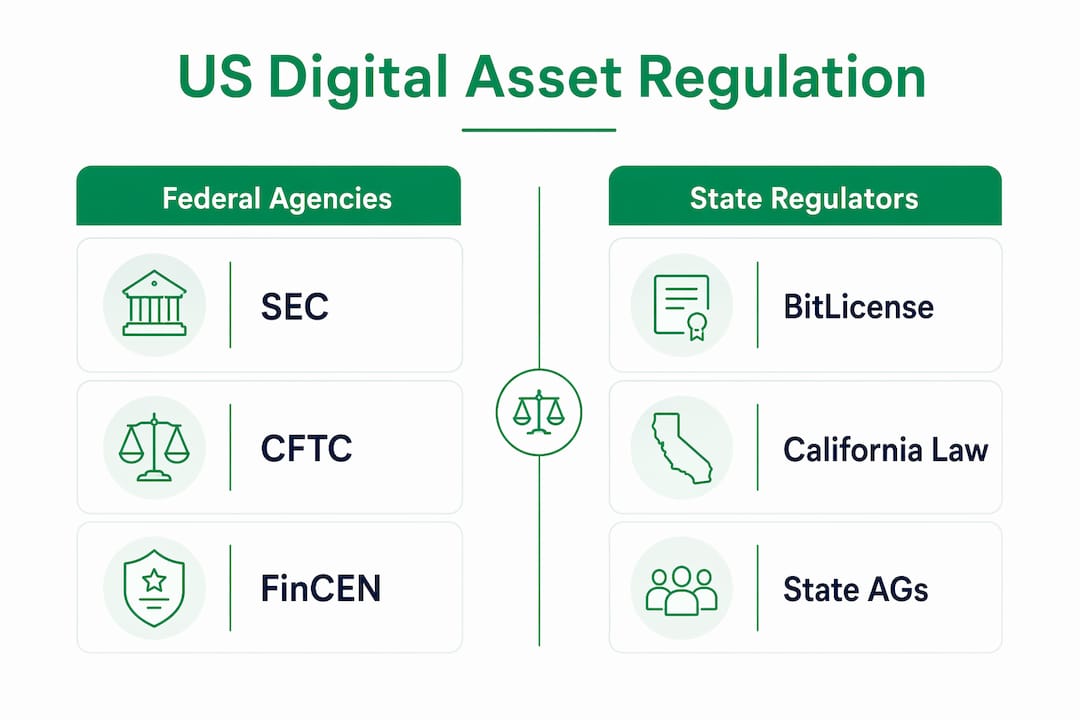
FinCEN requires virtual asset service providers (VASPs) operating in the US to register as money services businesses (MSBs) and comply with the Bank Secrecy Act, including the Travel Rule. For cross-border flows, FinCEN’s Travel Rule requires transmitters to pass originator and beneficiary information to the receiving institution for transfers at or above $3,000. Offshore VASPs that serve US customers without registration are a persistent enforcement target.
State regulators add another layer. New York’s BitLicense, California’s Digital Financial Assets Law, and equivalent state money-transmission frameworks can apply independently of federal registration. A cross-border program that clears federal requirements may still need state-by-state licensing analysis.
FTC and state AGs can intervene on consumer-protection grounds when digital-asset marketing or custody arrangements are deceptive, regardless of whether the primary regulator has acted.
Travel Rule adoption is now largely on the legislative agenda in most major markets, but supervisory maturity and operational readiness vary, creating bilateral compliance gaps that US regulators treat as the domestic firm’s problem to solve.
Pro Tip: Build a one-page activity-to-regulator matrix for each product or transfer type your program runs. Columns: activity description, SEC trigger (Y/N), CFTC trigger (Y/N), FinCEN/MSB trigger (Y/N), state license required (list states). Update it when guidance changes. Examiners respond well to documented mapping — it signals a firm that has thought through its exposure rather than hoping for the best.
How do courts decide which law governs a cross-border digital-asset dispute?
Conflict-of-laws analysis for digital assets is genuinely unsettled, and the answer depends on whether the asset is tokenized (with an identifiable issuer) or permissionless (with no issuer seat to anchor the analysis).
For tokenized assets, courts and statutes tend to apply connecting factors in roughly this priority:
- Issuer seat: The jurisdiction where the issuer is incorporated or has its statutory seat, used in Germany, Switzerland, Liechtenstein, and increasingly referenced in US UCC Article 12 analysis.
- Registrar/operator seat: Where the system operator or registrar maintains its principal place of business, relevant when the issuer is offshore but the platform is US-based.
- Place of custody or intermediary: The jurisdiction of the custodian holding the asset on behalf of the holder, which matters most in insolvency and enforcement scenarios.
- Holder residence: Used as a fallback in some consumer-protection and tax contexts, but rarely determinative for proprietary rights.
For permissionless tokens — Bitcoin, Ether, and similar assets with no identifiable issuer — the issuer-seat criterion simply fails as a connecting factor. Courts then look to party autonomy (contractual choice-of-law) or the location of the custodian as the most practical anchor.
UNIDROIT Principles on Digital Assets and Private Law support party-autonomy rules as a practical solution where an issuer or registrar is identifiable and its statutory seat is readily ascertainable. Where neither is true, UNIDROIT recommends other connecting factors or explicit contractual choice-of-law provisions. The Principles do not replace public regulatory licensing — both private-law and regulatory-law analysis must run in parallel.
“There is no global consensus on how to determine the applicable law for transnational cryptoasset transactions — the implications include compliance cost uncertainty, investor protection gaps, and potential for under- or over-regulation.” — Singapore Journal of Legal Studies
Practically, this means counsel evaluating jurisdiction risk should: (1) identify the connecting factors available for the specific asset type, (2) check whether the counterparty’s jurisdiction has enacted a special digital-asset conflict-of-laws statute (the US, Germany, Switzerland, Liechtenstein, and Spain have done so to varying degrees), and (3) draft explicit choice-of-law and jurisdiction clauses rather than relying on implied or default rules. For asset freezes and evidence collection, the custodian’s jurisdiction is usually the most actionable lever — it determines which court can issue an effective order.
How do AML, KYC, and sanctions rules apply to cross-border transfers?
Cross-border digital-asset transfers sit at the intersection of FinCEN’s Travel Rule, FATF’s Recommendation 16, and OFAC sanctions screening. Each obligation is real, and they interact in ways that create bilateral compliance gaps your program must close on its own side.

The Travel Rule requires US-regulated transmitters to collect and transmit originator and beneficiary information for transfers meeting applicable thresholds. The bilateral nature of this obligation is the operational challenge: your firm can be fully compliant and still carry unresolved exposure if the receiving VASP cannot accept or process the required data. Counterparty reachability is therefore a control objective, not just a monitoring metric. If a counterparty is unreachable for Travel Rule purposes, the transfer should not proceed without escalation and documented risk acceptance.
Sanctions screening adds a separate layer. OFAC’s SDN list and country-based prohibitions apply to digital-asset transfers the same way they apply to wire transfers. Inbound flows from prohibited jurisdictions and offshore VASPs that appear retail but operate at scale — nested VASP arrangements — are a persistent enforcement risk that FinCEN and OFAC have both pursued.
Minimum AML/KYC controls for cross-border flows:
- Verify VASP registration status and jurisdiction for every institutional counterparty before onboarding.
- Screen all parties against OFAC SDN, consolidated sanctions lists, and relevant foreign-government lists at onboarding and on an ongoing basis.
- Confirm Travel Rule reachability (technical and legal) before executing transfers; document the confirmation.
- Apply enhanced due diligence to offshore VASPs, nested arrangements, and counterparties in jurisdictions with partial or no Travel Rule enforcement capacity.
- Monitor unhosted wallet interactions for volume, pattern, and jurisdiction anomalies; document the monitoring methodology for examiners.
- Maintain transaction records for a minimum of five years per BSA requirements.
For a detailed operational workflow, the AML compliance workflow guide published by Wush covers step-by-step controls across jurisdictions.
Pro Tip: Treat counterparty reachability as a pre-transfer gate, not a post-transfer audit finding. Build a reachability registry — a maintained list of counterparty VASPs with their Travel Rule protocol, jurisdiction, and last-verified date. Examiners consistently ask for evidence that the firm knew, before the transfer, whether the counterparty could receive compliant data.
What custody model best manages cross-border legal risk?
Custody is where private-law uncertainty and operational risk converge. The model you choose determines your exposure in insolvency, your ability to produce evidence for courts, and your counterparty’s legal claim on the asset.

| Custody Model | Third-Party Enforceability | Insolvency Exposure | Court Evidence Quality |
|---|---|---|---|
| Self-custody (firm holds keys) | High — firm controls asset directly | Low — asset not commingled | Strong if key management is documented |
| Hosted custodian (third-party) | Depends on custodian jurisdiction and segregation | Moderate to high if assets are commingled | Depends on custodian’s record quality |
| Fiduciary custody (regulated trust) | High — statutory framework applies | Low if properly ring-fenced | Strong — regulated record-keeping |
| Hybrid (multi-sig, shared control) | Complex — requires clear contractual allocation | Moderate — depends on agreement terms | Variable — requires detailed documentation |
For cross-border programs, the key contractual protections to seek in any custody arrangement are:
- Segregation: Assets held in identifiable, separately designated accounts, not pooled with custodian or other client assets.
- Insolvency ring-fencing: Explicit contractual and, where available, statutory protections that prevent the custodian’s insolvency administrator from treating client digital assets as custodian property.
- Operational controls: Multi-factor authentication, withdrawal whitelisting, and documented key-management procedures that satisfy both internal audit and external examiner expectations.
- Transfer warranties: Representations that the custodian has legal authority to transfer the asset and that no third-party claim encumbers it at the time of transfer.
Tokenized securities carry an additional layer: issuer-based rules (securities law, transfer restrictions, corporate-action rights) apply on top of the custody arrangement. Permissionless tokens do not have an issuer to enforce those rules, which means the custody agreement and the governing law it specifies are the only legal framework available. That distinction matters most when you are trying to freeze or recover an asset across borders.
How do data privacy rules create friction for cross-border KYC and monitoring?
KYC and transaction monitoring generate personal data. Moving that data across borders to satisfy AML obligations or share it with foreign supervisors triggers a separate set of legal constraints that many programs underestimate until they hit a scaling problem.
Data-localization rules frequently force firms to bifurcate infrastructure, raising costs and creating operational breaks in monitoring coverage. The FSB has identified data localization as a major friction and recommends legal pathways for cross-border data sharing rather than purely technical fixes. The underlying policy drivers — cybersecurity, law enforcement access, national sovereignty — mean that technical architecture alone cannot solve the problem. You need legal access frameworks: mutual legal assistance treaties (MLATs), memoranda of understanding (MoUs) between regulators, and, where applicable, standard contractual clauses or equivalency determinations.
Practical operational mitigations:
- Data partitioning: Segment KYC and transaction-monitoring data by jurisdiction at the architecture level, so that data subject to localization requirements never leaves the relevant jurisdiction’s infrastructure.
- Controlled mirroring: Where cross-border data sharing is legally permitted, maintain a mirrored dataset in the receiving jurisdiction rather than routing queries back to the source jurisdiction in real time.
- Legal-hold processes: Document the legal basis for every cross-border data transfer — consent, contractual necessity, legitimate interest, or regulatory obligation — and retain that documentation for the same period as the underlying transaction record.
- Lawful-basis mapping: Maintain a data-flow map that identifies, for each data category and each jurisdiction pair, the lawful basis under which the transfer occurs and the supervisory authority responsible for oversight.
The tension between transparency and privacy in cross-border compliance is well-documented: mandatory KYC/AML expectations often clash with jurisdictional privacy limits, and the resolution requires counterparty reachability design and carefully structured data flows, not just policy statements.
Pro Tip: Build your lawful-basis map before you need it, not during an examination. Examiners in both the US and foreign jurisdictions increasingly ask for documented evidence that data transfers were legally authorized at the time they occurred. A map that was created after the fact is obvious and unconvincing.
Which contract clauses reduce cross-border legal risk most effectively?
Contract design is the most direct tool counsel has for allocating cross-border legal risk before a dispute arises. The following categories of provisions should appear in every material cross-border digital-asset agreement.
Priority contractual protections:
- Representations on title and transfer authority: The transferring party warrants that it holds unencumbered title, has authority to transfer, and that no regulatory hold, court order, or third-party claim encumbers the asset.
- Custody obligations: Explicit segregation, key-management, and operational-control requirements, with audit rights for the counterparty.
- Choice-of-law clause: Specify the governing law by name (e.g., “This agreement is governed by the laws of the State of New York, without regard to conflict-of-laws principles”). For tokenized assets with an identifiable issuer, align the contractual choice with the issuer’s seat where possible.
- Exclusive jurisdiction clause: Name the courts (or arbitral seat) with exclusive jurisdiction for disputes. For cross-border enforcement, consider whether the chosen court’s judgments are recognized in the counterparty’s jurisdiction.
- Interim relief and asset-preservation steps: Include a provision permitting either party to seek emergency injunctive relief in any competent court without waiving the exclusive jurisdiction clause.
- Indemnities: Scope them tightly — open-ended indemnities for “any loss arising from” digital-asset activity are a red flag in counterparty terms and should be negotiated down to specific, defined events.
“Commercial operators who decide to use digital assets should choose or otherwise identify the applicable law mindful of implications — in particular, they should safeguard the application of other laws, such as laws applicable to commercial documents and to money, and comply with all applicable regulations.” — UNCITRAL Guide on DLT in Trade
On dispute resolution: arbitration is generally preferable for cross-border digital-asset disputes where the counterparty is in a jurisdiction that is a signatory to the New York Convention, because arbitral awards are more reliably enforceable across borders than national court judgments. The exception is emergency asset preservation — national courts can issue freezing orders faster than most arbitral tribunals, which is why the interim-relief carve-out above is non-optional.
Red flags in counterparty standard terms: vague custody definitions that do not specify segregation, data-access limitations that would prevent you from producing records to a US examiner, and jurisdiction clauses naming courts in jurisdictions with limited enforcement cooperation with the US.
What US tax and reporting obligations apply to cross-border digital-asset activity?
The IRS treats digital assets as property for federal tax purposes, which means every disposition — sale, exchange, or use to pay for goods or services — is a taxable event requiring recognition of gain or loss. For cross-border activity, the reporting obligations layer on top of that baseline.
Key reporting touchpoints:
- Broker reporting (Form 1099-DA): The Infrastructure Investment and Jobs Act of 2021 expanded broker reporting requirements to digital assets. Brokers — including certain custodians and exchanges — must report gross proceeds from digital-asset transactions. The IRS has issued phased implementation guidance; compliance teams should confirm which counterparties qualify as brokers and what reporting they will generate.
- FBAR (FinCEN Form 114): US persons with a financial interest in or signature authority over foreign financial accounts exceeding $10,000 at any point during the year must file. Whether a foreign digital-asset account triggers FBAR is a fact-specific analysis; FinCEN has indicated that foreign crypto accounts held at foreign exchanges may qualify.
- FATCA (Form 8938): US persons with specified foreign financial assets above applicable thresholds must report on Form 8938. The OECD’s Crypto-Asset Reporting Framework (CARF) is designed to complement FATCA by enabling automatic exchange of crypto-asset tax information between jurisdictions.
- OECD Common Reporting Standard (CRS): The 2025 consolidated CRS text now covers specific electronic money products and central bank digital currencies, and indirect investments in crypto-assets through derivatives and investment vehicles. US-based programs with foreign counterparties in CRS-participating jurisdictions should expect information exchange.
Recordkeeping expectations: The IRS expects contemporaneous records of acquisition date, acquisition cost basis, disposition date, proceeds, and the method used to calculate gain or loss (FIFO, specific identification, etc.). For cross-border transfers, retain records of the counterparty’s jurisdiction, the transfer protocol used, and any Travel Rule data transmitted. Examiners look for metadata — timestamps, wallet addresses, transaction hashes — not just accounting entries.
“The CARF provides for the automatic exchange of tax-relevant information on crypto-assets and was developed to address the rapid growth of the crypto-asset market and to support global tax transparency.” — OECD CARF
Pro Tip: Preserve the raw transaction data from your exchange or custodian in its original format — CSV exports, API logs, blockchain explorer records — alongside your accounting entries. When an examiner or auditor questions a specific transaction, the ability to produce the on-chain record alongside the tax treatment is far more persuasive than a reconstructed spreadsheet.
What does a practical cross-border compliance readiness checklist look like?
Structure your remediation in three tiers. Immediate actions address the highest-probability enforcement risks. Near-term actions close structural gaps. Medium-term actions build the documented, tested control environment that satisfies examiners and external auditors.
Immediate (0–30 days):
- Complete the activity-to-regulator matrix (SEC, CFTC, FinCEN, state) for every product and transfer type currently in operation.
- Audit counterparty reachability for Travel Rule compliance; suspend or escalate any counterparty that cannot receive compliant data.
- Confirm OFAC and consolidated sanctions screening is running at onboarding and on an ongoing basis for all counterparties and wallet addresses.
- Identify any custody arrangements that lack written segregation and insolvency ring-fencing terms; flag for immediate contract remediation.
- Verify that all cross-border data transfers have a documented lawful basis.
Near-term (30–90 days):
- Remediate custody contracts to include segregation, transfer warranties, and audit rights.
- Map data flows and establish legal pathways (MoUs, SCCs where applicable) for sharing KYC/monitoring data with foreign supervisors.
- Review and update choice-of-law and jurisdiction clauses in all material counterparty agreements.
- Conduct a tax-reporting gap analysis: confirm broker-reporting obligations, FBAR exposure, and CARF/CRS implications for each counterparty jurisdiction.
- Establish a legal-hold process for digital-asset transaction records, including on-chain metadata.
Medium-term (90–180 days):
- Deploy automated Travel Rule tooling (solutions like Notabene or equivalent) and integrate it with your transaction-monitoring system.
- Update AML/CFT policies to reflect cross-border-specific controls, including nested VASP risk and unhosted wallet monitoring.
- Conduct cross-border compliance training for legal, compliance, treasury, and operations teams; document attendance and assessment results.
- Schedule internal audit of cross-border controls; produce a written remediation plan with owner assignments and deadlines.
- Implement board-level reporting on cross-border digital-asset risk, including a quarterly summary of open regulatory inquiries, enforcement developments, and control gaps.
Governance steps that consistently satisfy examiners: documented policies with version control and board approval, tested incident playbooks (tabletop exercises with written outcomes), vendor due diligence files for every material third-party service provider, and annual certification of control effectiveness.
For cross-border compliance readiness frameworks and maturity indicators, Wush’s published guidance covers the documented-controls standard that examiners expect.
Pro Tip: The artifacts that consistently satisfy examiners are not policy documents — they are evidence of testing. A tested incident playbook with a written after-action report, a reachability registry with last-verified dates, and a training log with assessment scores all demonstrate that controls are operational, not theoretical. Produce these before the exam, not during it.
Key Takeaways
Managing cross-border digital-asset flows under US law requires simultaneous compliance with AML/sanctions rules, overlapping federal and state regulator jurisdiction, and private-international-law frameworks that remain unsettled in most jurisdictions.
| Point | Details |
|---|---|
| Treat all flows as cross-border | Domestic AML exemptions are unreliable; apply full Travel Rule and sanctions screening to every transfer. |
| Map regulators before transacting | SEC, CFTC, FinCEN, and state agencies can all claim jurisdiction simultaneously; document the mapping in writing. |
| Counterparty reachability is a gate | Confirm Travel Rule reachability before each transfer; an unreachable counterparty is an unresolved AML exposure. |
| Lock custody and choice-of-law in writing | Oral or implied arrangements do not survive cross-border disputes or regulatory examinations. |
| Wush DARE certification | The DARE framework provides structured, examiner-facing evidence of documented controls, tested playbooks, and annual renewal for cross-border programs. |
Where most cross-border programs actually break down
The gap between a firm’s written compliance policy and what examiners actually find is almost always in three places: counterparty reachability, data friction, and underdocumented custody arrangements. These are not exotic edge cases. They are the default state of most programs that built their controls for domestic activity and then added cross-border flows without rebuilding the underlying architecture.
Counterparty reachability is the most common failure. A firm can have a technically compliant Travel Rule system and still be unable to complete a transfer because the receiving VASP has no compatible protocol, no registered contact, or no supervisory oversight that would make them respond to a compliance inquiry. The practical fix is a maintained reachability registry, not a policy that says “we will confirm reachability before transferring.”
Data friction is the second failure. Programs that built their KYC and monitoring infrastructure without accounting for data-localization requirements discover the problem when they try to scale into a second or third jurisdiction. The infrastructure bifurcation required is expensive and slow to implement under time pressure. Build the legal access framework and the partitioned architecture before you need it.
Underdocumented custody is the third. Custody agreements that were drafted for domestic use rarely include the segregation, insolvency ring-fencing, and transfer-warranty language that cross-border enforcement requires. When an asset freeze or insolvency event occurs, the absence of those terms is discovered at the worst possible moment.
On regulator engagement: voluntary disclosures and examiner briefings go better when the firm leads with documented evidence of controls, not with explanations of why the gap existed. Examiners are not looking for perfection — they are looking for a firm that knows where its gaps are, has a remediation plan with owners and deadlines, and can demonstrate that the plan is being executed. Structure every briefing around those three elements.
DARE certification gives your cross-border controls third-party validation
Legal and compliance teams that have completed the remediation steps in this guide face a practical next question: how do you demonstrate to a board, a regulator, or an M&A counterparty that your cross-border digital-asset controls are genuinely operational, not just documented on paper?
The DARE certification from Wush is built for exactly that moment. DARE — the Digital Asset Readiness Evaluation — is a structured, modular assessment that maps directly to the governance, AML/CFT, custody, legal, and operational control domains covered in this guide. It produces an assessment summary and a documented remediation plan that compliance teams can present to examiners, internal audit, and board risk committees as third-party evidence of control effectiveness.
Three situations where DARE certification is particularly well-timed: pre-examination remediation (when a regulatory inquiry is anticipated and you need to demonstrate proactive control improvement), board assurance (when executives need independent validation before approving a cross-border digital-asset program), and M&A diligence (when a counterparty or acquirer needs evidence of compliance maturity before closing). Annual renewal keeps the credential current as the regulatory environment evolves. Teams ready to engage can start the assessment at dare.wush.co/certification.
Useful sources for legal teams
The sources below are primary and high-authority references. Each is directly citable in regulatory briefings, internal audit reports, and counsel memos on cross-border digital-asset matters.
-
UNCITRAL Guide on Legal Issues Relating to DLT in Trade: The most comprehensive international treatment of digital-asset legal classification, electronic transferable records, and cross-border data-transfer obligations. Use this when briefing counsel or examiners on the legal status of tokenized trade documents and the interaction of MLETR with DLT-based systems.
-
UNIDROIT Principles on Digital Assets and Private Law: The authoritative private-law framework for proprietary rights in digital assets, including party-autonomy rules and connecting factors. Cite this in any cross-border dispute or contract-drafting context where the governing law for proprietary rights is contested.
-
FATF Seventh Targeted Update on Virtual Assets (via Notabene summary): Current status of Travel Rule adoption, supervisory maturity gaps, and nested VASP risk. Use this to support enhanced due diligence decisions and to brief risk committees on bilateral compliance gaps.
-
FSB Recommendations on Cross-Border Payments Data Frameworks: The FSB’s analysis of data-localization friction and recommended legal pathways for cross-border data sharing. Use this when designing data-partitioning architecture or negotiating MoUs with foreign supervisors.
-
OECD Crypto-Asset Reporting Framework and CRS (2025): The international tax-transparency standard for crypto-assets, including CARF and the amended CRS. Use this when assessing FATCA/CRS interaction and advising on cross-border tax reporting obligations.
-
Comparative Analysis: Digital Assets in the Conflict of Laws: Academic comparative research identifying how the US, Germany, Switzerland, Liechtenstein, Spain, England/Wales, and Singapore approach connecting factors for digital assets. Use this when evaluating jurisdiction risk for a specific asset type or drafting choice-of-law clauses.
-
Transnational Transactions on Cryptoasset Exchanges: A Conflict of Laws Perspective: Detailed analysis of the choice-of-law problem for on-exchange cryptoasset transactions, including the lex mercatus proposal. Use this when advising on exchange-based disputes or drafting jurisdiction clauses for exchange agreements.
“When using distributed ledgers, commercial operators should consider whether personal data will be stored on the distributed ledger and comply with applicable data privacy and protection laws. As the distributed ledger developer, operator and user can be located across multiple jurisdictions, clauses should be inserted in the contractual agreements to ensure compliance with all relevant data privacy and protection laws.” — UNCITRAL Guide on DLT in Trade
These sources should be cited by name and URL in any brief to counsel, internal audit report, or examiner response that addresses cross-border digital-asset legal risk. Primary sources carry more weight with examiners than secondary commentary, and the UNCITRAL, UNIDROIT, FATF, FSB, and OECD materials are recognized as authoritative across virtually every major jurisdiction your program is likely to encounter.
This article provides general legal and compliance information for educational purposes. It is not legal advice. Confirm current regulatory requirements with qualified legal counsel and the relevant primary sources for your specific situation.