
Digital Asset Compliance Readiness Explained for 2026

Most finance and compliance professionals assume digital asset compliance is simply a matter of picking the right policies and checking a few regulatory boxes. The reality is far more demanding. Digital asset compliance readiness explained properly means understanding how rapidly evolving rules across multiple jurisdictions intersect with your operational architecture, data systems, and vendor relationships. This article cuts through the complexity and gives you a structured view of the regulatory requirements, operational strategies, and technology decisions shaping compliance readiness for finance professionals in 2026.
Table of Contents
- Key takeaways
- Legal and regulatory frameworks shaping digital asset compliance
- Operationalizing compliance: data architecture and workflows
- Evaluating compliance technology for digital assets
- Practical checklist for assessing compliance readiness
- My honest take on compliance readiness
- Strengthen your compliance program with DARE
- FAQ
Key takeaways
| Point | Details |
|---|---|
| Regulatory deadlines are immediate | MiCA, IRS Form 1099-DA, and Regulation S-P all carry hard 2026 enforcement dates that require action now. |
| Auditability is an architecture decision | Building explainable data trails from the start is far more practical than retrofitting after regulators ask questions. |
| Technology selection is a control choice | Your blockchain intelligence platform directly determines your AML, sanctions, and Travel Rule compliance effectiveness. |
| Risk frameworks must be tailored and documented | Generic compliance documents do not satisfy regulators. Scored, version-controlled risk assessments tied to controls are the standard. |
| Third-party certification validates readiness | Structured evaluations like the DARE process provide defensible evidence of compliance maturity to regulators and partners. |
Legal and regulatory frameworks shaping digital asset compliance
Understanding digital compliance starts with knowing exactly which rules apply to your organization and when enforcement begins. In 2026, the deadline pressure is real across every major jurisdiction.
In the United States, the IRS has made broker-level reporting mandatory. Gross proceeds reporting under Form 1099-DA became effective January 1, 2025, with basis reporting for covered transactions starting January 1, 2026. This is not a future consideration. If your organization facilitates digital asset transactions and qualifies as a broker, your reporting infrastructure must be operational now.
The European Union presents its own hard stop. EU crypto-asset service providers must obtain MiCA authorization by July 1, 2026, or cease regulated services. Transitional provisions that allowed continued operation without full authorization are expiring. Late or incomplete applications carry significant consequences, including enforcement actions and forced suspension of EU operations.
The Financial Action Task Force’s Travel Rule adds a third layer of complexity. VASPs must share originator and beneficiary information across the full payment chain, including Know Your VASP checks and scrutiny of self-hosted wallets. This requirement is not just about data collection. It demands workflow-level integration that prevents transactions from executing when required information is missing.
On the cybersecurity front, the SEC’s Regulation S-P amendments apply directly to smaller entities. New requirements on incident response, breach notification within 72 hours, and service provider oversight carry a compliance deadline of June 3, 2026.
| Jurisdiction | Regulation | Key Deadline | Core Obligation |
|---|---|---|---|
| United States | IRS Form 1099-DA | Jan 1, 2026 | Basis reporting for digital asset transactions |
| European Union | MiCA | July 1, 2026 | Full authorization or cease EU operations |
| Global (FATF) | Travel Rule | Ongoing | Originator and beneficiary data exchange |
| United States | Regulation S-P | June 3, 2026 | Breach notification and vendor oversight |
Operationalizing compliance: data architecture and workflows
Knowing the regulations is the entry point. Executing against them operationally is where most organizations struggle. Building compliance readiness for assets at the systems level requires treating auditability as a design principle, not an afterthought.

For CARF-style reporting frameworks, auditability must be designed in from the moment you capture data, not patched in after tax authorities ask questions. This means retaining methodology snapshots, maintaining consistent data capture formats, and preserving historical records that can reconstruct your reporting logic across different tax years and jurisdictions. Organizations that patch this together retrospectively face enormous reconciliation burdens.
Travel Rule compliance exposes workflow timing as the critical failure point. Tightly synchronized workflows that halt transactions when originator or beneficiary data is incomplete are the operational standard. This requires KYV checks, exception queues, and counterparty verification steps embedded before execution, not as a post-transaction review. Every missing data scenario is a potential regulatory finding.
Vendor and service provider oversight deserves particular attention given Regulation S-P’s requirements. The 72-hour breach notification standard creates a contractual challenge. Your vendors may not meet your notification window unless you have written obligations, monitoring mechanisms, and escalation protocols in place. Creative contractual solutions and vendor certifications are becoming standard practice among well-prepared organizations.
Here is a structured approach to operationalizing your compliance controls:
- Map every regulatory obligation to a specific data source, system, or workflow. Gaps between obligations and operational systems are your highest-priority remediation items.
- Document exception-handling procedures for every workflow. Regulators want to see how you respond when data is missing, not just that you have a policy.
- Build version control into your risk assessments and methodology documentation. This is the evidence trail that demonstrates your framework evolves with regulation.
- Establish vendor oversight protocols with written notification timelines. Verbal agreements do not satisfy Regulation S-P’s vendor management expectations.
Pro Tip: Do not treat compliance documentation as a static deliverable. The professionals who sail through regulatory examinations treat their risk frameworks as living operational documents with version histories and regular review cycles.
Evaluating compliance technology for digital assets
Technology is not a compliance shortcut, but the right tools make the difference between a defensible program and an auditable one. Assessing compliance readiness with digital asset management guidelines means applying real selection criteria to your technology stack.
A blockchain intelligence platform should do more than flag transactions. FATF-aligned AML compliance demands configurable rules engines, complete audit logs of every escalation, sanctions screening coverage, Travel Rule integration, and the ability to generate traceable, documented suspicious activity reports. Treat the vendor selection process as a control choice, not a procurement exercise.
Key criteria when evaluating compliance technology:
- Sanctions and AML screening coverage: Does the platform cover all jurisdictions relevant to your business model, including OFAC, EU, and UN sanction lists?
- Travel Rule integration: Can the platform communicate with counterparty VASPs in real time and manage exception queues?
- Audit trail integrity: Are escalation decisions, rule changes, and case notes time-stamped and tamper-evident?
- SAR documentation quality: Does the platform produce evidence-backed documentation that holds up to regulatory scrutiny?
- API integration depth: Can the platform connect to your existing custody, transaction monitoring, and reporting systems?
Emerging trends worth watching include privacy-preserving compliance tools that allow data sharing without exposing sensitive customer information, and self-sovereign identity solutions that let counterparties prove KYC status without transmitting raw data. Interoperable compliance networks that allow VASPs to exchange Travel Rule data across protocol standards are also maturing rapidly. Digital currency banking considerations are increasingly integrated with these compliance architectures, particularly for treasury teams managing institutional digital asset holdings.
Pro Tip: Run your technology evaluation against a real transaction scenario, including a sanctions hit, a Travel Rule data gap, and a breach notification test. Vendors that perform well in demos often show gaps when tested against actual edge cases.
Practical checklist for assessing compliance readiness
Building a structured, documented approach to assessing compliance readiness is what separates organizations that satisfy regulators from those that scramble before examinations. A risk-based compliance program for digital assets must be tailored to your specific business model and governance structure.
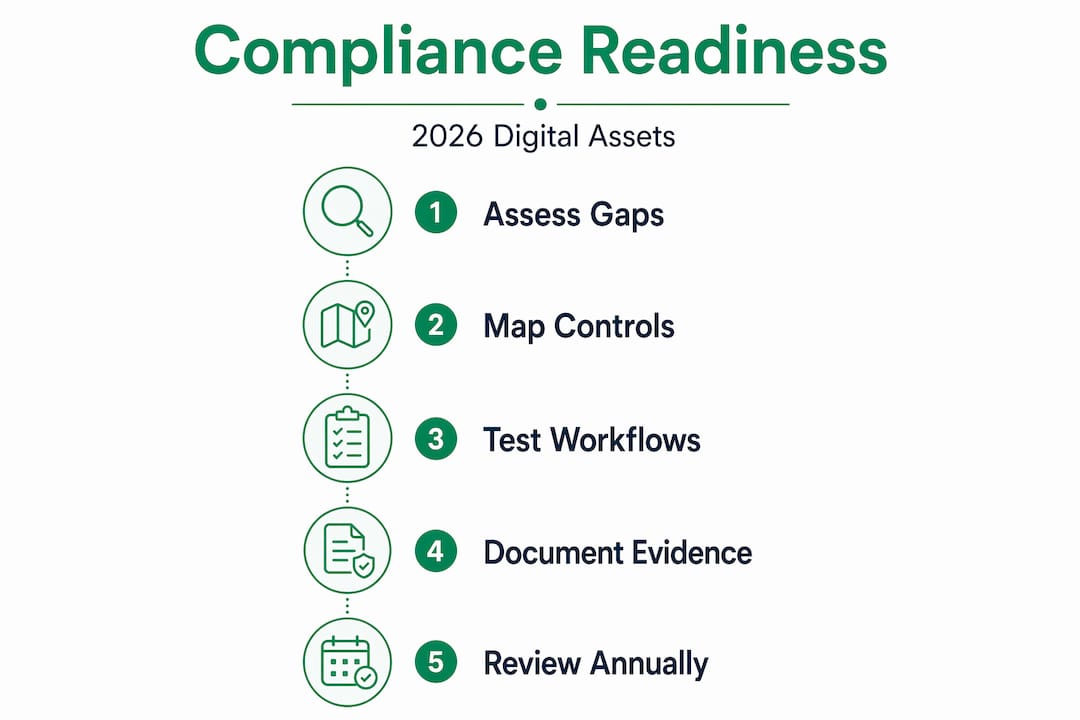
Regulators across FATF, VARA, MAS, and FSC Mauritius all expect the same core output: a scored risk assessment connected to specific operational controls, with evidence that the link between risk and control is actively maintained. Generic templates fail because they cannot demonstrate that your organization’s specific risk profile drove your control choices.
Follow this sequence to build or evaluate your program:
- Define your risk universe. Identify the specific products, customer types, geographies, and transaction volumes that create your compliance obligations. Do not borrow a risk framework from a different business model.
- Score and document each risk. Assign likelihood and impact scores, document your rationale, and link each scored risk to a specific control or control gap.
- Map regulations to controls. For each applicable regulation, identify the specific process, system, or policy that addresses the requirement. Gaps become your remediation roadmap.
- Set review triggers and schedules. Your framework should specify when it will be reviewed: at minimum annually, and whenever a material regulatory change or operational incident occurs.
- Prepare your examination evidence package. Collect policies, version histories, test results, audit logs, and vendor certifications into a structure that answers the questions regulators consistently ask.
- Evaluate against an external benchmark. Internal assessments have blind spots. An external evaluation using a structured framework like the DARE readiness evaluation identifies gaps your team may have normalized over time.
Common deficiencies found in examinations include risk assessments that describe risk categories but do not score them, controls listed without evidence of testing, and vendor oversight programs that exist on paper without underlying contractual obligations.
My honest take on compliance readiness
I’ve spent enough time reviewing compliance programs to know that the most dangerous state is confident incompleteness. Organizations that have assembled documentation feel prepared. They often are not.
What I’ve learned from watching regulatory examinations is that examiners probe the gap between what you say you do and what your data and systems show. A policy on Travel Rule compliance that was never operationalized into a workflow timer fails at the first transaction-level inquiry. A risk assessment that lists “custody risk” without scoring it or linking it to a control is not a risk assessment. It’s a catalog.
The data architecture point is where I see the most consistent failure. People understand they need auditability. They do not build for it. Then, when a jurisdiction requires historical reconstruction under a CARF-style framework, they discover that their data was stored in formats that cannot produce consistent outputs across reporting periods. That is not a technology gap. It is a design decision that was never made.
My view is that compliance readiness is fundamentally about evidence. The organizations that do well under regulatory pressure are the ones that can pull up a version-controlled risk framework, a documented control test, and a transaction-level audit log within minutes. If enterprise crypto risk oversight is a topic you engage with regularly, you already understand that this is operational discipline, not just documentation.
Future-proofing means building a program that can absorb a new regulation without starting from scratch. That requires modular architecture in your risk framework, technology integrations that support new data types, and a review cadence that is already embedded in your operational calendar.
— Gregg
Strengthen your compliance program with DARE
If this article surfaces gaps in how your organization approaches digital asset compliance readiness, a structured external evaluation is the most direct path forward.
Wush’s Digital Asset Readiness Evaluation, DARE, is built specifically for finance professionals, treasury teams, legal advisors, and risk managers who need a defensible, independently certified view of their compliance program. The platform covers custody, regulatory compliance, risk management, and operational controls through modular assessments aligned with the frameworks discussed throughout this article. Certifications are blockchain-backed and include annual renewal to stay current with evolving standards.
Explore the DARE certification to understand how credentials and assessments are structured, review the competitive edge DARE provides to organizations demonstrating compliance maturity, and check current pricing to find the right program for your organization’s size and scope.
FAQ
What does digital asset compliance readiness mean?
Digital asset compliance readiness is the degree to which an organization’s policies, systems, data architecture, and workflows can satisfy current and anticipated digital asset regulations. It goes beyond policy documents to include operational controls, auditability, and documented evidence of control effectiveness.
Which regulations should finance professionals prioritize in 2026?
The most time-sensitive obligations in 2026 are IRS Form 1099-DA basis reporting (effective January 1, 2026), MiCA authorization for EU operators (deadline July 1, 2026), and SEC Regulation S-P cybersecurity requirements for smaller entities (deadline June 3, 2026), alongside ongoing Travel Rule obligations.
How does the Travel Rule affect operational workflows?
The Travel Rule requires VASPs to exchange originator and beneficiary data before transaction execution. This means workflows must include KYV checks and exception handling that block transactions when required data is missing, not just log the gap after the fact.
What makes a risk framework acceptable to regulators?
Regulators across FATF member jurisdictions expect a scored, documented risk assessment that ties specific risk categories to defined operational controls, with evidence that the framework is reviewed regularly and updated when regulations or business activities change.
How can a certification help with compliance readiness?
An independent certification like DARE provides a structured assessment against recognized governance frameworks, identifies control gaps your internal team may have missed, and produces documented credentials that demonstrate compliance maturity to regulators, partners, and counterparties.