
Digital asset business continuity planning: executive guide

Most executives assume their existing business continuity frameworks translate cleanly to digital assets. They don’t. Digital asset business continuity planning operates on fundamentally different failure modes: private keys cannot be reset by a help desk, blockchain transactions cannot be reversed once confirmed, and 24/7 market exposure leaves no maintenance window for recovery. Regulators are catching up fast, and firms without demonstrably tested continuity programs face escalating enforcement risk. This guide gives you the technical grounding, regulatory context, and governance framework to build continuity planning that actually works.
Table of Contents
-
Understanding digital asset business continuity fundamentals
-
Addressing digital asset custody continuity and key management risks
-
Maintaining and governing continuity plans for enduring resilience
-
Why traditional continuity approaches fall short for digital asset firms
-
Leverage expert evaluation to strengthen your digital asset continuity planning
Key Takeaways
| Point | Details |
|---|---|
| Adapt to crypto risks | Tailor business continuity plans to address private keys and blockchain transaction risks unique to digital assets. |
| Regulatory compliance | Ensure plans meet standards like DORA and MiCA with defined recovery objectives and documented evidence. |
| Test regularly | Conduct risk-based, scenario-driven continuity testing at least annually to validate plan effectiveness. |
| Governance matters | Implement succession governance to secure authority transfer and prevent vulnerabilities during key personnel changes. |
| Maintain rigorously | Review and update plans regularly with board approval and after material changes to stay compliant and effective. |
Understanding digital asset business continuity fundamentals
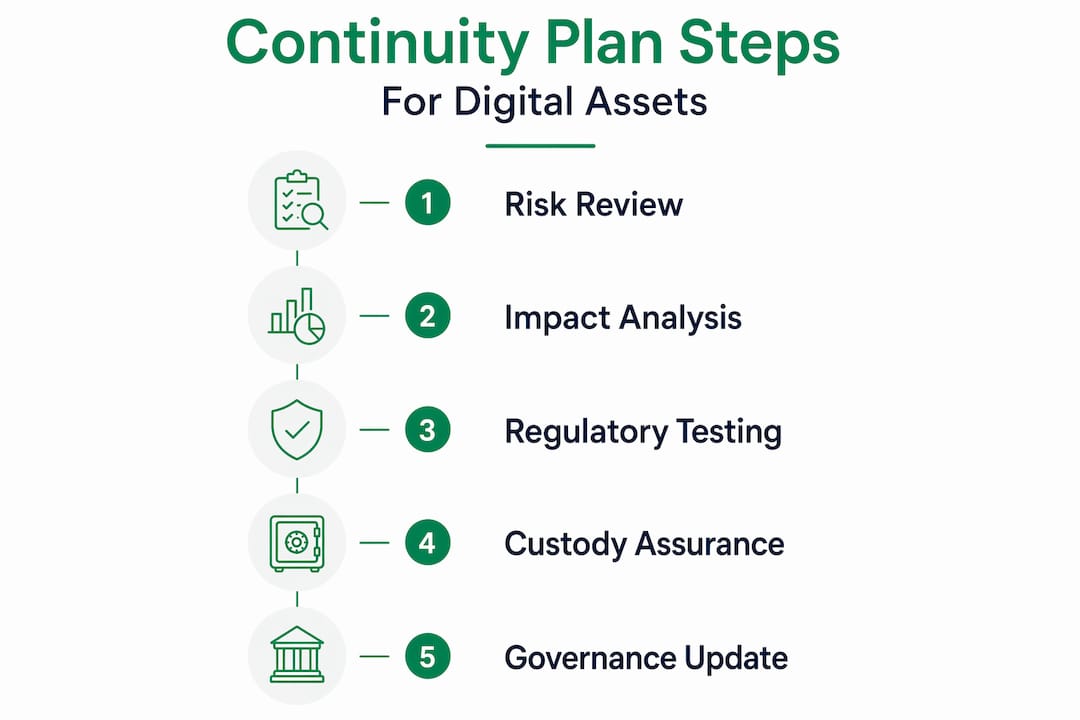
The foundation of any effective continuity program starts with recognizing what makes digital asset operations structurally different from conventional financial services. ISO 22301:2019 continuity framework adapted to sector-specific failure modes provides the strongest starting architecture for crypto firms. The standard covers risk assessment, business impact analysis, recovery strategies, incident response, and testing requirements. But without modification, it will miss the risks that matter most.
Digital asset-specific risks center on three areas that traditional continuity frameworks often ignore entirely:
-
Private key custody: Loss, compromise, or inaccessibility of private keys can make assets permanently unrecoverable. Unlike a forgotten password, there is no escalation path.
-
Transaction irreversibility: Once broadcast, a blockchain transaction cannot be recalled. An erroneous transfer during a disruption event can mean permanent financial loss.
-
Continuous operations: Crypto markets run 24/7, 365 days a year. The concept of a scheduled recovery window does not exist.
-
Counterparty and chain dependency: Smart contract interactions, DeFi protocols, and third-party custodians introduce continuity risks that sit outside your direct control.
-
Regulatory jurisdictional variation: Different licensing regimes apply different continuity standards, which can conflict across jurisdictions where your firm operates.
Each of these demands specific treatment inside your continuity plan, not just a footnote in a standard BIA template. Platforms focused on digital asset readiness evaluation increasingly reflect this by building modular assessments around exactly these risk categories.
Business impact analysis for digital assets must go further than asking “how long can we be offline?” It must ask: what decisions can be made without access to custody systems, what transactions are irreversible within that window, and which personnel hold authority that cannot be delegated during an incident? These questions are uncomfortable precisely because they expose governance gaps most firms have not addressed. Pairing your internal BIA with risk and recovery planning tools built for digital asset environments accelerates this process significantly.
With these fundamentals understood, it is critical to examine regulatory expectations shaping digital asset continuity programs.
Navigating regulatory requirements and industry standards
Regulators have moved well past accepting a PDF document labeled “Business Continuity Plan” as evidence of operational resilience. The new baseline is demonstrated capability.
Under the EU’s Digital Operational Resilience Act (DORA), scenario-based testing with RTO/RPO targets is mandatory for ICT assets, with full recordkeeping requirements. RTO (Recovery Time Objective) defines the maximum acceptable downtime; RPO (Recovery Point Objective) defines how much data loss is tolerable. These are not aspirational targets. DORA requires you to test against them and document the outcomes.
The EU’s Markets in Crypto-Assets Regulation (MiCA) builds directly on DORA for Crypto-Asset Service Providers (CASPs), requiring business continuity policies that satisfy DORA’s ICT resilience standards. If you hold a CASP license or are pursuing one, your continuity obligations under MiCA are legally binding, not advisory.
In the United States, the OCC’s final rule on recovery planning requires at least annual risk-based testing of continuity plans, scaled to the size and complexity of the institution. For firms managing digital assets under federal bank charters or trust charters, this is a direct compliance obligation.
The key regulatory expectations across jurisdictions converge on a short list of requirements:
-
Documented scenarios that reflect actual, plausible disruption events specific to your operations
-
Named roles and responsibilities, not generic job titles, so there is no ambiguity during an incident
-
Defined RTO and RPO targets that have been validated through testing, not just declared
-
Evidence of testing outcomes, including failures and corrective actions
-
Annual or trigger-based plan updates with documented board or senior management approval
-
Wind-down procedures for scenarios where recovery is not feasible within defined parameters
Regulators are no longer asking whether you have a continuity plan. They are asking whether it works. The difference between those two questions is where most firms are currently failing.
Proactive compliance with digital asset regulations requires treating these requirements as a continuous governance function, not a once-a-year document review. See proven crypto resilience strategies for additional operational guidance.
Understanding regulatory mandates clarifies what successful continuity plans must incorporate in terms of risk and testing.
Addressing digital asset custody continuity and key management risks
Custody continuity is the highest-stakes component of any digital asset business continuity plan. Get it wrong and no other part of the plan matters. Continuity failures in custody environments most commonly trace back to weak authority succession governance and inadequate key recovery procedures, not purely technical infrastructure failures.

Most firms focus on the technology: hardware security modules (HSMs), multi-party computation (MPC), or hardware wallets. These are necessary but not sufficient. The harder problem is governance: who can authorize a key rotation during an incident, who holds the knowledge to execute it, and what happens if those people are simultaneously unavailable?
Effective key management continuity must cover:
-
Multi-signature arrangements: Distribute signing authority so no single point of failure exists. Quorum configurations (for example, 3-of-5 signatories) should be documented with named individuals and designated alternates.
-
Key reconstruction protocols: Document the step-by-step process for reconstructing access from backup shards. Cryptographic recovery workflows with geo-distributed backups must be tested under realistic conditions.
-
Rotation schedules and emergency rotation procedures: Routine rotation reduces exposure; emergency rotation procedures address suspected compromise.
-
Succession governance: Define the authority transfer chain for each custody role. Critically, this means restricting what new personnel can access during a transition to avoid opening new attack surfaces.
-
Third-party custodian continuity: If you use external custodians, their continuity plans must be reviewed, and you need documented fallback procedures if they experience an outage.
Pro Tip: Run a tabletop exercise specifically around the scenario where your primary key custodian and their designated alternate are both unavailable simultaneously. Most firms discover immediately that their written procedure has a gap they never anticipated.
Custody continuity failures are largely preventable when you treat continuity governance models as a standing program rather than a document you file after onboarding. Test the human layer, not just the technical layer.
Effective key custody continuity mechanisms rely on understanding and addressing these operational and governance nuances.
Implementing and testing recovery strategies
A continuity plan without tested recovery procedures is a liability document. It gives you the appearance of readiness while leaving the actual capability unverified. RTO and RPO targets must be validated through scenario-based tests that demonstrate redundant systems can restore operations within defined limits.
Here is a practical sequence for building and validating your recovery strategies:
-
Define recovery objectives: Set specific RTO and RPO targets for each critical function. Custody operations, trading infrastructure, client reporting, and regulatory reporting may each have different thresholds.
-
Map dependencies: For each critical function, document every upstream and downstream dependency, including third-party providers, network infrastructure, and personnel.
-
Design redundant architectures: Build primary-to-backup switchover capability for each critical system. Geographic distribution matters for both data storage and key custody.
-
Document recovery runbooks: Write step-by-step recovery procedures for each scenario. Runbooks must be executable by someone who was not involved in the original system design.
-
Conduct scenario-based tests: Simulate specific failure events (exchange outage, key custodian unavailability, cloud provider failure) and measure actual recovery performance against defined objectives.
-
Record outcomes and close gaps: Document testing results including what failed, what was slower than expected, and what corrective actions were taken.
| Recovery scenario | RTO target | RPO target | Test frequency | Key dependencies |
|---|---|---|---|---|
| Custody system outage | 4 hours | 0 (no data loss) | Semi-annual | HSM vendor, key custodians |
| Trading platform failure | 1 hour | 15 minutes | Quarterly | Exchange APIs, internal systems |
| Cloud provider failure | 8 hours | 1 hour | Annual | Backup region activation |
| Key custodian unavailability | 2 hours | N/A | Annual | Succession governance chain |
| Regulatory reporting outage | 24 hours | 4 hours | Annual | Data feeds, compliance team |
Pro Tip: Build your testing calendar around your regulatory examination cycle, not your internal convenience. If your regulator typically examines continuity evidence from the prior 12 months, you want recent, documented test results ready before that window opens.
Recovery strategy testing best practices connect directly to how well your governance program maintains those strategies between tests.
Maintaining and governing continuity plans for enduring resilience
A continuity plan that was accurate 18 months ago may be dangerously wrong today. Personnel change, infrastructure migrates, regulatory requirements shift, and the threat environment evolves. Governance of the plan itself is as important as the plan’s content.
Trigger events that require an immediate plan review include:
-
Personnel changes: Any addition, departure, or role change for individuals named in the plan requires immediate review. This is especially critical for custody roles.
-
Infrastructure migration: Cloud provider changes, custodian transitions, or technology platform upgrades must prompt a full dependency review and updated recovery procedures.
-
Regulatory changes: New licensing requirements, updated standards, or enforcement actions in your jurisdiction may require material plan revisions.
-
Incident events: Any actual disruption, even one you recovered from successfully, should trigger a post-incident review to identify what the plan got right and what it missed.
-
Material business changes: Entering new asset classes, new jurisdictions, or new product lines changes your risk profile and must be reflected in the plan.
BCPs must be reviewed at least annually and after material changes, with evidence of recent testing and documented board-level approval. That board approval is not a formality. It creates legal accountability, signals organizational commitment, and satisfies regulators who specifically look for evidence of executive oversight.
Governance best practices for ongoing continuity management:
-
Assign a named continuity program owner with authority and accountability for plan currency
-
Establish a quarterly internal review cycle, with a full annual review and board sign-off
-
Maintain a version-controlled document history so you can demonstrate the plan’s evolution to regulators
-
Include wind-down procedures covering scenarios where recovery is not achievable within defined parameters, including orderly client notification and asset return protocols
Pro Tip: Attach your continuity plan review to your annual governance calendar alongside your risk assessment and compliance reporting. Plans that sit in a separate process tend to fall behind; plans embedded in governance cycles stay current.
Keeping continuity plans current is a standing governance obligation, not a project with an end date.
Why traditional continuity approaches fall short for digital asset firms
Here is the uncomfortable reality most continuity consultants will not tell you: the gap between a written plan and a functional recovery capability is far wider in digital assets than in any other financial services context.
Traditional business continuity planning assumes that infrastructure can be restored, data can be recovered from backups, and operations can resume with substitute personnel. In digital assets, none of those assumptions hold cleanly. The gap between documented plans and demonstrated resilience requires live testing and governance investment that most firms have simply not made.
The specific failure that most often blindsides firms is succession governance. Not a server going down. Not a data center outage. It is the scenario where the person with knowledge of the key reconstruction procedure is unreachable, and the written plan lists a phone number that has not been updated in two years. Succession governance failures expose new attack surfaces precisely when the firm is most vulnerable.
What regulators increasingly demand is continuity as a live capability. Evidence of annual testing, named responsibilities, documented outcomes, and board sign-off is the minimum. The firms that handle regulatory examinations well are the ones that treat their continuity program as a standing governance function, not a compliance deliverable they produce on request.
Executives and compliance officers who close this gap understand that technical recovery and governance rigor are not separate workstreams. They are the same problem. The technical layer tells you whether the system can restart. The governance layer tells you whether the right people are available to authorize and execute that restart, and whether they know exactly what to do when everything is on fire. Invest equally in both. See advanced continuity governance frameworks for structured guidance on closing these gaps.
Leverage expert evaluation to strengthen your digital asset continuity planning
The difference between firms that pass regulatory scrutiny and those that face enforcement action often comes down to one thing: independent verification that their continuity plans reflect actual operational capability, not aspirational documentation.
The Digital Asset Readiness Evaluation (DARE) platform provides exactly that independent verification. Designed specifically for enterprises managing digital assets, DARE’s modular assessment framework maps your continuity posture against current regulatory standards, including DORA, MiCA, and OCC requirements. It identifies gaps in custody governance, key management continuity, and recovery testing before a regulator does. For executives and compliance officers who need structured evidence of operational resilience, DARE’s credentialing and annual renewal process creates a continuously updated compliance record. Explore digital asset compliance solutions to start your evaluation.
Frequently asked questions
What unique risks should digital asset continuity plans address compared to traditional finance?
Digital asset plans must tackle private key custody risks, blockchain transaction irreversibility, and continuous 24/7 operations. Sector-specific challenges like these require material adaptations to standard continuity frameworks that traditional finance does not face.
How often must digital asset firms test their business continuity plans to satisfy regulators?
Regulators expect risk-based testing at minimum annually, scaled to the size and criticality of the functions being tested. Evidence of those tests, including outcomes and corrective actions, must be documented and available for examination.
Why is governance critical in digital asset continuity beyond technical recovery?
Governance ensures secure succession of authority during incidents, preventing the scenario where the right systems are online but no one with proper authorization is available to operate them. Succession governance failures are among the most common and costly continuity breakdowns in digital asset operations.
What do regulators look for when reviewing digital asset business continuity plans?
They prioritize scenario coverage, realistic RTO/RPO targets with evidence of testing, named current responsibilities, recent plan updates, and documented board approval. A well-written plan with no testing evidence will not satisfy modern regulatory expectations.