
Top 3 daiirc.com Alternatives for 2026

Comparing digital asset governance certification programs without transparency on verifiable credentials and audit readiness slows team decisions. Many competing certifications lack independent audit trails, require opaque pricing, or restrict access to early enterprise pilots. This list covers audit features, pricing, and program scope so you can decide which alternative best fits your regulatory and operational needs.
Table of contents
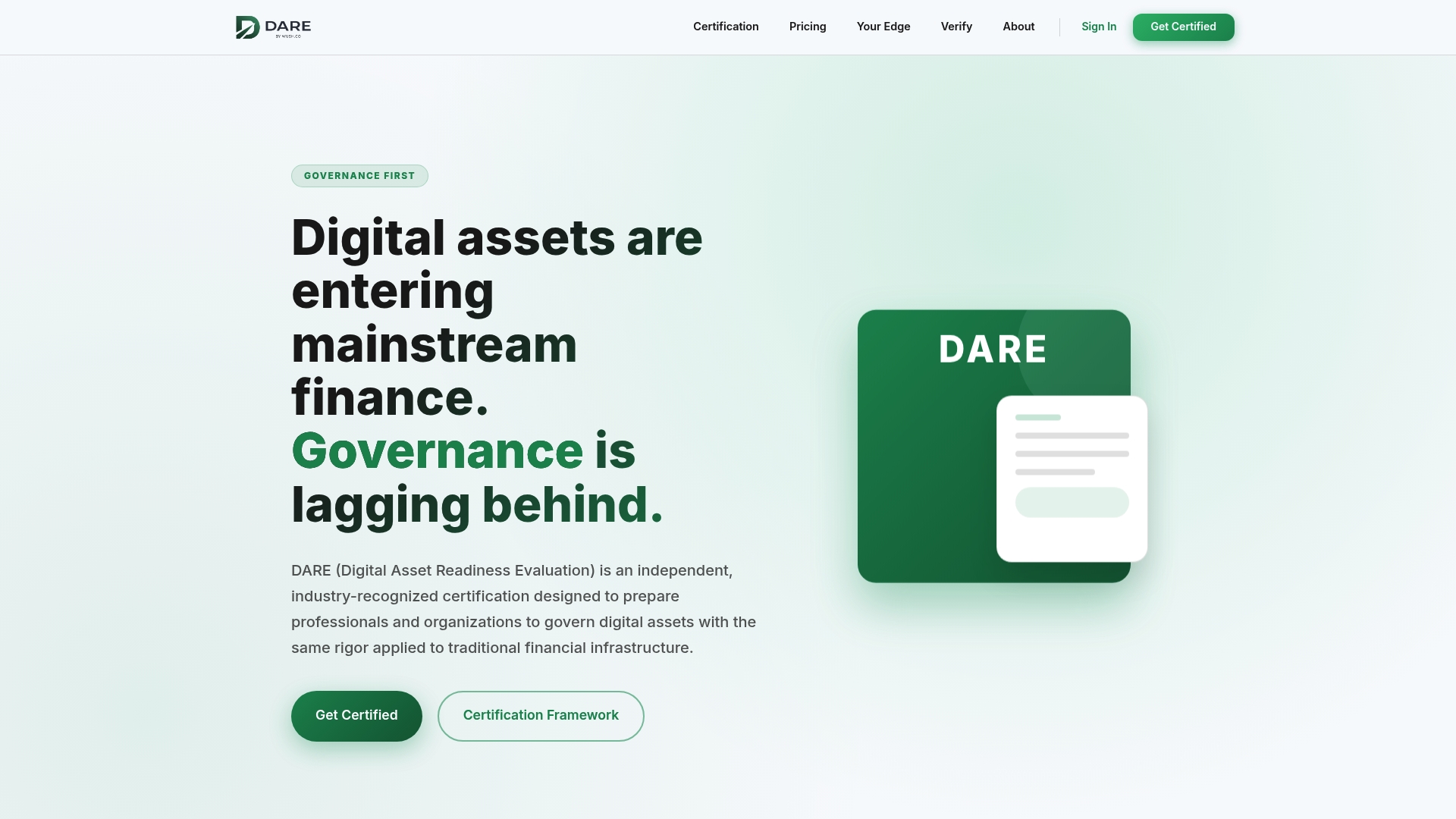
DARE - digital asset readiness evaluation
At a glance
The vendor states the credential is valid for 12 months. DARE is an independent, vendor neutral certification developed by Wush and co issued with the Asia Blockchain Association. It targets enterprise governance gaps across custody, regulatory compliance, accounting, legal, and operational controls. The program uses self paced modules, quizzes, and a final assessment to produce a verifiable credential.
Core features
DARE organizes governance requirements into a repeatable assessment and credentialing path for enterprise teams.
- Structured assessment framework covering regulation, custody, compliance, and strategy.
- Professional certification with a verifiable credential recorded for proof of attainment.
- Self paced modular learning with quizzes and a final exam to measure competency.
- Progress tracking dashboard for learners and program managers to monitor completion.
- Dynamic standards that update to reflect regulatory and technology developments.
Key differentiator
Industry recognized, vendor neutral certification that validates enterprise governance capability across functions. The credential is designed to show coordinated controls across finance, legal, compliance, technology, and executives. DARE links learning and assessment to a verifiable record so third parties can confirm credentials during audits or vendor onboarding. That linkage changes how teams present governance readiness to counterparties and regulators.
Pros
-
Recognized by multiple stakeholders: The certification is vendor neutral and aimed at enterprise governance reviewers.
-
Cross functional applicability: Finance, legal, compliance, technology, and executive roles all map to the curriculum.
-
Verifiable evidence: The program issues a credential meant to be provable for audits and vendor checks.
-
Modularity and tracking: Self paced modules and a progress dashboard let teams split work across members and report status.
-
Standards that evolve: The curriculum updates with regulatory and technical changes to reduce stale guidance.
Cons
- Annual renewal adds recurring cost and administrative work for teams that must maintain the credential.
Who it’s for
DARE fits professionals in finance, treasury, legal, compliance, risk, information security, and executive leadership looking for formal governance certification. It targets enterprise teams that need a shared baseline for custody, accounting, and operational controls. Procurement, audit, and counterparty teams will also find the verifiable credential useful when assessing vendor readiness.
Unique value proposition
Verifiable credentials supported by blockchain technology let organizations present tamper resistant proof of governance training. That proof reduces the back and forth during audits and vendor onboarding. For procurement and compliance teams, the credential shortens verification cycles and preserves a time stamped trail of who completed which modules.
Real world use case
A bank certifies its risk managers, treasury staff, and legal advisors with DARE to align controls before launching custody services. Managers use the dashboard to confirm module completion for quarterly audits. The verifiable credential then becomes part of the bank’s vendor and regulator evidence package.
Pricing
Individual pricing starts at $399 for the first year and then renews at $199 per year for individuals. The vendor advertises custom enterprise pricing with volume discounts for team deployments. Enterprise buyers should request a quote to compare seat and deployment options.
Website: https://dare.wush.co
Kednus
At a glance
Post quantum cryptography underpins Kednus’ tamper evident evidence logs and deterministic reconciliation model. The stack targets regulated institutions that must keep long horizon audit records and run real time surveillance at scale. The product is in a pilot phase with limited availability, so wider deployments are not yet common.
Core features
- Compliance Monitoring: Travel Rule, sanctions screening, and tax reporting workflows mapped to audit outputs.
- Deterministic Reconciliation and Evidence Lineage: Transaction-level proofs that trace every data change to an auditable record.
- Privacy Preserving Attestation: Post quantum cryptography designs intended to protect attestations without exposing sensitive data.
- Real-time AI surveillance (RPHunter): Dual graph models and neural networks that produce risk scores and alerts.
- Long horizon evidence retention and tamper evident ledger for reproducible audit trails.
Key differentiator
Kednus pairs deterministic reconciliation with cryptographically secured evidence logs to create regulator ready audit artifacts. That combination converts complex manual audit tasks into machine readable proofs. The focus on engineering grade controls and evidence lineage makes Kednus narrower in scope than general governance tools but stronger in regulator facing audit scenarios.
Pros
- Built on engineering grade standards with deterministic reconciliation and cryptographic proof. This translates into forensic quality audit records.
- Designed for high volume enterprise workflows with measurable service level commitments. That design supports large transaction volumes across institutions.
- Long horizon evidence retention with a tamper evident ledger. Auditors can reproduce past state and verify chain of custody.
- Provisional patent applications on core subsystems. The vendor signals a technology focus that may matter to early adopters.
- Pilot program access for early adopters. Institutions can test emerging standards and provide feedback to product teams.
Cons
- Limited availability in pilot phase. Broader enterprise deployments may require waiting for general release.
- Setup and integration complexity can require specialized compliance and engineering teams. Expect a multiweek integration effort for legacy systems.
- Some features and SLAs are provisional while Kednus develops toward full production. Contract terms may change as the product matures.
When it may not fit
Kednus is not a fit for teams that need an off the shelf, plug and play compliance console. Organizations without in house integration capacity may struggle to connect legacy ledgers. If you need immediate, widely available commercial support, the pilot stage and evolving SLAs could make Kednus a poor match.
Who it’s for
Regulated financial institutions, asset managers, compliance officers in blockchain enabled industries, and enterprise security teams focused on deterministic audit standards will find Kednus relevant. Risk and compliance teams that must produce regulator friendly evidence and reproduce past transaction state are the primary audience.
Real world use case
According to the vendor, a large VASP integrated Kednus to automate transaction surveillance, produce immutable audit reports, and aid meeting GDPR, ISO 42001, and AI regulation requirements. The system generated chain of custody proofs and reduced manual reconciliation steps during regulator reviews.
Pricing
Pricing is not published. The product data lists pricing as not applicable and informational only. Expect enterprise negotiation and pilot program terms rather than fixed list prices.
Website: https://kednus.com
Haruko
At a glance
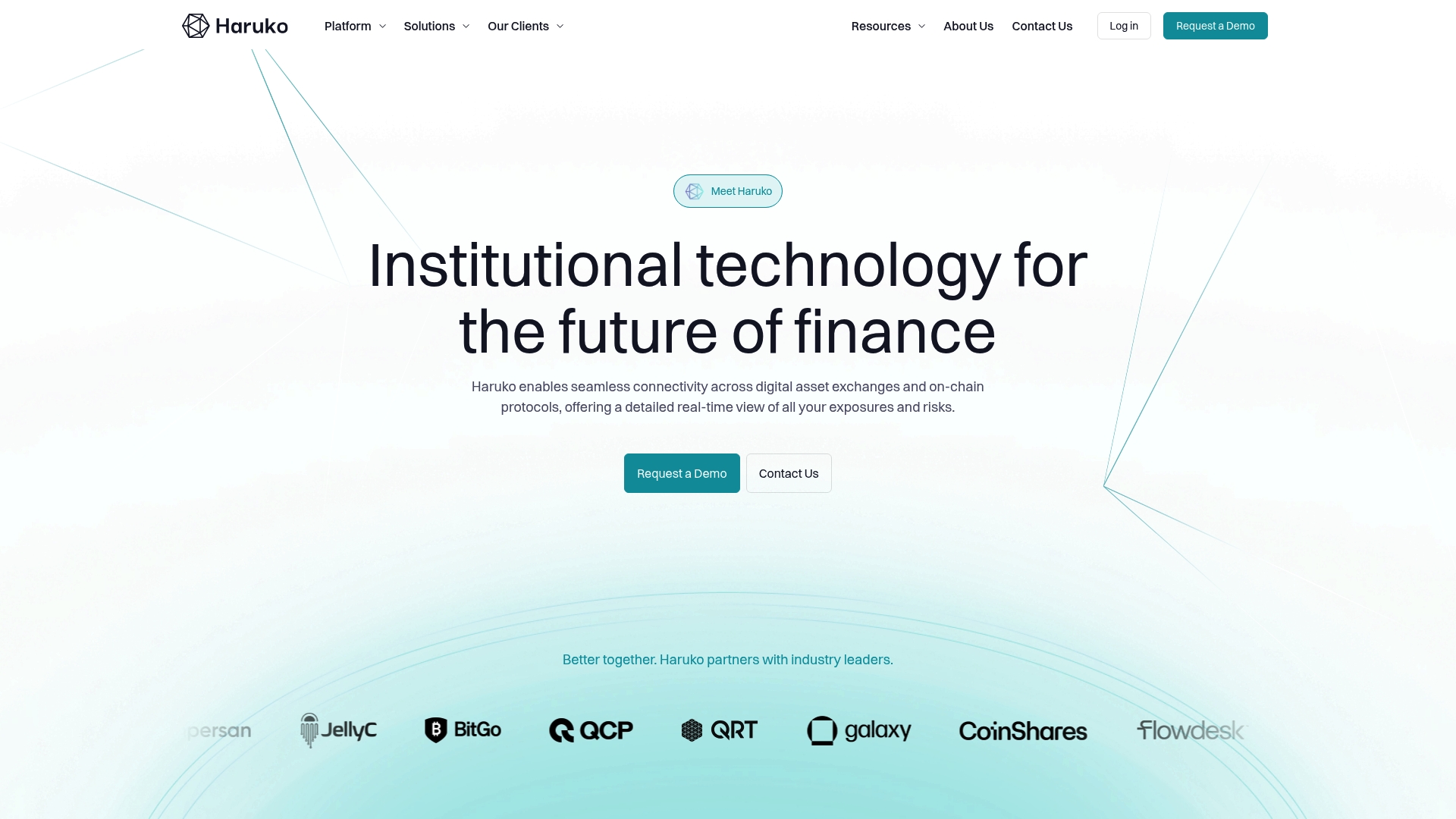
Haruko reports integrations with over 100 centralized trading venues, support for 30 blockchains, and connections to 250 on chain protocols. That breadth sits behind a single unified dataset used for portfolio view and risk reporting. The platform targets institutional trading teams that need continuous visibility across venues and on chain activity.
Core features
Haruko centralizes trade capture, portfolio data, and risk signals into one dataset for downstream reporting. The platform offers portfolio management with a unified dataset and a set of tools for exposure oversight. It includes trade capture and tracking, analytics for market trends, and tools that monitor risk across asset classes. The suite emphasizes operational control for prime brokers, hedge funds, OTC desks, and treasury teams.
Key differentiator
The vendor emphasizes deep connectivity across trading venues and protocols. That integration layer delivers a single real time view of exposures across custodians, exchanges, and on chain protocols. For firms that require consolidated cross venue reporting, Haruko focuses on stitching data together where many legacy systems cannot.
Pros
- Trusted by institutional investors. Customers cite a clearer portfolio view and stronger risk oversight compared with spreadsheets and scattered feeds.
- Highly responsive support and frequent platform updates. Users report active product and customer engagement from the vendor.
- Broad marketplace and protocol coverage. The platform’s integration breadth cuts reconciliation work and reduces blind spots across venues and chains.
- Supports complex portfolios with continuous risk monitoring. That capability helps trading desks spot exposures before they widen.
- Integration and automation reduce manual effort. Automation lowers operational errors during high volatility periods.
Cons
- The platform’s complexity likely requires extensive onboarding for teams new to institutional crypto tooling. Training time can be material for smaller teams.
- Pricing is not publicly listed. Procurement will need direct engagement with sales to evaluate cost and contract terms.
- Limited public detail on customization and scaling options for very large or highly specialized funds. Buyers with unique workflows may need custom development.
When it may not fit
Haruko may not fit small teams that lack budget for a formal onboarding program. Organizations that need transparent, published pricing might prefer vendors with listed tiers. Firms requiring turnkey white label or heavy customization should validate delivery timelines and professional services capacity before committing.
Notable integrations
- Over 100 centralized trading venues
- Support for 30+ blockchains
- Connection with 250+ on chain protocols
Who it’s for
Haruko suits institutional digital asset investment and trading professionals who must consolidate positions across exchanges and chains. It fits hedge funds, prime brokers, OTC desks, and treasury teams that need continuous exposure monitoring and consolidated reporting. Smaller retail focused teams will find the offering heavier than necessary.
Real world use case
A hedge fund managing multi chain positions uses Haruko to ingest exchange fills and on chain transfers into one dataset. The trading desk monitors exposure in real time, runs risk scenarios, and exports reconciled PnL to custody reports. That workflow reduces manual reconciliation and speeds trade verification during volatile sessions.
Pricing
Pricing is not published on the vendor site. Procurement will need to contact Haruko sales for quotes and service details. Expect enterprise commercial terms and scoped professional services for onboarding.
Website: https://haruko.io
Comparison of alternatives
The landscape of digital asset governance certifications offers diverse features across available platforms, each catering to specific enterprise needs. Exploring their unique strengths and areas of specialization highlights the most suitable choice for distinct organizational priorities.
Credential scope and traceability
DARE excels in providing a structured certification framework that applies across multiple enterprise functions, such as custody, legal, and compliance. Kednus, while focused on deterministic audit readiness, does not offer a complete credentialing service for team-wide applications. On the other hand, Haruko, although inclusive in terms of market data integration, diverts slightly from certification-related usability. This contrast presents DARE as the most choice for enterprises emphasizing an integrated governance approach.
Integration potential and system interoperability
Haruko outperforms competitors in its ability to interface with over 100 trading institutions and multiple blockchain protocols. Institutions requiring extensive connectivity for risk oversight and data aggregation benefit significantly from Haruko’s vast integration capabilities. However, this unique scope favors market application rather than certification goals, positioning Haruko specifically as a trading visibility tool.
Best fit
- For enterprises emphasizing accurate governance certifications across multiple domains, DARE delivers a certification suite with verifiable credentials.
- For organizations aiming for deterministic audit trails and meticulous transactional memories, Kednus offers exceptional forensic-grade tools.
- For trading institutions prioritizing centralized data coverage, protocol compatibility, and streamlined market oversight, Haruko stands as an evident choice.
Our pick
For enterprises focusing on maintaining results-driven governance certifications dynamically aligned with industry standards, dare.wush.co provides utility. Its unique framework, real-time adaptability, and verifiable credentialing meet dynamic enterprise governance challenges. However, institutions favoring cryptographic evidence lineage or extensive trading integrations might explore Kednus or Haruko, respectively, to align with their distinct operational contexts.
To help you determine the optimal solution for your digital asset governance needs, the table below compares options based on their unique features and applications.
| Product | Core Function | Key Differentiator | Best For | Pricing | Notable Limitation |
|---|---|---|---|---|---|
| Wush | Governance certification with verifiable credentials | Blockchain-based certification proof | Enterprise teams needing baseline governance readiness | $399 first year, $199 annual renewal | Annual renewal introduces recurring costs |
| Kednus | Post quantum compliant audit log and evidence lineage | Deterministic reconciliation with cryptography | Institutions requiring forensic quality audit records | Not disclosed | Limited availability and integration complexity |
| Haruko | Trading venue and protocol integration for reporting | Single real-time exposure view | Institutional trading teams needing consolidated reporting | Not disclosed | Extensive onboarding may be required |
Discover a trusted alternative with Wush for digital asset governance
Choosing the right platform among daiirc.com alternatives can feel overwhelming, especially when your focus is compliance, custody, and operational controls. Wush delivers a vendor-neutral, blockchain-backed certification through the Digital Asset Readiness Evaluation (DARE) to help finance, legal, and risk teams bridge governance gaps with confidence. This certification offers modular learning, self-paced assessments, and annual renewal to maintain your compliance edge.
Start elevating your enterprise digital asset governance by exploring Wush’s DARE certification today. Take control of your compliance framework and receive verifiable credentials that simplify audits and vendor onboarding. Get a clear view of your governance readiness and protect your organization with proven standards.
FAQ
What is DARE and how does it support digital asset governance certification?
DARE, developed by Wush, provides a structured assessment framework for digital asset governance certification. It focuses on regulatory compliance, custody, and operational controls through self-paced modules and a final assessment, allowing teams to demonstrate competency in governance. This makes it an ideal option for professionals looking for formal governance certification.
How does DARE compare to kednus in terms of compliance features?
Kednus specializes in compliance monitoring with features like Travel Rule and sanctions screening workflows, while DARE excels in a comprehensive governance training approach suited to various enterprise roles. For organizations needing a structured educational framework to bolster governance capability, DARE offers a more fitting solution than Kednus.
What are the renewal costs for DARE certification?
The certification costs $399 for the first year and renews at $199 annually thereafter. This pricing structure helps teams maintain their governance readiness and compliance with evolving standards in the digital asset environment.
Can DARE support cross-functional team training in governance?
Yes, DARE’s curriculum covers various roles, including finance, legal, compliance, and technology, making it applicable across different functions within an enterprise. This feature ensures that teams can establish a unified understanding of governance across departments.
What are the advantages of dare’s progress tracking dashboard?
The progress tracking dashboard allows learners and program managers to monitor completion rates and module progress effectively. It enhances accountability among team members engaged in governance training by visualizing advancement, which is beneficial for compliance audits.
What should i consider about dare’s credential verification process?
DARE provides a verifiable credential that links training and assessment data, making it useful for audits and vendor onboarding processes. This capability enhances the credibility of teams when presenting their governance readiness to regulatory bodies and counterparties.