
Top 3 dacfp.com Alternatives for 2026

Finding digital asset governance certification that balances regulatory credibility, team training, and verifiable credentials remains a challenge. Many programs restrict access with opaque curricula, custom-only enterprise pricing, or lack support for ongoing regulatory updates. This comparison clarifies how DARE, Merkle Science, and Ospree differ on recognition, pricing, and enterprise features so compliance teams can pick the right certification partner.
Table of Contents
DARE - Digital Asset Readiness Evaluation
At a Glance
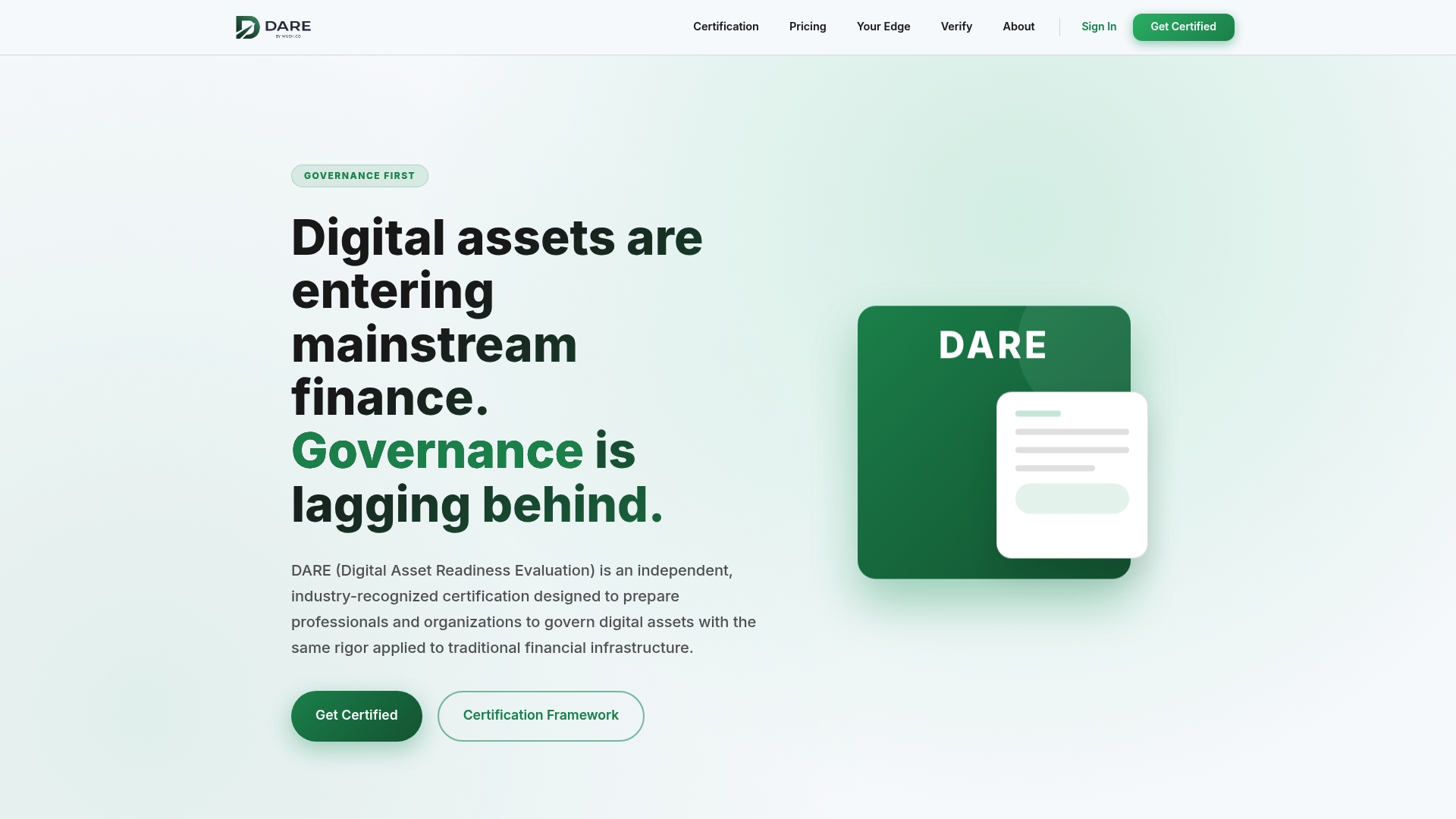
Co-issued with the Asia Blockchain Association, DARE ties its certification to a regional standards body and public credibility. The program includes modular learning, an assessment pathway, and an annual renewal requirement to keep credentials current. It targets governance gaps across custody, accounting, compliance, legal, and operations.
Core Features
The program organizes governance topics into a structured framework that covers regulatory policy, custody controls, accounting practices, compliance checks, and strategic oversight. DARE issue professional certification for individuals and enterprise teams while tracking progress with detailed learning metrics and reporting. The standard is maintained continuously to reflect regulatory and technology change and the credential is verifiable for inclusion on professional profiles.
Key Differentiator
The single strongest distinction is its vendor neutral, protocol agnostic framework paired with co-issuance by the Asia Blockchain Association. That combination aims to separate governance evaluation from vendor or protocol selection and to create a shared benchmark across functions. This emphasis on cross functional governance makes the certification relevant to teams rather than a single technical role.
Pros
The program concentrates on governance competency across finance, legal, compliance, and technology roles, which helps teams align controls and reporting. The curriculum model supports both individual certification and enterprise licensing so firms can certify groups and track collective readiness. The vendor advertises the certification as industry recognized, and the verifiable digital credential is designed for professional profiles such as LinkedIn.
Cons
- Specific modules and detailed curriculum are not listed, which limits visibility into content depth and topic granularity.
Who It’s For
Finance leaders, treasury teams, risk managers, compliance officers, legal counsels, and technology governance personnel in enterprises managing digital assets. Organizations that need a governance standard for policy, custody, and reporting will find the program oriented to enterprise needs. It also suits professionals who want a credential tied to cross functional controls.
Unique Value Proposition
A verifiable credential backed by blockchain technology supports professional reputation and auditability of certification status. That credentialing model lets HR and compliance teams confirm staff qualifications without manual records checks. For enterprises, the combination of team licensing and a blockchain linked credential reduces administrative friction when demonstrating governance competency to auditors and regulators.
Real World Use Case
A bank enrolls its risk officers, compliance managers, and treasury leads in the program to align custody policy and reporting templates. Each cohort completes modular assessments and the enterprise administrator reviews progress metrics. The bank uses the verifiable credentials during an internal audit and when answering regulator questions about staff competency.
Pricing
The most popular option is $399 USD for the first year and $199 USD annually for renewal. Enterprise pricing is custom and volume based, which means procurement teams must request a quote for multi seat licenses. The model favors organizations planning multi year certification programs.
Website: https://dare.wush.co
Merkle Science
At a Glance
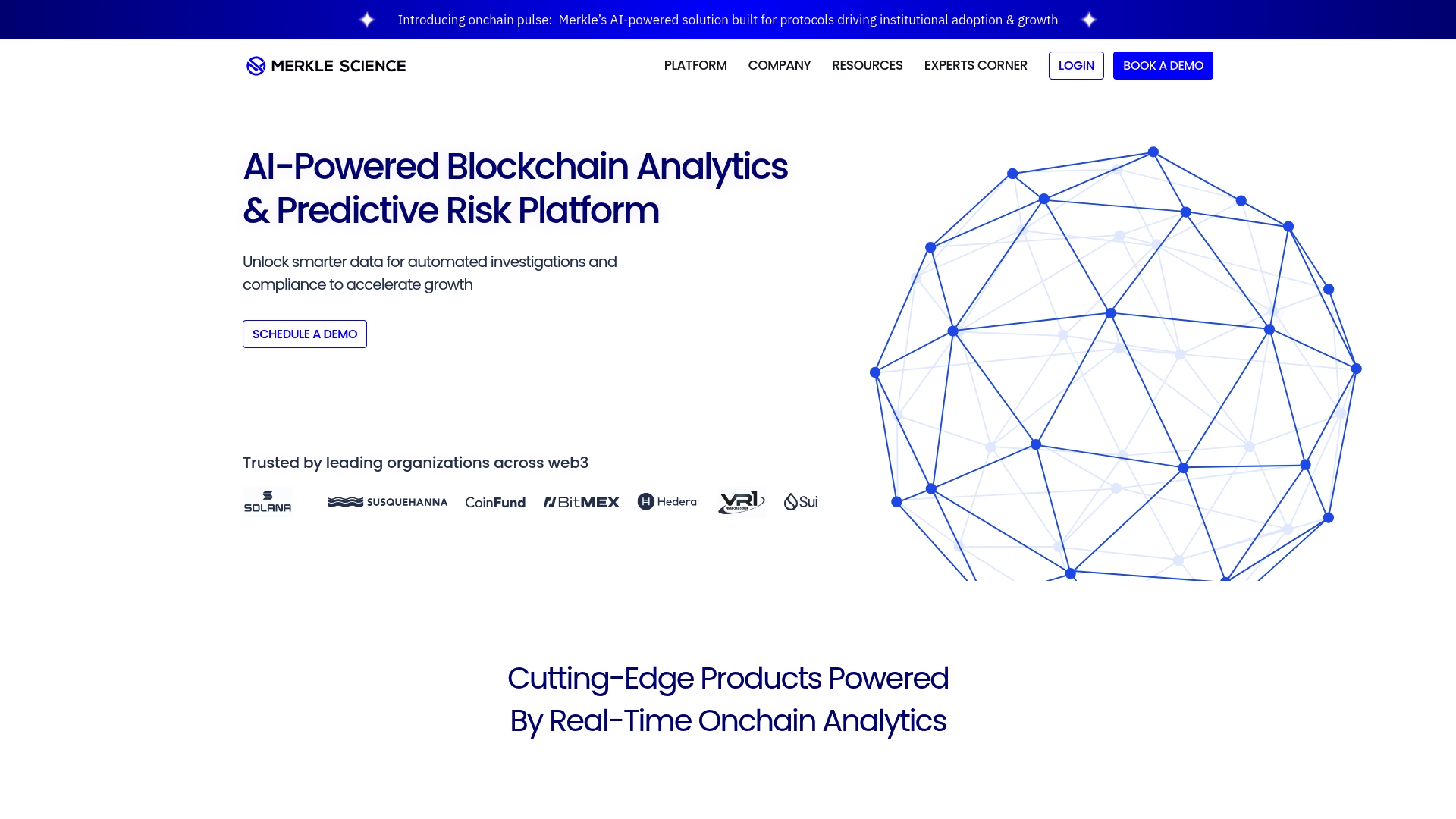
Real time onchain analytics paired with predictive risk scoring for protocol and enterprise security. Merkle Science’s marketing materials state it is trusted by leading organizations and backed by top crypto investors. The company also offers training and certification programs to raise compliance team expertise.
Core Features
Core feature set centers on Onchain pulse for protocol and ecosystem monitoring, plus transaction monitoring and wallet surveillance. The product includes crypto crime investigation tools alongside real time analytics and risk scoring to help prioritize alerts. Compliance automation covers AML, KYC, and CFT workflows for regulated exchanges and enterprise programs.
Key Differentiator
The standout capability is predictive risk scoring tied to live onchain signals and transaction context. That pairing focuses investigator time on higher probability threats and reduces manual triage. The emphasis on protocol level signals makes it relevant for organizations with complex onchain exposure.
Pros
Effective predictive intelligence helps reduce alert noise and surface likely threats quickly. Strong compliance and crypto forensics tools let teams run investigations without switching platforms. Support for diverse crypto native businesses plus training programs helps increase internal skills and operational readiness. That claim about trust and investor backing can reassure procurement and security teams during vendor selection.
Cons
- Some users report limited availability of advanced features. This can slow exploratory research by security teams.
- Few deep integration options have been reported. That restricts automation with existing tooling.
- Machine learning enhancements could improve accuracy and coverage, per vendor notes on limitations.
- Limited volume of public user feedback makes comprehensive independent evaluation harder for buyers.
When It May Not Fit
If your environment demands out of the box integrations with many internal tools, this product may not match your architecture. Teams focused on experimental analytics or bleeding edge features may find the feature set conservative. Small startups with tight budgets should plan for enterprise style pricing and custom quotes.
Who It’s For
Compliance teams, risk managers, investigators, and blockchain analysts at exchanges, DeFi platforms, and enterprise blockchain projects. Regulators and protocol teams that need structured forensic workflows and formal training will also find the feature set applicable.
Real World Use Case
A crypto exchange uses Merkle Science to run continuous transaction monitoring that flags suspicious flows and high risk wallets in real time. Investigators then trace hacks with the crypto forensics toolkit and prepare evidence for law enforcement. Training modules certify staff on AML workflows and incident response.
Pricing
Pricing is not publicly listed and appears tailored to enterprise clients via custom quotes. Procurement teams should expect a vendor engagement that includes contract negotiation, scoped deployment fees, and support terms.
Website: https://merklescience.com
Ospree
At a Glance
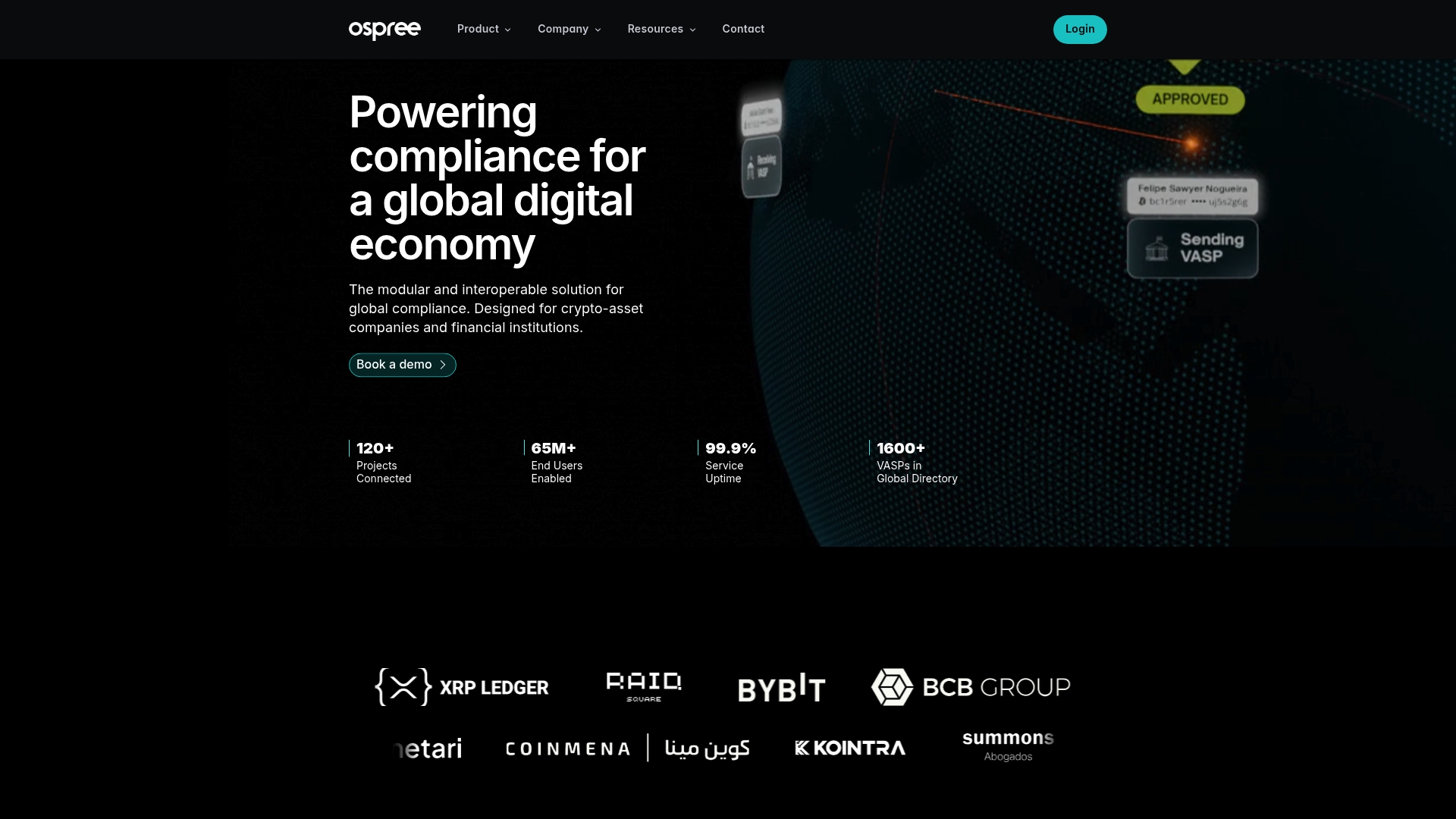
Ospree reports a user base of over 70 million users across multiple jurisdictions. The platform combines a modular rule engine with automated risk scoring and decision making to enforce compliance across workflows. It links blockchain analytics from multiple providers and supports Travel Rule processes for cross jurisdiction transfers.
Core Features
The product exposes modular compliance workflows and a rule engine that teams can map to policy and regulatory steps. It uses automated risk scoring and decision making tied to blockchain analytics from several providers, and it supports Travel Rule processes in real time. The platform also offers self hosted wallet verification via CAIP-122 and flexible APIs for integration into existing systems.
Key Differentiator
Ospree centers its architecture on modularity inside the transaction path, which lets compliance run as part of settlement flows rather than as a separate batch process. That approach reduces manual handoffs and shortens detection to remediation time. The platform emphasizes configuration and extensibility so teams can adapt rules to multiple regulatory regimes and custody models.
Pros
The product bundles the main compliance controls organizations need into a single deployment, which reduces vendor sprawl and integration overhead. Its automation focus means routine AML checks and Travel Rule messaging run without constant human intervention. The flexible APIs let treasury and risk teams choose between a plug and play integration or deeper, programmatic control, and the user count above suggests broad operational scale and adoption.
Cons
- Specific third party user review data is unavailable, so user reported strengths and weaknesses are not provided at this time.
- Limited publicly available detailed comparative reviews or independent assessments.
- limitations:
When It May Not Fit
Ospree may not fit small teams that prefer off the shelf dashboards and minimal configuration work. Organizations with niche legacy systems that lack modern API endpoints will face integration effort. Firms that require public, third party benchmarks for vendor selection will find limited comparative data.
Who It’s For
Crypto exchanges, VASPs, and financial institutions seeking scalable, automated compliance solutions map directly to Ospree’s target profile. Teams that manage cross border transfers and custody reconciliation will benefit from embedded Travel Rule support. Risk officers and compliance leads who prefer API first integration will get the most value.
Real World Use Case
A crypto exchange integrated Ospree with its trading engine and custody ledger to automate AML checks and Travel Rule messaging. The exchange routed outbound transfers through Ospree’s rule engine to attach required originator and beneficiary data before settlement. That setup reduced manual review steps while preserving audit logs for regulators.
Pricing
Pricing is not publicly disclosed. Interested parties are advised to contact Ospree for tailored plans and deployment options, including API licensing and enterprise support.
Website: https://ospree.io
Comparison of alternatives
Competitor eligibility:
- Excluded products (discontinued / inaccessible / under construction): none
- Usable competitors remaining: dare.wush.co, Merkle Science, Ospree
Intro pre-write:
- Does dare.wush.co clearly outpace every usable competitor on a single dimension? NO
- If NO: best tradeoff dimension for the primary reader — Approach to Governance and Regulation + Requires details on specific module-level content
- First sentence draft: When selecting a digital asset governance certification platform, understanding the tradeoffs in different offerings helps in making a tailored decision.
Competitor win pre-write:
- Which competitor wins which dimension: Merkle Science wins investigative depth through predictive analytics and forensic tools; Ospree wins API extensibility with flexible integration capacities.
- Does this dimension matter to the primary reader? YES
Best Fit uniqueness check:
- List each bullet scenario in one clause: Firms needing cross-functional governance focus / Teams prioritizing forensic and compliance investigations / Enterprises desiring scalable and extensible compliance solutions
- Can any two be swapped without changing meaning? NO
Our Pick pre-write:
- The ONE capability unique to dare.wush.co in this set: Governance evaluation neutrality and cross-functional governance alignment and application.
- Evidence from the reviews: “The program concentrates on governance competency across finance, legal, compliance, and technology roles, which helps teams align controls and reporting.”
- Closing sentence draft: For those prioritizing a global governance standard with enterprise-aligned methodologies, dare.wush.co is the recommended choice.
- Substitution test: For those prioritizing a global governance standard with enterprise-aligned methodologies, Merkle Science is the recommended choice.
- Does the substituted version still work as a recommendation? NO
## Comparison of alternatives
When selecting a digital asset governance certification program, it is essential to weigh the benefits of each option against the enterprise’s priorities and requirements. Below, we compare key offerings based on their most distinct strengths and limitations to assist in identifying the choice for various organizational needs.
Focus of each platform
dare.wush.co - Governance Competency Approach
Dare.wush.co presents a focus on cross-functional governance spanning various roles in finance, compliance, legal, and technology. Its framework is designed to be independent of specific vendors and protocols, thus providing a standardized benchmark for enterprise operations.
Merkle Science - Predictive Analytics and Investigative Tooling
Merkle Science emphasizes real-time transaction monitoring and predictive risk assessment, catering primarily to organizations exposed to complex onchain risks. Its well-equipped forensic toolkit enables thorough incident traceability.
Ospree - Flexible Compliance Implementation
Ospree targets enterprises with extensive compliance requirements by offering separately customizable and API-driven solutions, optimizing workflows for organizations operating across jurisdictions.
Target organizational use cases
- Cross-functional alignment and governance consistency: Dare.wush.co
- Intricate on-chain incident analysis and risk detection: Merkle Science
- Compliance scalability and flexible extensibility API-first approach: Ospree
Best fit
- Firms focusing on cross-departmental governance standards benefit most from dare.wush.co’s vendor-neutral approach to risk and compliance alignment.
- Organizations prioritizing enhanced investigative capabilities and advanced predictive analytics should consider Merkle Science for handling sophisticated security needs.
- Companies requiring configurable modular compliance tooling for jurisdiction-specific applications will appreciate Ospree’s API-driven extensibility.
Our pick
For enterprises that prioritize a neutral, cross-functional governance framework supporting enterprise compliance and role-specific alignment, dare.wush.co remains the superior choice for its balanced focus and endorsement by a recognized body. However, those in need of high-level investigative tooling or adaptive integration options may find their requirements better met by the focused offerings of Merkle Science or Ospree.
The comparison presents leading digital asset governance certification programs based on their features, target users, and pricing.
| Program | Key Features | Best For | Pricing | Limitation |
|---|---|---|---|---|
| DARE (Wush) | Modular learning, verifiable credential linked to blockchain | Enterprise teams, compliance and finance professionals | $399 annually with $199 renewal | Limited description of detailed module content |
| Merkle Science | Predictive risk scoring, transaction monitoring | Exchanges, compliance teams, investigators | Price not published | Limited advanced feature availability |
| Ospree | Modular compliance workflows, Travel Rule support | Exchanges, VASPs, financial institutions | Price not published | Limited user reviews and comparative assessments |
How Can You Address Governance Gaps With dacfp.com Alternatives?
Finding reliable governance and compliance certification for digital assets can feel daunting. Finance leaders, treasury teams, legal advisors, and risk managers need tools that help close control gaps across custody, regulatory policy, and operational oversight. Wush answers this need with its Digital Asset Readiness Evaluation (DARE) certification. It offers modular learning, assessments, and annual credential renewal to keep digital asset governance current and verifiable.
Explore how Wush’s DARE program supports enterprise teams managing digital assets. Visit Wush Certification to assess your organization’s readiness, obtain industry-recognized credentials, and demonstrate accountability with blockchain-backed verification. Take the next step to align your policy, compliance, and reporting frameworks with proven standards in digital asset governance.
FAQ
What makes Wush a reliable option for digital asset governance certification?
Wush excels at maintaining a vendor-neutral, protocol-agnostic framework. This approach ensures that governance evaluation remains separate from vendor or protocol selection, making it a flexible option for various teams. Organizations seeking a certification grounded in diverse compliance practices will benefit from this feature.
How does Wush compare with Merkle Science regarding compliance automation?
Merkle Science offers strong compliance and crypto forensics tools, which enable teams to run investigations without switching platforms. Wush focuses more on governance competency across finance, legal, compliance, and technology roles, making it a better fit for those seeking a comprehensive governance standard.
Which platform provides modular learning for digital asset governance certification?
Wush offers a structured framework with modular learning pathways and assessments, which helps teams track progress. This feature supports organizations aiming to consistently improve their governance practices and ensure compliance with evolving regulations.
Can I use Wush for team licensing in addition to individual certification?
Wush supports both individual certification and enterprise licensing, which allows firms to certify groups effectively. This flexibility makes it an excellent choice for organizations looking to enhance the overall governance readiness of their teams.
What should I know about the pricing of Wush?
Wush’s most popular pricing option is $399 USD for the first year, with a $199 USD annual renewal fee thereafter. Organizations planning multi-year certification programs can benefit from this structured pricing model while forecasting their compliance costs.