
Crypto Regulatory Change Management Practices: 2026 Guide

Effective crypto regulatory change management practices are a systematic process for tracking, assessing, and operationalizing regulatory updates across your compliance, legal, product, and technology functions. For U.S. financial institutions, getting this right is no longer optional. The SEC and CFTC jointly clarified how federal securities laws apply to crypto assets in 2026, and FinCEN’s Bank Secrecy Act obligations continue to apply in full to money services businesses. The core components of a defensible program are:
- Auditability first: Every alert review, SAR decision, and high-risk customer assessment needs granular, timestamped records.
- Integrated governance: Assign a named executive sponsor, a steering committee, and clear role ownership across compliance, legal, product, and technology.
- Cross-functional teams: Regulatory change cannot live in one department. Legal interprets, product implements, technology builds, and compliance owns the audit trail.
- Documented change impact analysis: Each regulatory update needs a structured assessment tied to specific crypto products and business lines.
- Continuous monitoring: Authorization or registration is a milestone, not a finish line. Ongoing tracking of agency guidance, enforcement signals, and technical standards is the actual job.
Table of Contents
- How crypto regulatory change management actually works in practice
- Why auditability is your strongest compliance asset
- Technology supports governance; it does not replace it
- What DARE offers compliance teams managing digital asset obligations
- How risk assessment integrates with governance frameworks
- What good crypto regulatory change management looks like in practice
- Wush DARE certification: your structured path to regulatory readiness
- Key Takeaways
How crypto regulatory change management actually works in practice
The most common mistake institutions make is treating regulatory change as a documentation exercise. Effective change management requires re-engineering operational workflows, not just refreshing policy language. Onboarding flows, transaction monitoring parameters, and customer-facing controls all need to reflect the updated rule, not just the updated policy document.
The U.S. regulatory environment compounds this. A single crypto exchange may face overlapping obligations from FinCEN, the SEC, the CFTC, and up to 47 state money transmitter licensing regimes. Jurisdictional fragmentation means a rule change in one lane can create downstream gaps in another.
Governance structure matters here. The minimum viable setup includes a named executive sponsor (typically the CCO or COO), a monthly steering committee with the MLRO, CTO, and head of onboarding, and quarterly board updates with documented phase-gate progress. Without that structure, regulatory updates get triaged informally and accountability disappears.
Pro Tip: Treat each regulatory change as a discrete release event with defined phase gates: gap analysis, policy refresh, infrastructure update, and supervisory readiness. Running these phases concurrently rather than sequentially is the single most common cause of compliance program cost overruns.
Staff communication is equally critical. Monthly steering committees and quarterly board updates maintain executive accountability, but front-line staff need role-specific training tied to the actual operational change, not a generic policy memo.
Why auditability is your strongest compliance asset
Auditability is the core of any viable crypto compliance program. Regulators evaluating your program during an examination are not reading your policy documents. They are asking whether you can reconstruct every alert review, every SAR determination, and every high-risk customer decision with reproducible evidence.
Enforcement actions against firms lacking audit trails have resulted in severe penalties. The cost of a weak program is not just the fine. It includes remediation costs, monitor fees, licensing friction, and the operational drag of rebuilding controls under regulatory scrutiny.
Practically, this means:
- Timestamped records for every compliance decision, automated or human.
- Documented false positive clearances on sanctions matches, showing what evidence was reviewed.
- SAR narratives with supporting case documentation retained for five years per FinCEN requirements.
- Structured workflows where the triage decision itself is a recorded event, not an informal handoff.
Manual processes cannot scale here. Automating audit trail capture produces more consistent, defensible records than analyst notes, and it does so without proportional headcount growth. A practical digital asset audit trail checklist can help teams operationalize this systematically.
Technology supports governance; it does not replace it
Technology adoption without prior regulatory mapping and risk assessment consistently produces fragmented, ineffective compliance stacks. The sequence matters: build the program design first, then select technology to implement it.
That said, the right tools make a real operational difference. Blockchain analytics platforms track funds across chains and flag addresses associated with darknet markets or mixers. Identity verification APIs handle liveness detection, biometric matching, and sanctions list cross-referencing at onboarding. Travel Rule messaging solutions handle encrypted VASP-to-VASP data exchange for transfers at or above the $3,000 FinCEN threshold. For broader crypto risk management strategies, the same principle applies: tools execute a strategy, they do not define one.
Architecture matters as much as tool selection. Build modular systems where a new rule affecting one business line can be addressed without rebuilding the entire compliance stack. Feature flags are particularly useful for managing regulatory uncertainty: a product feature can be region-restricted or limited to staff accounts while legal reviews the posture, then released without a full redeploy once the risk assessment is resolved.
Pro Tip: Deploy a regulatory watchlist system that converts policy updates into structured workflows with defined outcomes: proceed, proceed with controls, or pause pending clarification. Each item should carry an owner, a timestamp, and a linked audit trail.
What DARE offers compliance teams managing digital asset obligations
The DARE certification (Digital Assets Readiness Evaluation) from Wush addresses the governance gap that most enterprise digital asset programs leave unresolved. It covers custody, AML obligations, operational controls, legal obligations, and risk management in a single structured framework built specifically for finance, legal, and risk professionals.
| Feature | Details |
|---|---|
| Coverage areas | Custody, AML, regulatory compliance, legal, operational controls |
| Credential format | Blockchain-backed, industry-recognized certification |
| Learning structure | Modular assessments aligned to specific compliance domains |
| Renewal process | Annual renewal supporting ongoing regulatory change monitoring |
| Target users | Finance, legal, risk, treasury, and executive teams |
The modular structure means teams can address specific gaps, such as custody governance or AML controls, without completing the entire program at once. Annual renewal keeps credentials current as regulations evolve, which directly supports the continuous monitoring requirement that regulators increasingly expect. Blockchain-backed credentialing provides verifiable proof of readiness that holds up under examination.
How risk assessment integrates with governance frameworks
Risk assessment is the foundation that drives every other element of a crypto compliance program. Without it, technology choices are arbitrary, policy documents are generic, and governance structures lack the specificity regulators expect.
A governance framework like the Senior Managers and Certification Regime (SM&CR) is becoming integral for crypto firms, ensuring accountability comparable to traditional finance standards. U.S. institutions face analogous expectations: the CCO should report directly to the CEO or board, hold authority to approve or reject customer onboarding, and have access to all transaction data without business unit interference.
For enterprise crypto risk oversight, the risk assessment should be updated at least annually and whenever a material regulatory change occurs. It should map each business line’s exposure to specific regulatory requirements, score current controls against those requirements, and produce a prioritized remediation plan with named owners and target dates.
What good crypto regulatory change management looks like in practice
The institutions that navigate regulatory change cleanly share a few consistent practices. They run structured readiness programs with phase gates rather than reactive sprints. They maintain a regulatory watchlist that maps each policy catalyst to specific business lines, controls, and owners. And they treat the audit trail as a live operational record, not a retrospective reconstruction.

One concrete pattern: mature organizations embed policy updates into DevOps-style pipelines, where each regulatory change triggers a change impact assessment, a governance review, and a staged implementation with documented approval at each step. The output is not just a compliant product. It is a defensible record showing exactly how the organization moved from policy signal to operational change.
Regulatory reporting obligations are another area where this discipline pays off. MSBs must file SARs within 30 days of detecting qualifying suspicious activity, and continuing SARs every 90 days when activity persists. Programs that automate the tracking and triggering of these deadlines consistently outperform those relying on manual calendar management.
The regulatory exposure facing U.S. institutions is also expanding. Japan’s 2026 reclassification of crypto as a financial instrument, the EU’s ongoing MiCA supervisory monitoring requirements, and the SEC/CFTC’s joint token taxonomy all signal a global convergence toward investment-grade regulatory standards. U.S. compliance officers need programs built to adapt, not just to comply with the current rule set.
Wush DARE certification: your structured path to regulatory readiness
Compliance officers managing digital asset obligations face a specific problem: the governance frameworks, credentialing, and structured readiness processes that traditional finance takes for granted simply do not exist off the shelf for crypto. Wush built DARE to fill exactly that gap.
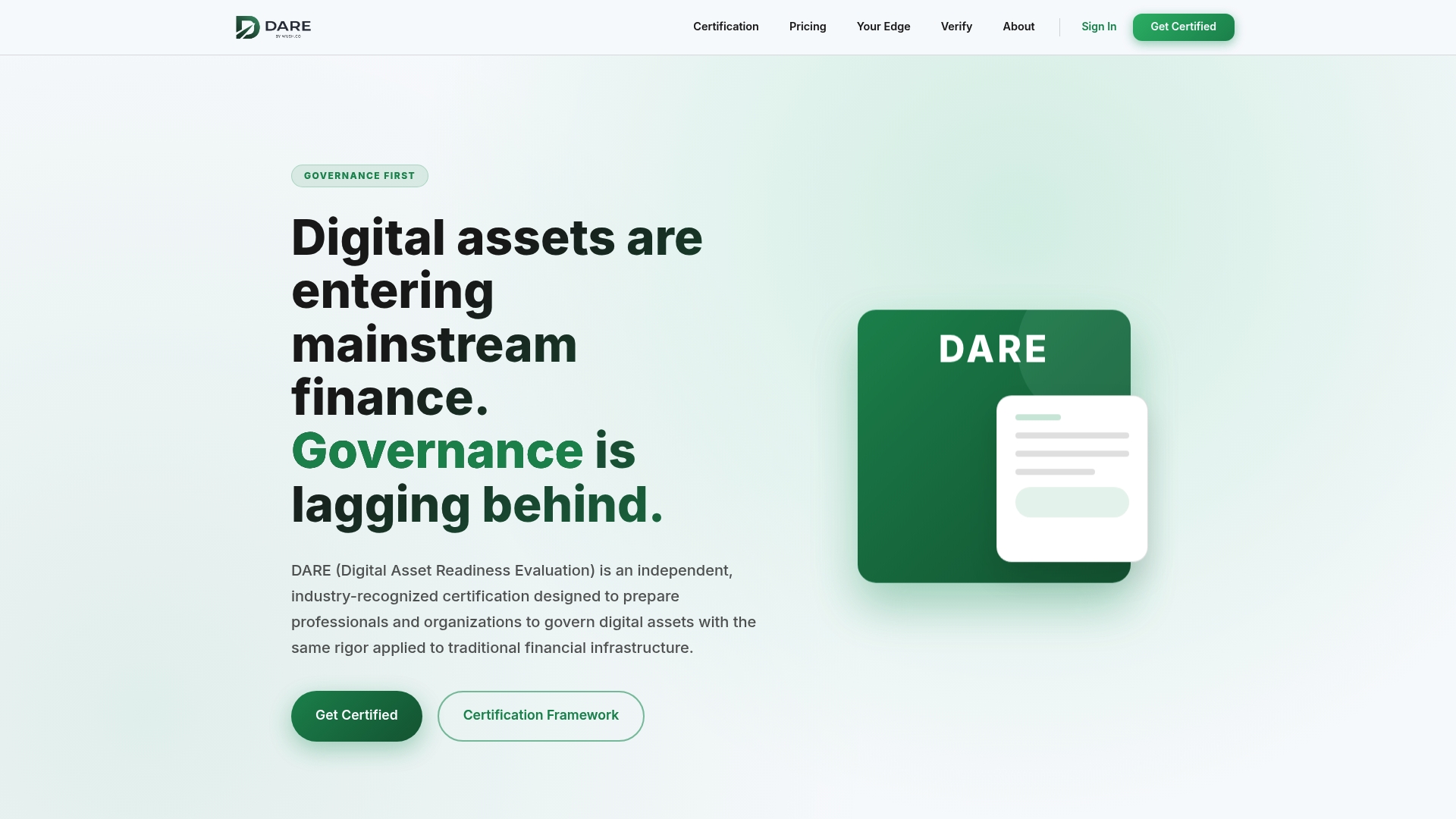
The DARE certification gives your team a structured, blockchain-backed credential covering the full range of enterprise digital asset obligations, from custody and AML to operational controls and legal risk. It is modular, so you can address the highest-priority gaps first, and the annual renewal process keeps your team’s knowledge current as regulations evolve. For executives who need to demonstrate readiness to a board, a regulator, or an institutional counterparty, DARE provides verifiable, credible evidence that your program meets professional governance standards.
Start your team’s readiness evaluation at dare.wush.co/certification or review how DARE credentials create a competitive compliance edge for your organization.
Key Takeaways
Effective crypto regulatory change management requires governance, auditability, and continuous monitoring as foundational elements, with technology serving those priorities rather than substituting for them.
| Point | Details |
|---|---|
| Auditability is the differentiator | Timestamped, reproducible records of every compliance decision determine whether a program survives examination. |
| Governance before technology | Map regulatory requirements and assign ownership before selecting any compliance tool or platform. |
| Treat changes as release events | Phase-gated implementation (gap analysis, policy refresh, infrastructure, supervisory readiness) reduces cost overruns and compliance gaps. |
| Continuous monitoring is mandatory | Authorization is a milestone; ongoing tracking of agency guidance, enforcement signals, and technical standards is the actual compliance job. |
| Wush DARE for structured readiness | DARE’s modular, blockchain-backed certification covers custody, AML, legal, and operational controls with annual renewal for ongoing compliance assurance. |