
Common Digital Asset Legal Liability Examples for Compliance Teams

The common legal liabilities tied to digital assets fall into multiple categories that U.S. legal and compliance teams should map before any incident occurs.
- Custody and key loss — irrevocable asset loss when cryptographic keys are compromised or inaccessible
- Fiduciary duty breaches — failure to act in clients’ or beneficiaries’ best interests when managing digital holdings
- Regulatory enforcement — SEC securities violations, FinCEN AML failures, IRS tax reporting gaps, and state money-transmitter license (MTL) deficiencies
- AML and money-transmission exposure — operating as an unlicensed money-transmitting business or failing to file Suspicious Activity Reports
- Tax reporting errors — mischaracterizing gains, failing to report staking income, or missing cost-basis documentation
- Contractual disputes with custodians and vendors — ambiguous SLAs, missing indemnity clauses, and undefined subcustodian liability chains
- Employee and insider theft — privileged-access misuse, private-key exfiltration, and unauthorized transfers
- IP and consumer-protection claims — misleading token disclosures, deceptive marketing, and unlicensed use of third-party IP
- Estate and succession risks — inaccessible assets at death, public exposure of keys in probate records, and undefined fiduciary authority
For a broader picture of how these risks connect to enterprise operations, the enterprise digital asset legal risks guide covers remediation roadmaps in detail.
Pro Tip: In the next 24–72 hours, run a custody-responsibility checklist: confirm who legally holds your keys, verify that reconciliation logs are current, and document which employees have privileged access to wallets or signing systems. That single exercise surfaces most latent liabilities before they become enforcement matters.

Table of Contents
- What are the main categories of digital asset legal liability under U.S. law?
- How do these liabilities actually materialize? Five incident scenarios
- What governance failures create the most legal exposure?
- How do you build a practical mitigation plan for digital asset liability?
- How does independent certification reduce your legal liability exposure?
- Which U.S. regulators should you consult first when assessing digital asset liability?
- Key Takeaways
- The governance gap no one talks about
- How DARE certification helps legal and compliance teams reduce exposure
- Further reading: primary sources and practical commentary
What are the main categories of digital asset legal liability under U.S. law?
Each liability category carries its own statutory hooks, regulators, and causes of action. Here is how they break down in practice.
Regulatory enforcement
The SEC treats many tokens as securities under the Howey test. Firms that issue, trade, or advise on unregistered securities face enforcement actions, disgorgement, and civil penalties. FinCEN requires money-services businesses to register and maintain AML programs under the Bank Secrecy Act. IRS Notice 2014-21 and subsequent guidance treat digital assets as property, meaning every disposition is a taxable event. State MTL regimes add another layer: operating a crypto exchange or payment service without a state license in New York (BitLicense), Texas, or California can trigger cease-and-desist orders and fines.
Fiduciary duty breach
Registered investment advisers, trustees, and plan fiduciaries who hold digital assets on behalf of clients carry the same duty of care and loyalty they owe for any other asset class. Causes of action include breach of fiduciary duty, negligence, and unjust enrichment. A common trigger: an adviser allocates client funds to a digital asset without adequate due diligence on custody arrangements, and the custodian subsequently fails.
“Effective safekeeping involves control over cryptographic keys, reconciliation, and clear customer agreements to define responsibilities.” — FDIC Interagency Statement on Crypto-Asset Safekeeping
The FDIC’s interagency guidance makes clear that key compromise creates custodian liability and ties safekeeping directly to BSA/AML and OFAC compliance. A custodian bank that loses a client’s assets through inadequate key controls faces both regulatory sanction and civil claims.
Custody and negligence
Custody liability is where digital asset law diverges most sharply from traditional finance. Losing a private key is not like losing a paper certificate — there is no transfer agent, no reissuance, and no SIPC backstop for crypto. PwC’s analysis of digital asset provider risks identifies custody and security as one of six key risk areas, recommending SOC 1 and SOC 2 reports to evaluate whether a provider’s controls cover the entire private-key lifecycle. A firm that outsources custody to a third party does not outsource its legal responsibility for reconciliation and compliance — that distinction trips up institutional clients repeatedly.
AML and money-transmission exposure
Any entity that accepts and transmits value denominated in digital assets may qualify as a money-services business under 31 U.S.C. § 5330. The Tornado Cash prosecution illustrates the outer boundary: the mixed verdict in that case confirmed that operating an unlicensed money-transmitting business and intentionally facilitating laundering can produce criminal exposure for developers and operators, not just exchanges. Firms must assess whether their product or service constitutes money transmission at the federal level and in every state where they operate.
Tax reporting and taxpayer liability
The IRS treats digital asset transactions as property dispositions. Staking rewards, hard-fork proceeds, and DeFi yield are all taxable income at receipt. Firms that fail to issue accurate 1099-DA forms (required for brokers under Treasury’s 2024 final rule) face penalties, and clients who rely on inaccurate reporting face their own underpayment exposure. Cost-basis tracking across wallets and chains is the operational gap most firms underestimate.
Contractual disputes with vendors and counterparties
Ambiguous custody agreements are the most common source of litigation in institutional digital asset operations. If a contract does not specify who bears the loss when a custodian is hacked, courts will look to general negligence and contract principles — and the outcome is unpredictable. Smart-contract disputes add a layer: when code executes differently than the parties intended, the question of whether the code is the contract or merely implements the contract is still being litigated.
Platform liability and IP/consumer-protection claims
Courts have begun drawing a clear line between platform operators and participants. In Risley v. Uniswap, the court held that creating a marketplace where fraud can occur is not the same as knowingly facilitating specific fraud. Plaintiffs must show actual knowledge and substantial assistance. That said, consumer-protection claims under FTC Act Section 5 and state UDAP statutes do not require the same scienter showing — misleading token disclosures or deceptive marketing can trigger liability even without intent.
Estate and succession risks
When a key holder dies without a documented succession plan, assets are effectively gone. Listing private keys in a will is a critical mistake: wills become public probate records, and exposure of keys guarantees loss. Best practice is to name fiduciary authority in the will and direct the fiduciary to a separate, secured key-escrow process.
How do these liabilities actually materialize? Five incident scenarios
Abstract categories become real problems in specific operational contexts. These five scenarios show how claims arise and what legal teams should do in the first hours.
Scenario 1: Custodian hack with customer losses
What happened: A qualified custodian holding institutional client assets suffers a hot-wallet breach. Private keys stored in an internet-connected signing system are exfiltrated. Client balances are unrecoverable.
Likely claims and regulators: Negligence, breach of fiduciary duty, breach of contract. The SEC may inquire if the custodian is a registered investment adviser or broker-dealer. State regulators may act under MTL or trust-company statutes. OFAC will scrutinize whether stolen assets moved through sanctioned addresses.
Immediate steps for legal/compliance teams:
- Preserve all access logs, signing records, and network traffic captures before any remediation activity touches those systems.
- Notify outside counsel immediately; assess whether the incident triggers mandatory regulator notification under state data-breach laws or SEC Rule 17a-11.
- Freeze any remaining wallet movements and document the chain of custody for all evidence.
Scenario 2: Token misclassification leading to SEC inquiry
What happened: A firm issues a governance token to raise capital, relying on a legal opinion that it is a utility token. The SEC opens an investigation, concluding the token meets the Howey test.
Likely claims and regulators: Unregistered securities offering under Securities Act Section 5. The SEC may seek disgorgement of proceeds, civil penalties, and injunctive relief. Secondary market platforms that listed the token face their own aiding-and-abetting exposure — though under the Risley standard, platforms that merely provided infrastructure without actual knowledge of the violation have a meaningful defense.
Immediate steps:
- Pull all marketing materials and offering documents; identify every representation made about the token’s expected returns or profit potential.
- Engage securities counsel to assess whether a voluntary disclosure or Wells submission is appropriate before the SEC issues a formal order.
- Document the legal opinion obtained at issuance and the facts presented to counsel.
Scenario 3: Employee exfiltrates private keys
What happened: A treasury operations employee with privileged access to a multi-signature wallet scheme copies signing keys to a personal device and transfers assets to an external address before resigning.
Likely claims and regulators: Criminal charges under 18 U.S.C. § 1030 (Computer Fraud and Abuse Act) and wire fraud statutes. Civil claims for conversion and breach of fiduciary duty. FinCEN may inquire if the transfer pattern resembles structuring.
Immediate steps:
- Revoke all access credentials immediately and rotate keys on any wallet the employee could have touched.
- Preserve device logs, email, and badge-access records; do not allow the employee to return equipment without forensic imaging.
- File a Suspicious Activity Report if the transfer amount and pattern meet BSA thresholds.
Scenario 4: AML/KYC failure triggering OFAC and FinCEN action
What happened: A crypto payment processor onboards customers without adequate KYC, and transaction monitoring fails to flag transfers to a sanctioned jurisdiction. OFAC identifies the exposure through blockchain analytics.
Likely claims and regulators: OFAC civil penalties (strict liability — no intent required). FinCEN enforcement for BSA violations. State MTL regulators may revoke licenses. The Tornado Cash verdict underscores that AML failures in crypto contexts carry criminal as well as civil exposure.
Immediate steps:
- Conduct an immediate lookback on all transactions involving the flagged addresses and calculate total exposure.
- Self-disclose to OFAC under the voluntary self-disclosure program, which can reduce penalties significantly.
- Engage a BSA/AML consultant to remediate the KYC program and document the remediation for regulators.
Scenario 5: Estate probate exposes private keys
What happened: A decedent’s attorney-drafted will includes the seed phrase for a hardware wallet holding significant digital assets. The will enters probate and becomes a public record. A third party copies the phrase and drains the wallet before the estate can act.
Likely claims and regulators: Malpractice claim against the drafting attorney. Potential negligence claim against the estate administrator. No regulator is likely to act, but the loss is permanent and uninsurable.
Immediate steps:
- Audit all estate documents immediately to identify any other exposed credentials.
- Engage a digital-asset estate specialist to implement secure key-escrow arrangements going forward.
- Document the loss for probate court and assess whether a malpractice claim against the drafting attorney is viable.
What governance failures create the most legal exposure?
Most digital asset liabilities do not appear suddenly. They accumulate through specific, auditable governance gaps that legal teams can identify before an incident occurs.
Unclear custody ownership is the single most common gap. Firms sign custody agreements without specifying who bears the loss in each failure scenario. When a custodian fails, both parties point to the other. The FDIC’s safekeeping guidance is explicit: customer agreements must define responsibilities clearly, or the custodian assumes them by default.
Weak vendor oversight compounds the problem. Outsourcing custody does not outsource legal responsibility. Firms that cannot produce a current SOC 2 report for their custodian, or that have never reviewed subcustodian arrangements, are carrying undisclosed risk. PwC recommends SOC 1 and SOC 2 reporting as a baseline for evaluating any digital asset provider.
Missing reconciliations produce inaccurate books that trigger fiduciary and negligence claims. If your custodian’s reported balances and your internal ledger diverge and you cannot explain the difference, you have a problem that a plaintiff’s attorney will find before you do. For a practical framework, the digital asset financial controls overview covers reconciliation procedures in detail.
Ambiguous contract terms on liability caps, indemnities, and SLAs leave firms without a remedy when something goes wrong. Courts interpret ambiguous indemnity clauses against the drafter — and in digital asset contracts, the drafter is usually the custodian.
No incident-response playbook means the first hours after a breach are spent deciding who to call rather than preserving evidence. That delay is often what converts a manageable incident into a regulatory enforcement matter.
Poor role separation and access controls are the direct enabler of insider theft. The Kroll operational risk framework extends beyond cyber controls to physical security: key-holding personnel should be treated as high-value custodians, with background checks, split custody, and physical security plans. Coercion-based theft targeting key holders is a documented real-world risk.
Deficient board-level oversight closes the loop. When boards cannot demonstrate that they reviewed digital asset risks, approved custody arrangements, and monitored compliance, they face personal liability exposure in addition to the firm’s. The board-level oversight checklist maps the governance questions boards should be able to answer.
Pro Tip: When reviewing a custodian contract, demand these four things in writing: (1) a liability cap that covers full asset value, not just fees paid; (2) an indemnity for subcustodian failures; (3) a reconciliation SLA with a defined cure period; and (4) annual audit rights with access to SOC reports. If a custodian refuses any of these, treat that refusal as a material risk signal.
How do you build a practical mitigation plan for digital asset liability?
Mitigation works best when it is organized by time horizon. Here is a prioritized implementation structure.
Quick wins (24–72 hours):
- Confirm who legally holds your private keys and document the custody model (self-custody, qualified custodian, or hybrid).
- Pull your current custodian agreement and flag any clause that is silent on loss allocation.
- Verify that reconciliation between your internal ledger and custodian-reported balances is current.
- Identify every employee with privileged access to wallets or signing systems and confirm that access is still appropriate.
- Check whether your AML/KYC program covers all digital asset product lines, including any new tokens or chains added in the past 12 months.
Near-term fixes (30–90 days):
- Negotiate or amend custodian contracts to include explicit liability caps, indemnities, subcustodian disclosure, and audit rights.
- Implement a formal vendor oversight program: request current SOC 2 reports from all digital asset service providers and schedule annual reviews.
- Establish a digital-asset-specific incident-response playbook covering evidence preservation, regulator notification triggers, and communication protocols.
- Engage a tax specialist to audit cost-basis tracking and 1099-DA reporting obligations.
- Review your entity structure with counsel to assess whether a subsidiary or special-purpose vehicle reduces parent-company exposure.
Medium-term projects (3–12 months):
- Implement multi-party computation or multi-signature custody to eliminate single points of key failure.
- Build a board reporting cadence that documents digital asset risk reviews and custody decisions.
- Evaluate insurance coverage gaps with a broker who specializes in digital assets. Marsh warns that custodial aggregation exposures may be uninsurable, making internal controls the primary defense. The digital asset insurance coverage guide details what to ask brokers and where policies typically fall short.
- Complete an independent governance certification to produce auditable evidence of controls for regulators and courts.
The table below maps each control to its owner and the evidentiary artifact it produces.
| Control | Responsible Owner | Evidentiary Artifact |
|---|---|---|
| Custody agreement review and amendment | General Counsel | Signed contract with liability cap and indemnity clauses |
| Reconciliation program | Head of Custody Operations / CFO | Monthly reconciliation reports with sign-off |
| AML/KYC program review | Chief Compliance Officer | Updated AML policy, training records, SAR log |
| Vendor SOC report collection | Chief Risk Officer | Annual SOC 2 reports from each custodian |
| Incident-response playbook | General Counsel + CISO | Documented playbook with tabletop exercise records |
| Board risk reporting | General Counsel / Board Secretary | Board minutes documenting digital asset risk reviews |
| Insurance coverage review | CFO + Risk Manager | Broker coverage analysis with gap memo |
For custody-specific contract language, the digital asset custody guide covers the clauses institutional investors should demand. For a broader look at regulated digital banking practices that inform custody standards, that resource provides useful context on how regulated entities approach safekeeping.
How does independent certification reduce your legal liability exposure?
Certification does not eliminate liability. What it does is produce documented, verifiable evidence that your organization identified the risks, implemented controls, and trained the people responsible for them. That evidence matters enormously when a regulator asks what you did before the incident, or when a plaintiff argues your governance was deficient.
The DARE certification from Wush is built specifically for this purpose. Its modular framework covers the liability categories that matter most in institutional settings:
- Custody governance — documents key management policies, reconciliation procedures, and custodian oversight, directly supporting a defense against negligence claims.
- Vendor oversight — produces attestation records showing due diligence on third-party providers, reducing exposure from subcustodian failures.
- AML controls — maps your program to FinCEN expectations and generates training completion records that demonstrate a culture of compliance.
- Reconciliation and accounting — creates an audit trail of balance verification, reducing fiduciary exposure from inaccurate books.
- Incident response — documents your playbook and tabletop exercise history, showing regulators that you had a plan before the breach.
- Board reporting — produces evidence that senior leadership reviewed and approved digital asset risk decisions, limiting personal liability for directors.
Each module generates an auditable assessment report and a verifiable credential backed by blockchain technology. When a regulator or opposing counsel asks for evidence of your governance program, you hand them a structured, timestamped record rather than a collection of internal memos. Annual renewal keeps that record current, which matters because regulators assess the state of controls at the time of the incident, not at the time of certification.
For legal teams specifically, the certification framework also functions as a discovery-readiness tool: the assessment outputs document what you knew, when you knew it, and what you did about it.
Which U.S. regulators should you consult first when assessing digital asset liability?
The table below identifies the primary U.S. regulators and the specific guidance documents legal teams should read first when assessing or defending a digital asset liability exposure.
| Regulator | Why It Matters | Primary Guidance to Read First |
|---|---|---|
| SEC | Securities enforcement, custody rules for RIAs and broker-dealers, token classification | SEC Staff Bulletin on Crypto Asset Custody; enforcement actions database |
| FinCEN | AML/BSA compliance, money-services business registration, SAR obligations | FinCEN Guidance FIN-2019-G001 (Application of FinCEN Regulations to Certain Business Models) |
| IRS | Tax reporting, cost-basis rules, 1099-DA broker obligations | IRS Notice 2014-21; Rev. Rul. 2023-14 (staking income); Treasury final broker reporting rule |
| FDIC | Custody standards for banking organizations, BSA/AML tie-ins for custodial banks | FDIC Interagency Statement on Crypto-Asset Safekeeping |
| State MTL regulators | Money-transmitter licensing, state-level AML requirements, consumer protection | CSBS Model Money Transmission Modernization Act; state-specific MTL pages (NY DFS, TX DOB, CA DFPI) |
| OFAC | Sanctions compliance, strict-liability penalties for transactions with sanctioned addresses | OFAC Virtual Currency Guidance |
Reading order for an active incident: Start with FinCEN’s AML guidance if the exposure involves suspected money transmission or sanctions. Move to the FDIC safekeeping statement if the issue is custody loss at a banking organization. Pull SEC enforcement resources if token classification or unregistered securities are in play. State MTL pages come last but should not be skipped — state penalties can exceed federal ones in some jurisdictions.
The GENIUS Act, signed into law in 2025, adds a federal stablecoin framework that compliance teams should now track alongside the existing SEC and FinCEN regimes. It does not displace state MTL requirements but creates a parallel federal pathway for payment stablecoin issuers.
Key Takeaways
Digital asset legal liability is concentrated in nine categories, and most incidents trace back to the same governance gaps: unclear custody ownership, missing reconciliations, and contracts that are silent on loss allocation.
| Point | Details |
|---|---|
| Custody clarity is the first priority | Confirm who legally holds your keys and what your contract says about loss allocation before any incident occurs. |
| Outsourcing custody does not outsource liability | Firms remain responsible for reconciliation and compliance even when a third party holds the assets. |
| AML and tax failures carry criminal exposure | FinCEN and IRS violations can produce criminal charges, not just civil penalties, as the Tornado Cash verdict confirmed. |
| Insurance gaps are real and often uninsurable | Custodial aggregation exposures may fall outside cyber and crime policies; internal controls are the primary defense. |
| Wush DARE certification produces auditable evidence | The DARE framework generates timestamped assessment reports and verifiable credentials that support regulatory inquiries and litigation defense. |
The governance gap no one talks about
The conversation in legal and compliance circles tends to focus on the headline risks: the SEC enforcement action, the exchange hack, the rogue employee. Those are real, but the liability that actually catches firms off guard is quieter. It is the custody agreement that was signed three years ago by someone who has since left, that nobody has reviewed since, and that is completely silent on what happens when the custodian’s subcustodian fails. It is the reconciliation that has been running a small unexplained variance for six months that nobody escalated because the dollar amount seemed immaterial.
What I see succeed in enterprise settings is not the firm with the most sophisticated legal team. It is the firm that has made governance a documented, repeatable process rather than a one-time legal review. The difference between a manageable incident and an enforcement matter is almost always whether you can show a regulator what you did before the problem arose. A custody policy that was reviewed last quarter, a reconciliation that was signed off last month, a board minute that shows directors asked the right questions last year — that paper trail is the actual defense.
The legal risk management guide covers the operational behaviors that translate into defensible governance records. The firms that build those habits before they need them are the ones that come out of incidents intact.
How DARE certification helps legal and compliance teams reduce exposure
Legal and compliance teams managing digital asset risk need more than a policy document. They need auditable evidence that governance controls were in place, tested, and current at the time of any incident or regulator inquiry.
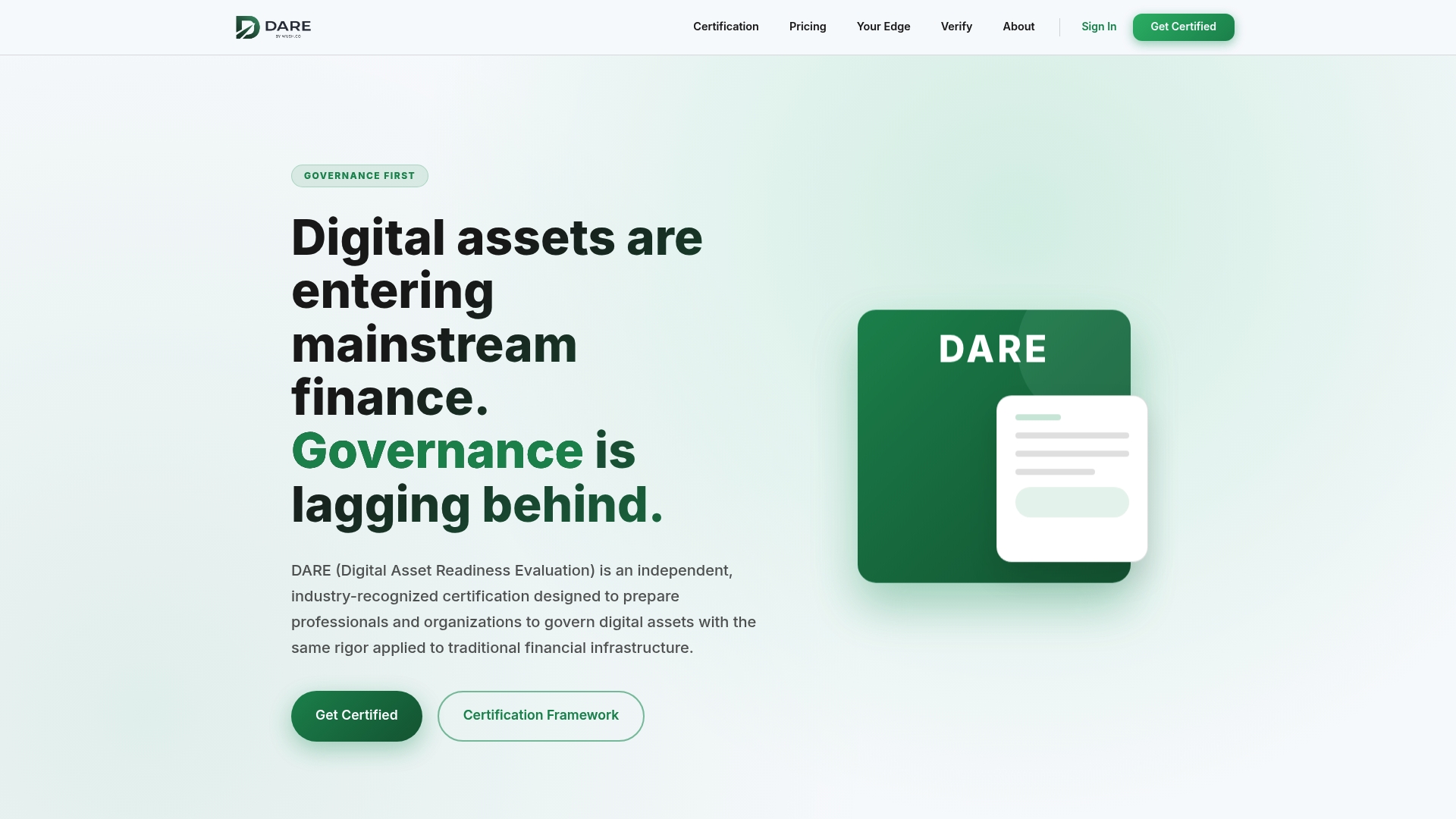
The Wush DARE certification provides exactly that: a structured assessment framework covering custody governance, AML controls, vendor oversight, incident response, and board reporting, with each module generating a verifiable, blockchain-backed credential and a timestamped assessment report. When a regulator asks what your organization did to manage digital asset risk, DARE gives you a structured, defensible answer rather than a collection of internal memos.
The path is straightforward: complete the DARE assessment to identify your current governance gaps, enroll in the relevant modules to remediate them, and receive an audit-ready report that documents your controls and training completion. Annual renewal keeps the record current as regulatory requirements evolve.
Start your DARE certification and build the governance record your legal team will need.
Further reading: primary sources and practical commentary
These are the sources worth bookmarking for a fast legal review, organized by the liability category they best illuminate.
-
FDIC Interagency Statement on Crypto-Asset Safekeeping — Start here for custody contract language. The guidance ties key control, reconciliation, and customer agreements directly to BSA/AML and OFAC obligations. Use it when drafting or reviewing custodian agreements.
-
FinCEN Guidance FIN-2019-G001 — The primary reference for AML and money-transmission exposure. Read this first when assessing whether a product or service triggers MSB registration requirements.
-
IRS Notice 2014-21 and Rev. Rul. 2023-14 — The foundational IRS guidance on digital asset taxation, including staking income. Use alongside the Treasury broker reporting final rule when auditing 1099-DA obligations.
-
SEC Enforcement Resources — The enforcement database is the fastest way to assess how the SEC has characterized a specific token type or business model. Use it when evaluating token classification risk.
-
Mayer Brown: Tornado Cash Mixed Verdict Analysis — The most current analysis of developer and operator liability for AML failures in crypto contexts. Use it when assessing exposure for protocol developers or privacy-tool operators.
-
Mondaq: Risley v. Uniswap — Token Fraud Decision — Sets the current standard for platform liability in token fraud cases. Use it when assessing whether a marketplace operator faces secondary liability for third-party fraud.
-
Croke Fairchild: Platform ≠ Participant — Useful companion to the Risley analysis; covers the aiding-and-abetting standard and the Taamneh line of cases. Read alongside Risley when building a platform liability defense.
-
Moye Law: Digital Asset Estate Planning — The clearest practical guidance on succession planning for digital assets. Use it when advising clients on fiduciary authority and key-escrow arrangements.
-
Kroll: Best Practices for Securing Crypto Assets — Covers the physical security layer that most governance frameworks miss. Use it when building an operational risk framework for key-holding personnel.
-
PwC: Six Risk Areas When Choosing a Digital Asset Provider — The best vendor due-diligence framework available publicly. Use it when evaluating custodians and requesting SOC reports.
-
Marsh: Risk Outlook for Digital Assets — Read this before any insurance coverage review. It identifies the specific gaps between traditional cyber/crime policies and digital asset exposures, including custodial aggregation risks that may be uninsurable.
This article provides general information for legal and compliance professionals and does not constitute legal, tax, or regulatory advice. Confirm current rules and requirements with qualified counsel and the relevant primary sources for your specific situation.