
Top 6 101blockchains.com Alternatives 2026

Finding a digital asset governance certification that offers recognized credentials without hidden fees or limited instructor credibility is difficult. Too many certification programs either restrict course content, hide pricing, or lack verifiable credentials and industry recognition. This comparison lists credential structure, pricing clarity, and verification methods across six alternatives so finance, legal, and compliance teams can match each to their needs.
Table of Contents
- DARE (Digital Asset Readiness Evaluation)
- Digital Assets Council of Financial Professionals (DACFP)
- MM Blockchain Academy (MMBA)
- Unoversity
- Blockdegree
- Blockchain Council
- Comparison of alternatives
DARE (Digital Asset Readiness Evaluation)
At a Glance
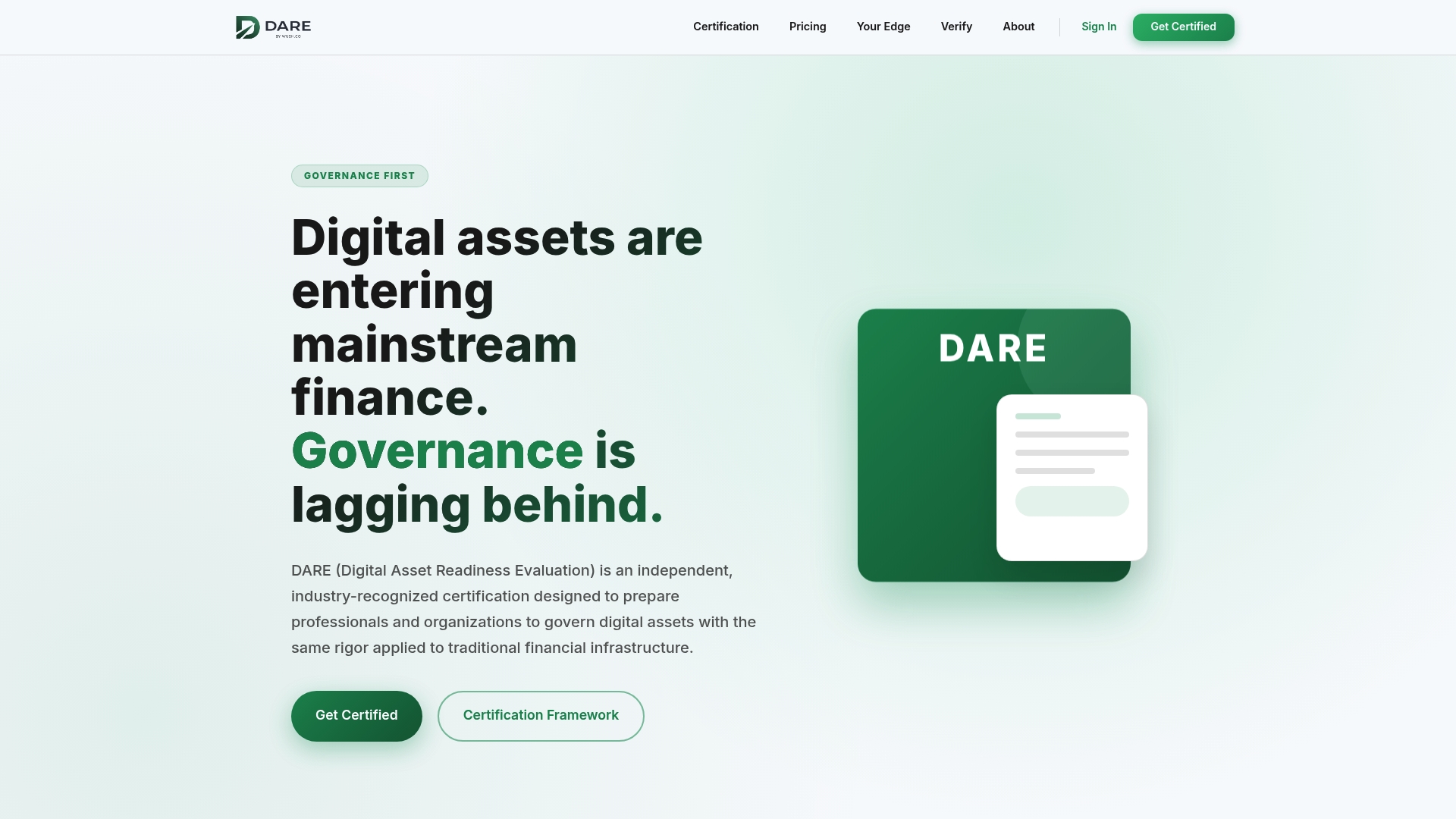
Co issued with the Asia Blockchain Association, DARE target enterprise governance and compliance for digital assets. The credential maps to governance pillars like Direction, Authority, Risk and Controls, and Execution. The program includes a renewal process to keep credentials current.
Core Features
The certification uses a structured assessment based on the DARE pillars and pairs self paced modular learning with quizzes and a final evaluation. The offering issues a verifiable digital credential that integrates with LinkedIn and professional profiles and a progress tracking dashboard monitors candidate completion. An annual renewal process maintains compliance relevance for certified members.
Key Differentiator
DARE provide a vendor neutral governance certification co issued with the Asia Blockchain Association. That partnership positions the credential for recognition across regulators and industry groups focused on governance and compliance.
Pros
The program is industry recognized and vendor neutral, which helps procurement and compliance teams compare credentials without vendor bias. Coverage spans governance, regulatory compliance, custody considerations, accounting, and strategy, so legal and finance stakeholders see relevant topics. Self paced modules fit busy professional schedules and the verifiable credential supports audit trails and public profiles.
Cons
- Limited details on specific course content or modules are available in public materials, which makes it harder for reviewers to map individual lessons to internal training plans.
Who It’s For
Finance, legal, compliance, technology professionals and executive leaders responsible for digital asset oversight will find this credential relevant. Treasury teams and risk managers building governance frameworks will use the assessment to benchmark controls. The certification also serves organizations that must demonstrate governance readiness to auditors or regulators.
Unique Value Proposition
Verifiable digital credential compatible with LinkedIn and professional profiles enables quick credential checks during hiring, vendor due diligence, or audits. Because the credential ties to a tracked progress dashboard and annual renewal, organizations can treat certification status as a living control instead of a one time paper exercise. That workflow reduces administrative friction when documenting governance competency.
Real World Use Case
A corporate legal team enrolls staff in the DARE program to align internal policies with common governance pillars and to produce auditable proof of competence for regulators. Team leads use the progress dashboard to track completion before scheduled audits. The verifiable credential then appears on professional profiles and in vendor assessment records.
Website: https://dare.wush.co
Digital Assets Council of Financial Professionals (DACFP)
At a Glance
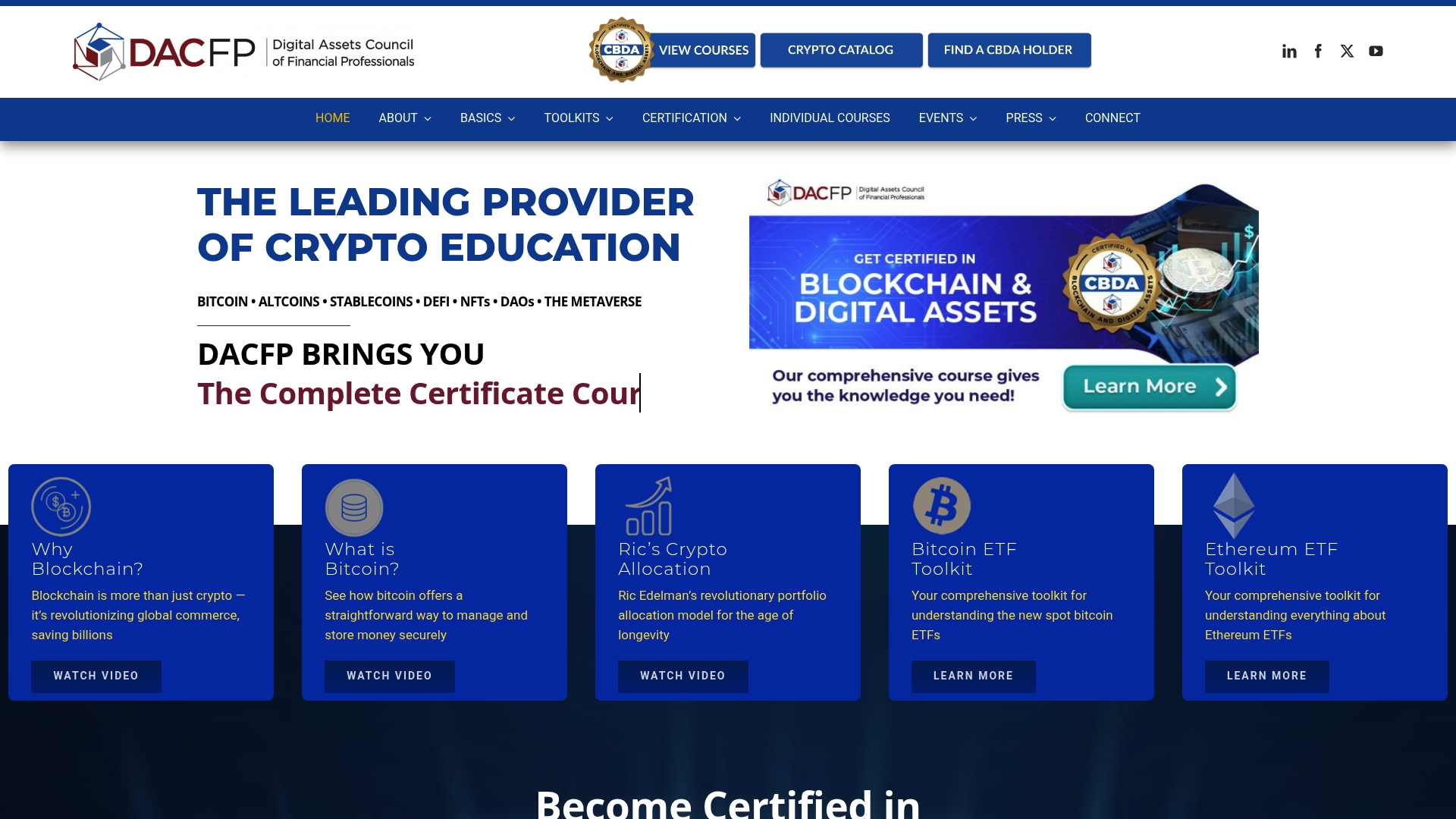
DACFP’s materials state its CBDA designation is listed by FINRA and its courses carry CE credits for CFP and CFA. That credential claim makes DACFP a credential-focused option for advisors who want formal recognition for crypto expertise. Offerings include self paced certification, white papers from Ric Edelman, ETF toolkits, webinars, and a white label program for firms.
Core Features
The curriculum centers on a self paced certification course in blockchain and digital assets that culminates in the CBDA credential. The resource library pairs white papers and articles with practical toolkits for Bitcoin and Ethereum ETFs and ETF-related briefs. DACFP also runs webinars, maintains industry updates, and offers a White Label Program to deliver firm specific training.
Key Differentiator
That FINRA-listed credential and the multi‑designation CE credit approvals mark DACFP as a certification provider aimed squarely at licensed financial advisors. The program emphasizes advisor-facing content and continuing education rather than consumer basics or developer training. Firms that want an advisor credential tied to established CE systems will find that focus immediately apparent.
Pros
The CBDA credential provides a recognizable designation for advisors seeking to add crypto expertise to their public profile; that listing supports credibility when speaking with compliance teams. The curriculum covers ETFs, custody basics, and market mechanics, and the resource library includes white papers authored by known industry figures. The White Label Program lets firms deploy consistent training across advisors and staff, which simplifies internal compliance and knowledge transfer.
Cons
-
Course fees are required and public pages do not list free or tiered pricing.
-
Independent third party user reviews are limited; most references are professional or industry oriented.
-
Some content carries licensing restrictions that limit use for AI model training or broader redistribution.
When It May Not Fit
If you need an advisory platform or portfolio management software, DACFP will not meet that requirement. The offering focuses on education and credentialing, not trade execution or custodial services. Organizations looking for free open resources or transparent public pricing may find the lack of published fees a mismatch.
Who It’s For
Financial professionals, licensed advisors, and wealth firms seeking a formal credential and CE credits in digital assets will get the most value from DACFP. Compliance teams that must document advisor education and firms rolling out standardized internal training also match the program profile.
Real World Use Case
A financial advisor completes the self paced CBDA course, cites the credential in client communications, and uses DACFP white papers to create a client briefing on spot bitcoin ETFs. The advisor reports the CE credits to their continuing education tracker and uses the White Label Program to align junior advisors on the same materials.
Pricing
Not applicable — informational only. Course participation is paid, and DACFP does not publish detailed tiered pricing on public pages. Firms interested in the White Label Program must contact DACFP for program fees and licensing terms.
Website: https://dacfp.com
MM Blockchain Academy (MMBA)

At a Glance
The vendor states its certifications are backed by organizations such as FTI and ABC. That claimed backing supports structured pathways and industry recognized credentials from entry level to advanced professional tracks. The offering targets accounting and finance professionals, university programs, and enterprise training teams.
Core Features
MMBA organizes self paced, online courses and certifications focused on blockchain accounting, finance, and digital assets. Coursework pairs video modules with Hands on labs, simulators, and blockchain explorers to provide practical experience. Progress assessments and digital badges verify completion and support credential checks in academic or corporate settings. Partnerships with CPA societies and corporations support academic integration and workforce training.
Key Differentiator
MMBA’s main distinction is aligning professional certification with higher education and corporate training pathways. That backing lets credentials map into university programs and employer upskilling plans. That orientation helps align credential outcomes with employer hiring and academic credit practices.
Pros
The academy emphasizes accredited credentials that the vendor says receive recognition from professional organizations. Its curriculum combines theory with practical lab work, which helps practitioners learn transaction reporting and accounting treatments. Flexible self paced courses and university partnerships make it feasible for firms to train teams without major scheduling disruptions. It explicitly supports both higher education and corporate training needs.
Cons
- No third party user reviews or independent evaluations are publicly available to confirm efficacy or user satisfaction.
- Course pricing and specific costs are not listed, so you likely need to contact MMBA for program fees.
- No explicit mention of language options beyond English limits accessibility for non English speaking learners.
When It May Not Fit
If you require transparent public reviews or independent course evaluations, MMBA may not meet that need. If clear pricing or free trial options drive vendor selection, you will likely need to request details directly. Organizations needing multilingual delivery should verify language support before committing to a program. Large enterprises that require customized LMS integrations may need richer platform features.
Who It’s For
Accounting and finance professionals seeking formal blockchain accounting credentials match MMBA’s focus. University departments can map courses into curricula and use digital badges for credit or continuing education. Corporate training teams that need self paced professional development will find the program structure familiar. Educators and curriculum planners can use partnership channels for credit alignment.
Real World Use Case
A CPA firm deploys MMBA modules to upskill auditors on digital asset transaction classification and reporting. Staff complete hands on labs and earn digital badges that the firm uses to market new advisory services. The vendor claims universities can accept these credentials for program credit, streamlining academic integration. Corporate compliance teams use the program to standardize internal accounting treatment for token transactions.
Website: https://mmba.io
Unoversity

At a Glance
Free courses with certificate options and a large multimedia learning library anchor Unoversity’s offering. The site combines blogs, podcasts, videos, and a knowledge base to cover beginner and intermediate topics. Institutions and teachers can register and contribute courses for classroom or public use.
Core Features
Unoversity hosts both free and paid courses that include certificate options and practical blockchain topics. The learning hub bundles written guides, a searchable knowledge base, podcasts, and videos to support different study styles. Registered teachers and institutions can publish courses and run institution specific tracks.
Key Differentiator
The clearest differentiator is the emphasis on no-cost entry through free courses together with formal certification pathways. That setup lowers the barrier for learners who want a credential without an upfront fee. Supplemental blogs and podcasts provide trend updates and concrete examples that help classroom adoption.
Pros
A large portion of the course material is available at no cost, which lowers the entry barrier for learners and institutions. Multimedia resources such as podcasts and videos complement written lessons and help learners who prefer audio or visual formats. Teacher and institution registration creates a practical route for educators to publish material and run tailored programs.
Cons
- User reviews are scarce and independent sources express skepticism about legitimacy and administrative disputes.
- Course syllabi and instructor credentials are not detailed, which makes it hard to assess depth or academic rigor.
- Beyond free access, the pricing model and paid course terms are not transparently communicated.
When It May Not Fit
Organizations that require external validation or audited learning outcomes should pause. Procurement and compliance teams may find the lack of instructor credentials and course detail problematic. Teams planning paid enterprise training will need clear pricing and service terms before adopting this site.
Who It’s For
Independent learners and crypto enthusiasts who want an entry point into blockchain will find value here. Educators and small institutions looking to publish introductory material can use the teacher registration and institutional options. Enterprise teams seeking accredited or auditable training should treat Unoversity as a pilot resource rather than a final solution.
Real World Use Case
A regional university can partner to add introductory blockchain modules to its electives, using Unoversity content to fill gaps. Faculty can register, adapt lessons, and issue certificates alongside campus credentials. An individual could complete free beginner tracks to prepare for a role that requires basic blockchain literacy.
Website: https://unoversity.com
Blockdegree

At a Glance
Certificates can be minted as NFTs on an integrated NFT marketplace, which Blockdegree lists as early alpha. According to the company, the platform partners with the United States Government and blockchain education initiatives. The site combines free courses, a funding mechanism for students, and XDC network credentialing into one offering.
Core Features
Blockdegree offers free online courses across blockchain fundamentals, advanced topics, cloud computing, and XDC network specifics. The platform issues certification after course completion and provides a funding platform for students and degree sponsorships. Community features include tutorials and a campus ambassador program that lets contributors publish learning material.
Key Differentiator
The platform ties issued credentials to the XinFin (XDC) Network and exposes certificates as NFTs on a marketplace while also hosting a funding workflow for learners. That combination of blockchain-backed credentials plus a marketplace and sponsorship options is the central distinction versus typical MOOC style offerings. This model targets credential provenance and alternative funding in one package.
Pros
Blockdegree gives learners a low barrier to start with free courses that cover both basic and network specific topics. Its certificate model links credentials to a public blockchain which helps traceability. The platform also adds a funding route for students and a community contribution path through tutorials and ambassadors that can increase content variety.
Cons
- Users report difficulty accessing paid courses and slow or inadequate support, which hurts learner experience.
- Some members express concern about the site trustworthiness and legitimacy of certain claims.
- Course quality verification and formal accreditation are not comprehensively documented.
When It May Not Fit
If your organization needs formally audited or widely recognized accreditation, Blockdegree may not meet that requirement. Teams that depend on rapid vendor support will find reported support shortfalls problematic. Enterprises seeking rigorous course quality assurance or clear third party accreditation should look elsewhere.
Notable Integrations
Blockdegree integrates with the XinFin (XDC) Network for credential issuance and NFT minting. That direct integration supports blockchain verification of certificates and the marketplace primitive. No other third party integrations are listed.
Who It’s For
Individual learners and early career professionals who want hands on blockchain credentials and a low cost entry path will find value here. Students who need sponsorship or alternative funding for certification can use the funding features. Community contributors and educators who want to publish tutorials or run campus ambassador programs will also fit the platform.
Real World Use Case
A software engineer completes the basic blockchain course, takes the exam, and receives an XDC backed certificate they can display or list on the NFT marketplace. A student discovers a degree sponsorship listing and secures funding to complete a certification path. Employers can accept the XDC backed certificate as a verifiable record when screening candidates.
Website: https://blockdegree.org
Blockchain Council

At a Glance
Blockchain Council reports 125,000 certified members across 145+ countries since 2016. The organization pairs industry training with a research library and community support. Lifetime access to coursework and both self paced and instructor led tracks helps working professionals balance study with full time roles.
Core Features
The site centers on research backed certification programs covering blockchain, AI, and Web3 topics. It offers both self paced and live training tracks and gives learners lifetime access to course materials and projects. The platform also highlights employer validation for credentials and a large alumni network that supports ongoing career connections.
Key Differentiator
Blockchain Council’s main distinction is a broad portfolio of programs tied to industry names and practical research articles. That mix aims to move learners from concept to applied projects while signaling credentials to recruiters and partners.
Pros
Course content receives consistent praise for clarity and direct practical relevance, which helps professionals apply concepts quickly. Flexible learning options let people study outside normal business hours and keep access long term. Partnerships and recognition from major organizations increase external credibility and make certifications easier to reference during hiring or procurement conversations.
Cons
-
Some learners report materials that feel dated or that lack deeper technical depth. This creates gaps for advanced practitioners who need up to date code examples.
-
Several users raise concerns about quiz sufficiency and the depth of practical assessments. That feedback suggests stronger hands on evaluations are needed.
-
A few reports mention technical content discrepancies between course text and sample code. Those issues can slow troubleshooting for learners following exercises.
When It May Not Fit
Organizations requiring university credit or academically accredited pathways will find this offering a weaker match. Teams that need intensive, instructor led lab time or enterprise grade sandbox environments may need a vendor that guarantees up to date code labs. Individuals seeking deeply technical, research level courses may prefer specialist academic programs.
Who It’s For
Professionals and organizations seeking industry recognized certification and practical knowledge in blockchain, AI, and Web3 will find this relevant. Hiring managers who want a credential they can check against employer expectations will also find value. Corporate training buyers that want scalable certification options may consider its enterprise consulting tracks.
Real World Use Case
A software engineer completes a Blockchain Council certification, builds a portfolio project from the course modules, and cites the credential during interviews. A procurement team engages the organization for consulting and uses the research articles to shape an internal pilot for a permissioned ledger.
Website: https://blockchain-council.org
Comparison of alternatives
DARE’s approach to maintaining credential relevance through renewals establishes its stand-out position among these solutions.
Credential specific features
DARE distinguishes itself with its renewable professional credentials that align with governance protocols. DACFP targets a specific audience—financial advisors—delivering FINRA-aligned CE accreditation towards licensure maintenance. MMBA focuses on academic alignment, making it beneficial for curriculum integration.
Accessibility and certification structure
Unoversity provides a free entry model allowing beginners to access foundational courses, while Blockdegree combines certification issuance with blockchain NFT integration for authenticity. Blockchain Council offers diverse certifications with lifetime access, accommodating long-term learning strategies.
Best fit
- Users prioritizing credentials with active compliance updates will appreciate DARE’s ongoing relevance through renewable certification.
- Financial advisors requiring FINRA-aligned CE accreditation to integrate cryptocurrency understanding into their licensure maintenance benefit from DACFP.
- Organizations seeking a free entry model with optional pay-as-you-go certifications can explore Unoversity’s offering.
- Academics needing to align credentials with higher education frameworks find MMBA’s programs instrumental.
- Individuals wanting publicly traceable certificates via NFTs will prefer Blockdegree.
Our pick
For professionals and organizations prioritizing ongoing compliance assurance, DARE emerges as an efficient and well-rounded choice in certification solutions unavailable elsewhere.
For selecting a digital asset governance certification that emphasizes verifiable credentials and professional recognition, the following comparison table offers comprehensive insights:
| Program | Key Differentiator | Best For | Pricing | Notable Limitation |
|---|---|---|---|---|
| DARE by Wush | Vendor-neutral governance credential | Finance, legal, and compliance professionals | Price not published | Limited details on specific course content |
| DACFP | CE credits and FINRA-listed CBDA | Licensed financial advisors | Price not published | No published free or tiered pricing |
| MM Blockchain Academy | Alignment with corporate training | Accounting and finance professionals | Price not published | No independent course evaluations available |
| Unoversity | Free courses with certification | Individual learners | Price not published | Limited instructor and syllabus transparency |
| Blockdegree | Blockchain-backed certificates | Students and early career professionals | Price not published | Concerns about site trustworthiness |
| Blockchain Council | Practical industry-aligned programs | Professionals seeking applied blockchain knowledge | Price not published | Some materials lack depth for advanced topics |
How to Address Governance Gaps with Reliable Digital Asset Certification
Many finance, legal, and compliance professionals find digital asset governance challenging due to unclear frameworks and evolving regulations. The article highlights the need for independent certification that verifies competency across custody, regulatory compliance, risk management, and operational controls. Without verifiable credentials, teams risk failing audits and falling short on governance standards.
Wush directly tackles these pain points through its Digital Asset Readiness Evaluation (DARE). This vendor-neutral certification equips treasury teams, risk managers, and executives with clear, modular learning and an annual renewal process to keep skills current. The blockchain-backed credential integrates with professional profiles, supporting easy verification in hiring or vendor assessments.
Experience Wush’s certification platform to close your digital asset governance gaps. Track team progress, demonstrate audit readiness, and secure your enterprise’s compliance with a recognized, independent credential.
FAQ
What makes Wush a suitable choice for digital asset governance certification?
Wush provides a structured assessment based on governance pillars, offering self-paced modular learning along with quizzes and a final evaluation. The certification framework is designed specifically for enterprise governance and compliance in digital assets, which is detailed in the article.
Wush’s focus on governance ensures that finance and compliance professionals gain relevant knowledge. Readers seeking effective solutions for digital asset oversight should consider engaging with this program.
How does DARE compare to DACFP in terms of certification details?
DACFP offers a FINRA-listed CBDA designation that includes CE credits for financial professionals, making it an attractive choice for advisors aiming for formal crypto expertise. In contrast, Wush focuses on governance and compliance for digital assets, emphasizing a structured program rather than just credentials.
Wush’s approach may be more beneficial for organizations looking to establish comprehensive governance frameworks in digital assets.
What is the main feature of Wush that supports ongoing compliance?
Wush includes an annual renewal process for its certifications, ensuring credentials remain current and relevant. This continuous compliance feature is essential for professionals who need to keep up with changing regulations in the digital asset landscape.
Readers should expect that Wush provides not just initial certification but also long-term support to maintain compliance status.
Who would benefit the most from the Wush certification?
Wush is specifically relevant for finance, legal, and compliance professionals responsible for digital asset oversight. It addresses the needs of treasury teams and risk managers aiming to benchmark and improve their governance frameworks.
Those in roles related to digital asset regulation should consider Wush a valuable resource for enhancing their expertise.
What type of credential does Wush issue, and how can it be utilized?
Wush issues a verifiable digital credential that integrates with LinkedIn and other professional profiles, allowing individuals to showcase their qualifications visibly. This feature supports audit trails and strengthens personal branding in the financial sector.
For professionals looking to leverage their certifications, Wush’s integration with digital platforms ensures easy sharing during job searches or compliance audits.